 Add to Chrome
 Add to Firefox
 Add to Edge
Controlling Embedding Spaces with Text-Conditioned Transformations
Jul 24, 2026
Multimodal embedding spaces in models like CLIP enable powerful capabilities such as semantic similarity retrieval and cross-modal zero-shot classification. These embeddings compress high-level semantics into a single vector, which comes at the cost of primarily expressing a dominant semantics like main object while suppressing other important attributes such as camera angle or color tone. We propose a text-conditioned transformation of visual embeddings that makes such attributes explicitly accessible. Given a natural language description of an attribute category (e.g., "color" or "art style"), a network generates an affine transformation that emphasizes the specified attribute. Conditioning on text enables it to learn many attributes simultaneously, accessing them at inference time through an intuitive interface. The network is trained to align transformed embeddings with the frozen latent space, enabling retrieval using existing large-scale embeddings without any re-encoding. When applied to a full set, the same mechanism transforms the latent space for attribute disentanglement tasks such as multi-clustering. By operating directly in latent space, our method provides a unified and efficient framework for controlling embedding spaces, demonstrating state-of-the-art performance across both attribute-based retrieval and multi-attribute organization tasks with near-zero inference cost. Project page: https://joefioresi718.github.io/ControlEmbed_webpage/

Learning to Share: Selective Memory for Efficient Parallel Agentic Systems
Feb 05, 2026Agentic systems solve complex tasks by coordinating multiple agents that iteratively reason, invoke tools, and exchange intermediate results. To improve robustness and solution quality, recent approaches deploy multiple agent teams running in parallel to explore diverse reasoning trajectories. However, parallel execution comes at a significant computational cost: when different teams independently reason about similar sub-problems or execute analogous steps, they repeatedly perform substantial overlapping computation. To address these limitations, in this paper, we propose Learning to Share (LTS), a learned shared-memory mechanism for parallel agentic frameworks that enables selective cross-team information reuse while controlling context growth. LTS introduces a global memory bank accessible to all teams and a lightweight controller that decides whether intermediate agent steps should be added to memory or not. The controller is trained using stepwise reinforcement learning with usage-aware credit assignment, allowing it to identify information that is globally useful across parallel executions. Experiments on the AssistantBench and GAIA benchmarks show that LTS significantly reduces overall runtime while matching or improving task performance compared to memory-free parallel baselines, demonstrating that learned memory admission is an effective strategy for improving the efficiency of parallel agentic systems. Project page: https://joefioresi718.github.io/LTS_webpage/
Privacy Beyond Pixels: Latent Anonymization for Privacy-Preserving Video Understanding
Nov 11, 2025We introduce a novel formulation of visual privacy preservation for video foundation models that operates entirely in the latent space. While spatio-temporal features learned by foundation models have deepened general understanding of video content, sharing or storing these extracted visual features for downstream tasks inadvertently reveals sensitive personal information like skin color, gender, or clothing. Current privacy preservation methods focus on input-pixel-level anonymization, which requires retraining the entire utility video model and results in task-specific anonymization, making them unsuitable for recent video foundational models. To address these challenges, we introduce a lightweight Anonymizing Adapter Module (AAM) that removes private information from video features while retaining general task utility. AAM can be applied in a plug-and-play fashion to frozen video encoders, minimizing the computational burden of finetuning and re-extracting features. Our framework employs three newly designed training objectives: (1) a clip-level self-supervised privacy objective to reduce mutual information between static clips, (2) a co-training objective to retain utility across seen tasks, and (3) a latent consistency loss for generalization on unseen tasks. Our extensive evaluations demonstrate a significant 35% reduction in privacy leakage while maintaining near-baseline utility performance across various downstream tasks: Action Recognition (Kinetics400, UCF101, HMDB51), Temporal Action Detection (THUMOS14), and Anomaly Detection (UCF-Crime). We also provide an analysis on anonymization for sensitive temporal attribute recognition. Additionally, we propose new protocols for assessing gender bias in action recognition models, showing that our method effectively mitigates such biases and promotes more equitable video understanding.
TeD-SPAD: Temporal Distinctiveness for Self-supervised Privacy-preservation for video Anomaly Detection
Aug 21, 2023

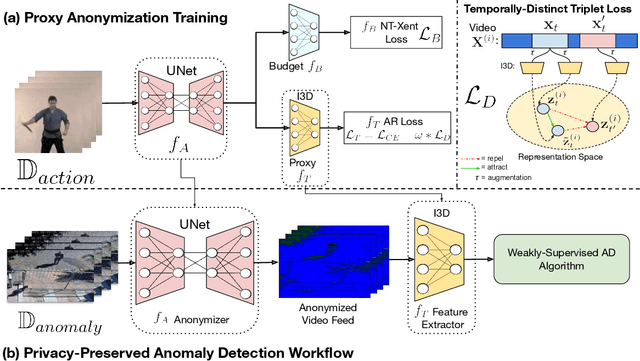

Video anomaly detection (VAD) without human monitoring is a complex computer vision task that can have a positive impact on society if implemented successfully. While recent advances have made significant progress in solving this task, most existing approaches overlook a critical real-world concern: privacy. With the increasing popularity of artificial intelligence technologies, it becomes crucial to implement proper AI ethics into their development. Privacy leakage in VAD allows models to pick up and amplify unnecessary biases related to people's personal information, which may lead to undesirable decision making. In this paper, we propose TeD-SPAD, a privacy-aware video anomaly detection framework that destroys visual private information in a self-supervised manner. In particular, we propose the use of a temporally-distinct triplet loss to promote temporally discriminative features, which complements current weakly-supervised VAD methods. Using TeD-SPAD, we achieve a positive trade-off between privacy protection and utility anomaly detection performance on three popular weakly supervised VAD datasets: UCF-Crime, XD-Violence, and ShanghaiTech. Our proposed anonymization model reduces private attribute prediction by 32.25% while only reducing frame-level ROC AUC on the UCF-Crime anomaly detection dataset by 3.69%. Project Page: https://joefioresi718.github.io/TeD-SPAD_webpage/