 Add to Chrome
 Add to Firefox
 Add to Edge
Behavioral Engagement in VR-Based Sign Language Learning: Visual Attention as a Predictor of Performance and Temporal Dynamics
Mar 20, 2026
This study analyzes behavioral engagement in SONAR, a virtual reality application designed for sign language training and validation. We focus on three automatically derived engagement indicators (Visual Attention (VA), Video Replay Frequency (VRF), and Post-Playback Viewing Time (PPVT)) and examine their relationship with learning performance. Participants completed a self-paced Training phase, followed by a Validation quiz assessing retention. We employed Pearson correlation analysis to examine the relationships between engagement indicators and quiz performance, followed by binomial Generalized Linear Model (GLM) regression to assess their joint predictive contributions. Additionally, we conducted temporal analysis by aggregating moment-to-moment VA traces across all learners to characterize engagement dynamics during the learning session. Results show that VA exhibits a strong positive correlation with quiz performance,followed by PPVT, whereas VRF shows no meaningful association. A binomial GLM confirms that VA and PPVT are significant predictors of learning success, jointly explaining a substantial proportion of performance variance. Going beyond outcome-oriented analysis, we characterize temporal engagement patterns by aggregating moment-to-moment VA traces across all learners. The temporal profile reveals distinct attention peaks aligned with informationally dense segments of both training and validation videos, as well as phase-specific engagement dynamics, including initial acclimatization, oscillatory attention cycles during learning, and pronounced attentional peaks during assessment. Together, these findings highlight the central role of sustained and strategically allocated visual attention in VR-based sign language learning and demonstrate the value of behavioral trace data for understanding and predicting learner engagement in immersive environments.
* 22 pages. 5 figures. 2 tables

Fostering Inclusion: A Virtual Reality Experience to Raise Awareness of Dyslexia-Related Barriers in University Settings
Feb 20, 2025This work introduces the design, implementation, and validation of a virtual reality (VR) experience aimed at promoting the inclusion of individuals with dyslexia in university settings. Unlike traditional awareness methods, this immersive approach offers a novel way to foster empathy by allowing participants to experience firsthand the challenges faced by students with dyslexia. Specifically, the experience raises awareness by exposing non-dyslexic individuals to the difficulties commonly encountered by dyslexic students. In the virtual environment, participants explore a virtual campus with multiple buildings, navigating between them while completing tasks and simultaneously encountering barriers that simulate some of the challenges faced by individuals with dyslexia. These barriers include reading signs with shifting letters, following directional arrows that may point incorrectly, and dealing with a lack of assistance. The campus is a comprehensive model featuring both indoor and outdoor spaces and supporting various modes of locomotion. To validate the experience, more than 30 non-dyslexic participants from the university environment, mainly professors and students, evaluated it through ad hoc satisfaction surveys. The results indicated heightened awareness of the barriers encountered by students with dyslexia, with participants deeming the experience a valuable tool for increasing visibility and fostering understanding of dyslexic students.
* 20 pages, 9 figures
Use of recommendation models to provide support to dyslexic students
Mar 18, 2024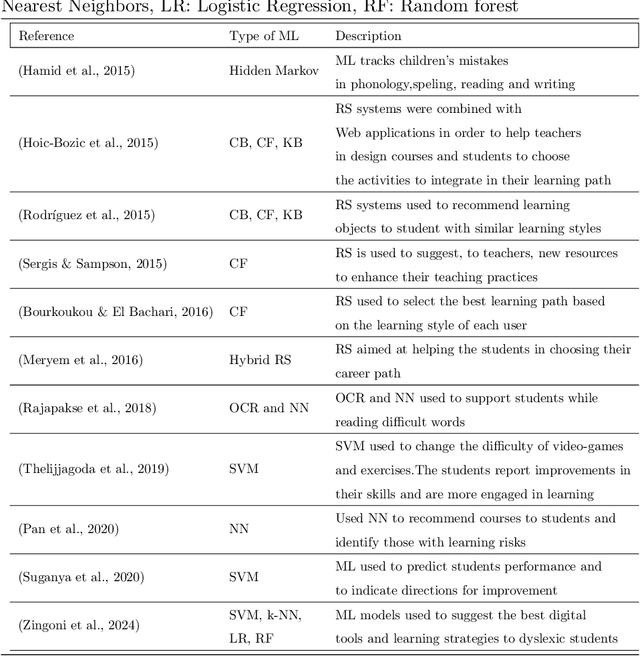

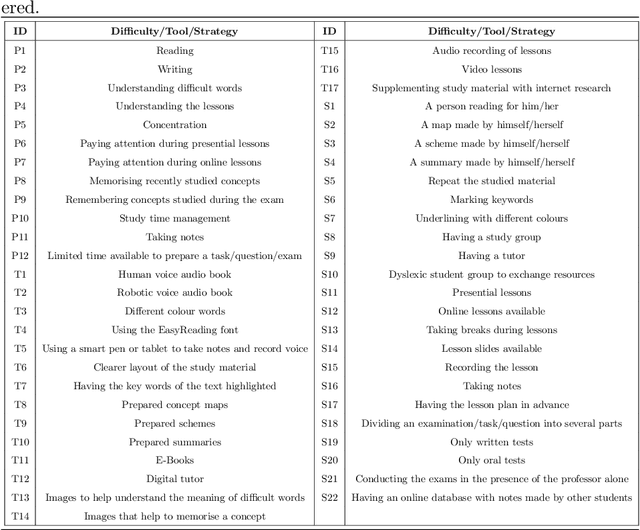
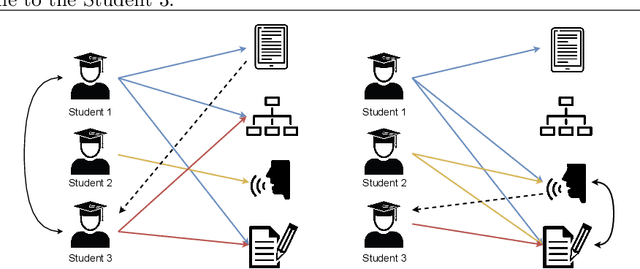
Dyslexia is the most widespread specific learning disorder and significantly impair different cognitive domains. This, in turn, negatively affects dyslexic students during their learning path. Therefore, specific support must be given to these students. In addition, such a support must be highly personalized, since the problems generated by the disorder can be very different from one to another. In this work, we explored the possibility of using AI to suggest the most suitable supporting tools for dyslexic students, so as to provide a targeted help that can be of real utility. To do this, we relied on recommendation algorithms, which are a branch of machine learning, that aim to detect personal preferences and provide the most suitable suggestions. We hence implemented and trained three collaborative-filtering recommendation models, namely an item-based, a user-based and a weighted-hybrid model, and studied their performance on a large database of 1237 students' information, collected with a self-evaluating questionnaire regarding all the most used supporting strategies and digital tools. Each recommendation model was tested with three different similarity metrics, namely Pearson correlation, Euclidean distance and Cosine similarity. The obtained results showed that a recommendation system is highly effective in suggesting the optimal help tools/strategies for everyone. This demonstrates that the proposed approach is successful and can be used as a new and effective methodology to support students with dyslexia.