 Add to Chrome
 Add to Firefox
 Add to Edge
PlanRL: A Trajectory Planning Architecture for Reinforcement Learning-based Driving Experts
Jun 25, 2026
Reinforcement learning (RL) has become a prominent framework for developing driving experts in autonomous vehicles. However, most existing RL-based experts are designed to output direct control commands (e.g., throttle, steering), which suffer from a lack of interpretability, high spatial complexity in learning road geometries, and poor compatibility with modern end-to-end planning architectures. To address these limitations, we propose a novel trajectory planning architecture for RL driving experts that integrates an RL policy with a polynomial-based trajectory planner. By employing a Frenet-frame coordinate system, our method simplifies complex road geometries into a curvilinear framework, offering a structured coordinate prior that facilitates policy learning. Furthermore, we incorporate a kinematic feasibility check into the planning stage to ensure that generated trajectories remain within the vehicle's physical limits, effectively mitigating cumulative tracking errors typically found in planning-based systems. We evaluate our approach on key CARLA benchmarks, where it significantly outperforms existing state-of-the-art control-based RL experts. On the CARLA Offline Leaderboard v1 and NoCrash benchmarks, our method improves the driving score by 5% and 11%, respectively, and increases the success rate by 8% and 19%.

REOcc: Camera-Radar Fusion with Radar Feature Enrichment for 3D Occupancy Prediction
Nov 10, 2025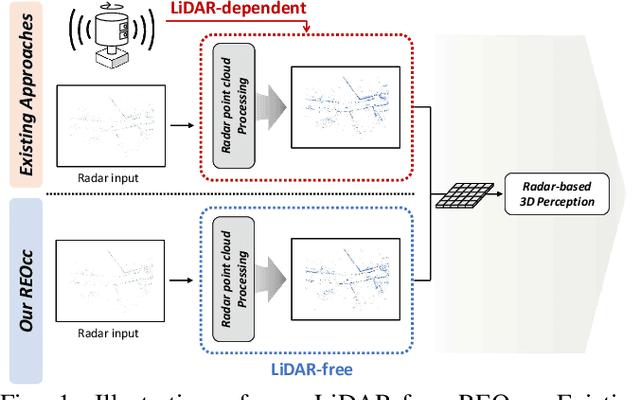
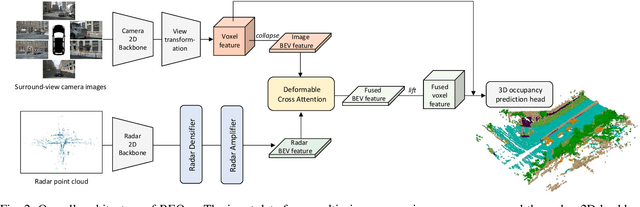
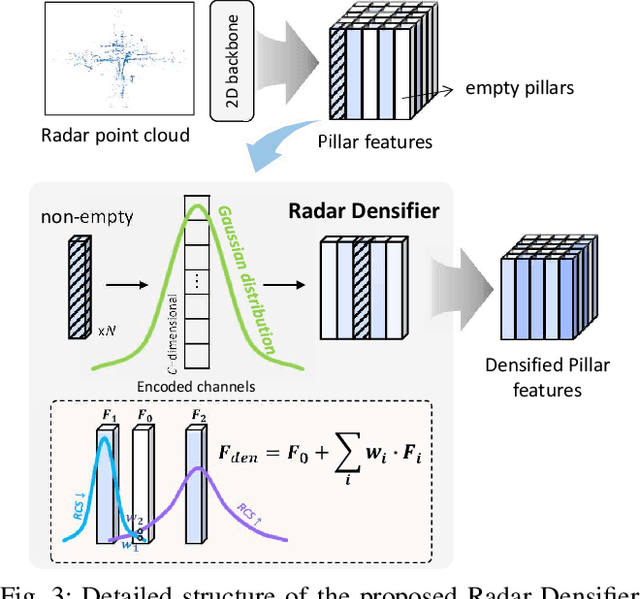
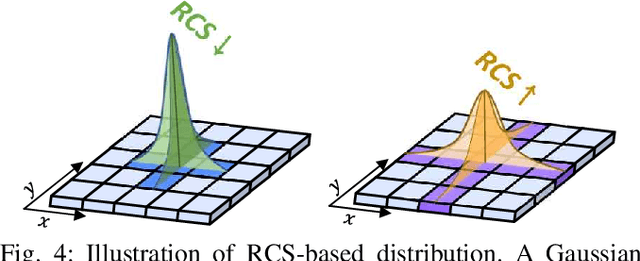
Vision-based 3D occupancy prediction has made significant advancements, but its reliance on cameras alone struggles in challenging environments. This limitation has driven the adoption of sensor fusion, among which camera-radar fusion stands out as a promising solution due to their complementary strengths. However, the sparsity and noise of the radar data limits its effectiveness, leading to suboptimal fusion performance. In this paper, we propose REOcc, a novel camera-radar fusion network designed to enrich radar feature representations for 3D occupancy prediction. Our approach introduces two main components, a Radar Densifier and a Radar Amplifier, which refine radar features by integrating spatial and contextual information, effectively enhancing spatial density and quality. Extensive experiments on the Occ3D-nuScenes benchmark demonstrate that REOcc achieves significant performance gains over the camera-only baseline model, particularly in dynamic object classes. These results underscore REOcc's capability to mitigate the sparsity and noise of the radar data. Consequently, radar complements camera data more effectively, unlocking the full potential of camera-radar fusion for robust and reliable 3D occupancy prediction.