 Add to Chrome
 Add to Firefox
 Add to Edge
Physics-Embedded Neural ODEs for Learning Antagonistic Pneumatic Artificial Muscle Dynamics
Feb 27, 2026
Pneumatic artificial muscles (PAMs) enable compliant actuation for soft wearable, assistive, and interactive robots. When arranged antagonistically, PAMs can provide variable impedance through co-contraction but exhibit coupled, nonlinear, and hysteretic dynamics that challenge modeling and control. This paper presents a hybrid neural ordinary differential equation (Neural ODE) framework that embeds physical structure into a learned model of antagonistic PAM dynamics. The formulation combines parametric joint mechanics and pneumatic state dynamics with a neural network force component that captures antagonistic coupling and rate-dependent hysteresis. The forward model predicts joint motion and chamber pressures with a mean R$^2$ of 0.88 across 225 co-contraction conditions. An inverse formulation, derived from the learned dynamics, computes pressure commands offline for desired motion and stiffness profiles, tracked in closed loop during execution. Experimental validation demonstrates reliable stiffness control across 126-176 N/mm and consistent impedance behavior across operating velocities, in contrast to a static model, which shows degraded stiffness consistency at higher velocities.

Personalizing User Engagement Dynamics in a Non-Verbal Communication Game for Cerebral Palsy
Jul 15, 2021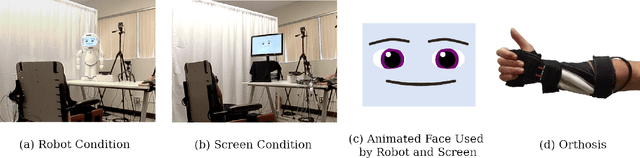
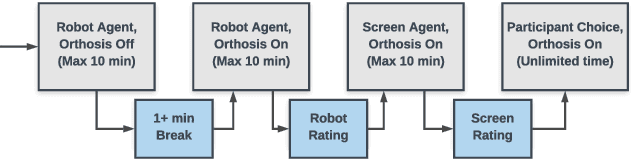

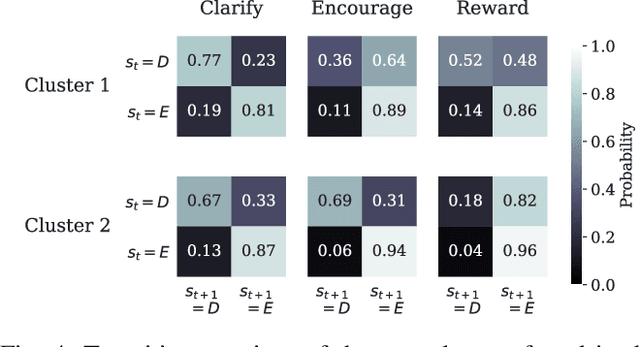
Children and adults with cerebral palsy (CP) can have involuntary upper limb movements as a consequence of the symptoms that characterize their motor disability, leading to difficulties in communicating with caretakers and peers. We describe how a socially assistive robot may help individuals with CP to practice non-verbal communicative gestures using an active orthosis in a one-on-one number-guessing game. We performed a user study and data collection with participants with CP; we found that participants preferred an embodied robot over a screen-based agent, and we used the participant data to train personalized models of participant engagement dynamics that can be used to select personalized robot actions. Our work highlights the benefit of personalized models in the engagement of users with CP with a socially assistive robot and offers design insights for future work in this area.