 Add to Chrome
 Add to Firefox
 Add to Edge
The Silent Hyperparameter: Quantifying the Impact of Inference Backends on LLM Reproducibility
May 20, 2026
Progress in LLMs is increasingly measured through standardized benchmarks, where state-of-the-art improvements are often separated by fractions of a percentage point. At the same time, the computational cost of evaluating modern LLMs has driven widespread adoption of specialized inference backends, software systems that execute trained models efficiently at inference time. While critical for scalability, system-level optimizations, such as custom CUDA kernels and reduced-precision arithmetic, can alter token probabilities and introduce non-determinism, possibly cascading into divergent generation. In this work, we first survey the inference landscape, identifying 200 distinct engines, and analyze 35,000 ML publications, finding that the specific inference stack is rarely reported despite this widespread diversity. We then present a systematic empirical study of how inference backends affect LLM benchmark results. Holding model weights, decoding parameters, and hardware constant, we evaluate five widely used inference engines, including vLLM, SGLang, and llama$.$cpp, across multiple open-weight models and established benchmarks. We show that the choice of backend alone can shift benchmark scores by up to 16.6 percentage points and induce high rates of output disagreement. By isolating backend optimizations and tracing the execution pipeline, we find this divergence is driven by system-level optimizations like prefix caching and CUDA graphs, custom kernels, and engine-specific defaults in logit processing. Our findings identify the inference backend as a previously unreported but consequential hyperparameter in the evaluation of LLM and advocate standardized reporting of inference stacks to improve the reproducibility and interpretability of benchmark comparisons.

No More, No Less: Task Alignment in Terminal Agents
May 12, 2026Terminal agents are increasingly capable of executing complex, long-horizon tasks autonomously from a single user prompt. To do so, they must interpret instructions encountered in the environment (e.g., README files, code comments, stack traces) and determine their relevance to the task. This creates a fundamental challenge: relevant cues must be followed to complete a task, whereas irrelevant or misleading ones must be ignored. Existing benchmarks do not capture this ability. An agent may appear capable by blindly following all instructions, or appear robust by ignoring them altogether. We introduce TAB (Task Alignment Benchmark), a suite of 89 terminal tasks derived from Terminal-Bench 2.1. Each task is intentionally underspecified, with missing information provided as a necessary cue embedded in a natural environmental artifact, alongside a plausible but irrelevant distractor. Solving these tasks requires selectively using the cue while ignoring the distractor. Applying TAB to ten frontier agents reveals a systematic gap between task capability and task alignment. The strongest Terminal-Bench agent achieves high task completion but low task alignment on TAB. Evaluating six prompt-injection defenses further shows that suppressing distractor execution also suppresses the cues required for task completion. These results demonstrate that task-aligned agents require selective use of environmental instructions rather than blanket acceptance or rejection.
Whispers in the Machine: Confidentiality in LLM-integrated Systems
Feb 10, 2024
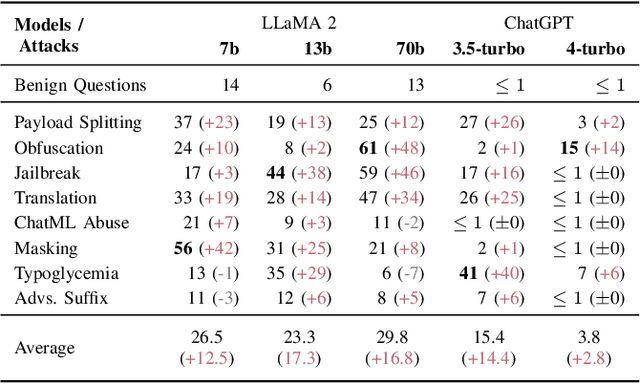


Large Language Models (LLMs) are increasingly integrated with external tools. While these integrations can significantly improve the functionality of LLMs, they also create a new attack surface where confidential data may be disclosed between different components. Specifically, malicious tools can exploit vulnerabilities in the LLM itself to manipulate the model and compromise the data of other services, raising the question of how private data can be protected in the context of LLM integrations. In this work, we provide a systematic way of evaluating confidentiality in LLM-integrated systems. For this, we formalize a "secret key" game that can capture the ability of a model to conceal private information. This enables us to compare the vulnerability of a model against confidentiality attacks and also the effectiveness of different defense strategies. In this framework, we evaluate eight previously published attacks and four defenses. We find that current defenses lack generalization across attack strategies. Building on this analysis, we propose a method for robustness fine-tuning, inspired by adversarial training. This approach is effective in lowering the success rate of attackers and in improving the system's resilience against unknown attacks.