 Add to Chrome
 Add to Firefox
 Add to Edge
EmbedTalk: Triplane-Free Talking Head Synthesis using Embedding-Driven Gaussian Deformation
Mar 08, 2026
Real-time talking head synthesis increasingly relies on deformable 3D Gaussian Splatting (3DGS) due to its low latency. Tri-planes are the standard choice for encoding Gaussians prior to deformation, since they provide a continuous domain with explicit spatial relationships. However, tri-plane representations are limited by grid resolution and approximation errors introduced by projecting 3D volumetric fields onto 2D subspaces. Recent work has shown the superiority of learnt embeddings for driving temporal deformations in 4D scene reconstruction. We introduce $\textbf{EmbedTalk}$, which shows how such embeddings can be leveraged for modelling speech deformations in talking head synthesis. Through comprehensive experiments, we show that EmbedTalk outperforms existing 3DGS-based methods in rendering quality, lip synchronisation, and motion consistency, while remaining competitive with state-of-the-art generative models. Moreover, replacing the tri-plane encoding with learnt embeddings enables significantly more compact models that achieve over 60 FPS on a mobile GPU (RTX 2060 6 GB). Our code will be placed in the public domain on acceptance.

Score Before You Speak: Improving Persona Consistency in Dialogue Generation using Response Quality Scores
Aug 09, 2025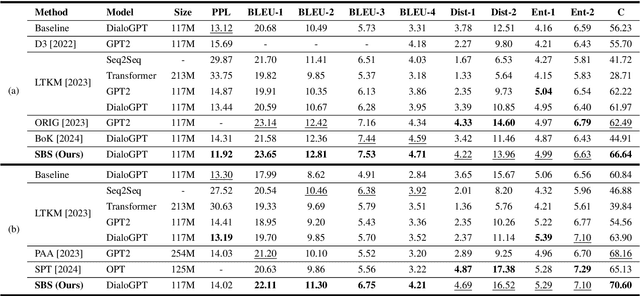
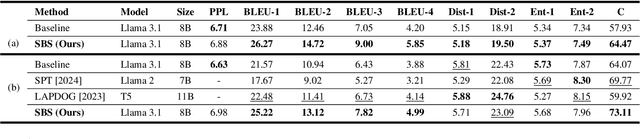
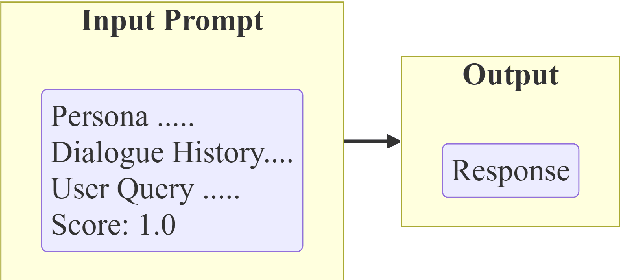
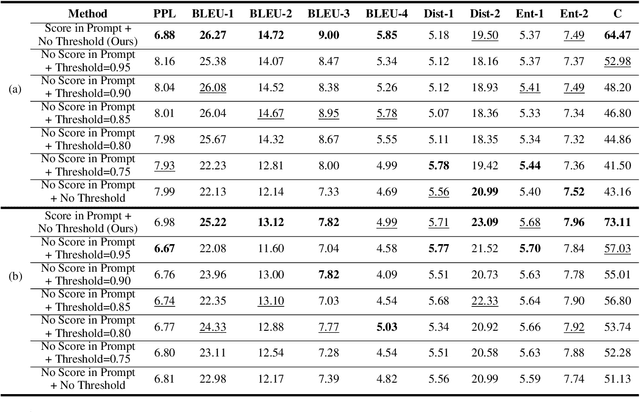
Persona-based dialogue generation is an important milestone towards building conversational artificial intelligence. Despite the ever-improving capabilities of large language models (LLMs), effectively integrating persona fidelity in conversations remains challenging due to the limited diversity in existing dialogue data. We propose a novel framework SBS (Score-Before-Speaking), which outperforms previous methods and yields improvements for both million and billion-parameter models. Unlike previous methods, SBS unifies the learning of responses and their relative quality into a single step. The key innovation is to train a dialogue model to correlate augmented responses with a quality score during training and then leverage this knowledge at inference. We use noun-based substitution for augmentation and semantic similarity-based scores as a proxy for response quality. Through extensive experiments with benchmark datasets (PERSONA-CHAT and ConvAI2), we show that score-conditioned training allows existing models to better capture a spectrum of persona-consistent dialogues. Our ablation studies also demonstrate that including scores in the input prompt during training is superior to conventional training setups. Code and further details are available at https://arpita2512.github.io/score_before_you_speak