 Add to Chrome
 Add to Firefox
 Add to Edge
Persona Vectors in Games: Measuring and Steering Strategies via Activation Vectors
Mar 22, 2026
Large language models (LLMs) are increasingly deployed as autonomous decision-makers in strategic settings, yet we have limited tools for understanding their high-level behavioral traits. We use activation steering methods in game-theoretic settings, constructing persona vectors for altruism, forgiveness, and expectations of others by contrastive activation addition. Evaluating on canonical games, we find that activation steering systematically shifts both quantitative strategic choices and natural-language justifications. However, we also observe that rhetoric and strategy can diverge under steering. In addition, vectors for self-behavior and expectations of others are partially distinct. Our results suggest that persona vectors offer a promising mechanistic handle on high-level traits in strategic environments.

Does visualization help AI understand data?
Jul 24, 2025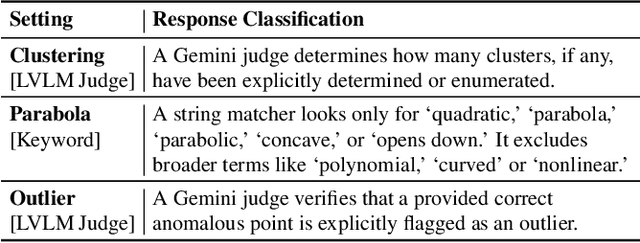
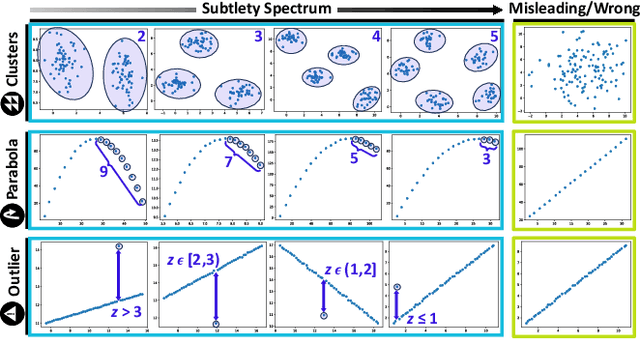


Charts and graphs help people analyze data, but can they also be useful to AI systems? To investigate this question, we perform a series of experiments with two commercial vision-language models: GPT 4.1 and Claude 3.5. Across three representative analysis tasks, the two systems describe synthetic datasets more precisely and accurately when raw data is accompanied by a scatterplot, especially as datasets grow in complexity. Comparison with two baselines -- providing a blank chart and a chart with mismatched data -- shows that the improved performance is due to the content of the charts. Our results are initial evidence that AI systems, like humans, can benefit from visualization.