 Add to Chrome
 Add to Firefox
 Add to Edge
AcroRL: Learning Aggressive Quadrotor Inversion using Bidirectional Thrust
May 23, 2026
Bidirectional thrust grants quadrotors a second equilibrium condition and increased control authority, expanding the envelope of possible aggressive maneuvers and enabling inverted flight, perching, and sensing. Prior geometric control approaches extend differential flatness through Hopf fibration-based attitude representations to support bidirectional thrust, but struggle with actuator saturation and motor reversal delay during inversions, requiring heuristic thrust posture scheduling and waypoint tuning. We propose a learning-based framework that modulates a constant reference trajectory to perform compact, position-constrained quadrotor inversions while remaining compatible with traditional trajectory generation and tracking across flight regimes. Separate policies are trained via reinforcement learning for nominal-to-inverted and inverted-to-nominal transitions. In JAX-based simulation, the proposed method achieves the lowest position deviation and settling time across all evaluated baselines, reducing position root mean square error (RMSE) by 32% and settling time by 57% relative to the strongest optimization-based baseline. Hardware experiments demonstrate successful inversion across multiple yaw configurations with position RMSE below 0.35m, and compatibility with downstream trajectory generation and control through circular flight in both regimes. Additionally, we provide an open-source implementation of the proposed framework.

Quadrotor Navigation using Reinforcement Learning with Privileged Information
Sep 09, 2025This paper presents a reinforcement learning-based quadrotor navigation method that leverages efficient differentiable simulation, novel loss functions, and privileged information to navigate around large obstacles. Prior learning-based methods perform well in scenes that exhibit narrow obstacles, but struggle when the goal location is blocked by large walls or terrain. In contrast, the proposed method utilizes time-of-arrival (ToA) maps as privileged information and a yaw alignment loss to guide the robot around large obstacles. The policy is evaluated in photo-realistic simulation environments containing large obstacles, sharp corners, and dead-ends. Our approach achieves an 86% success rate and outperforms baseline strategies by 34%. We deploy the policy onboard a custom quadrotor in outdoor cluttered environments both during the day and night. The policy is validated across 20 flights, covering 589 meters without collisions at speeds up to 4 m/s.
Rapid Quadrotor Navigation in Diverse Environments using an Onboard Depth Camera
Nov 07, 2024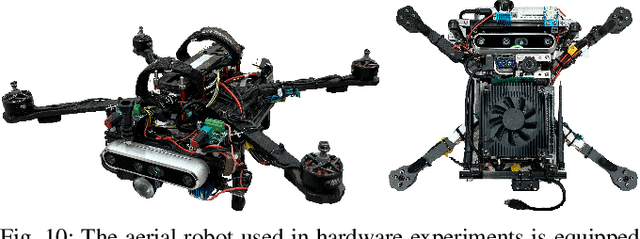

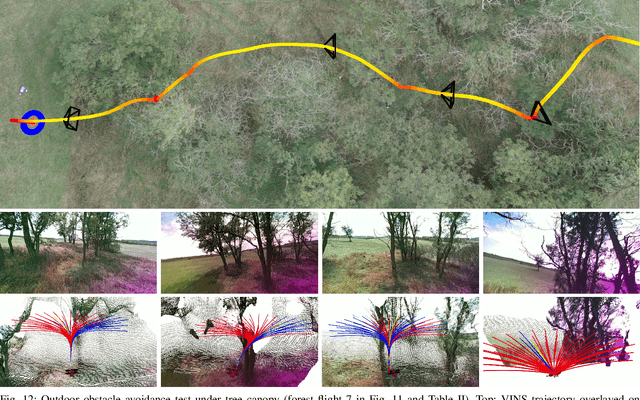
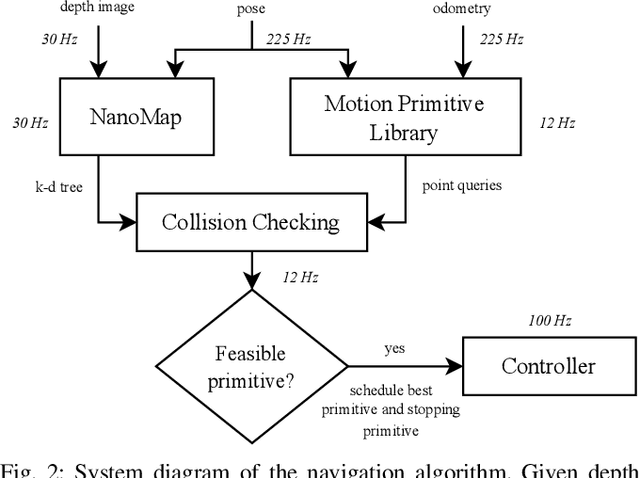
Search and rescue environments exhibit challenging 3D geometry (e.g., confined spaces, rubble, and breakdown), which necessitates agile and maneuverable aerial robotic systems. Because these systems are size, weight, and power (SWaP) constrained, rapid navigation is essential for maximizing environment coverage. Onboard autonomy must be robust to prevent collisions, which may endanger rescuers and victims. Prior works have developed high-speed navigation solutions for autonomous aerial systems, but few have considered safety for search and rescue applications. These works have also not demonstrated their approaches in diverse environments. We bridge this gap in the state of the art by developing a reactive planner using forward-arc motion primitives, which leverages a history of RGB-D observations to safely maneuver in close proximity to obstacles. At every planning round, a safe stopping action is scheduled, which is executed if no feasible motion plan is found at the next planning round. The approach is evaluated in thousands of simulations and deployed in diverse environments, including caves and forests. The results demonstrate a 24% increase in success rate compared to state-of-the-art approaches.
Decentralized Uncertainty-Aware Active Search with a Team of Aerial Robots
Oct 11, 2024Rapid search and rescue is critical to maximizing survival rates following natural disasters. However, these efforts are challenged by the need to search large disaster zones, lack of reliability in the communications infrastructure, and a priori unknown numbers of objects of interest (OOIs), such as injured survivors. Aerial robots are increasingly being deployed for search and rescue due to their high mobility, but there remains a gap in deploying multi-robot autonomous aerial systems for methodical search of large environments. Prior works have relied on preprogrammed paths from human operators or are evaluated only in simulation. We bridge these gaps in the state of the art by developing and demonstrating a decentralized active search system, which biases its trajectories to take additional views of uncertain OOIs. The methodology leverages stochasticity for rapid coverage in communication denied scenarios. When communications are available, robots share poses, goals, and OOI information to accelerate the rate of search. Extensive simulations and hardware experiments in Bloomingdale, OH, are conducted to validate the approach. The results demonstrate the active search approach outperforms greedy coverage-based planning in communication-denied scenarios while maintaining comparable performance in communication-enabled scenarios.