 Add to Chrome
 Add to Firefox
 Add to Edge
Learning to Coordinate via Quantum Entanglement in Multi-Agent Reinforcement Learning
Feb 09, 2026
The inability to communicate poses a major challenge to coordination in multi-agent reinforcement learning (MARL). Prior work has explored correlating local policies via shared randomness, sometimes in the form of a correlation device, as a mechanism to assist in decentralized decision-making. In contrast, this work introduces the first framework for training MARL agents to exploit shared quantum entanglement as a coordination resource, which permits a larger class of communication-free correlated policies than shared randomness alone. This is motivated by well-known results in quantum physics which posit that, for certain single-round cooperative games with no communication, shared quantum entanglement enables strategies that outperform those that only use shared randomness. In such cases, we say that there is quantum advantage. Our framework is based on a novel differentiable policy parameterization that enables optimization over quantum measurements, together with a novel policy architecture that decomposes joint policies into a quantum coordinator and decentralized local actors. To illustrate the effectiveness of our proposed method, we first show that we can learn, purely from experience, strategies that attain quantum advantage in single-round games that are treated as black box oracles. We then demonstrate how our machinery can learn policies with quantum advantage in an illustrative multi-agent sequential decision-making problem formulated as a decentralized partially observable Markov decision process (Dec-POMDP).

Tensor Network Estimation of Distribution Algorithms
Dec 27, 2024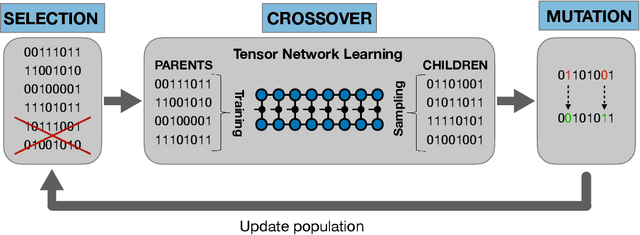
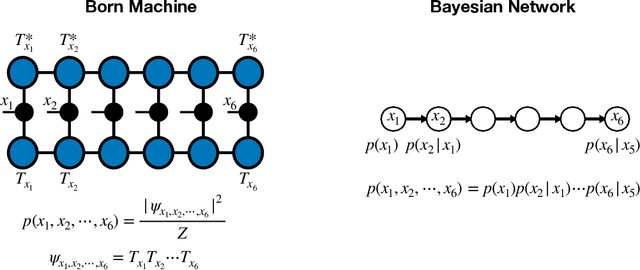
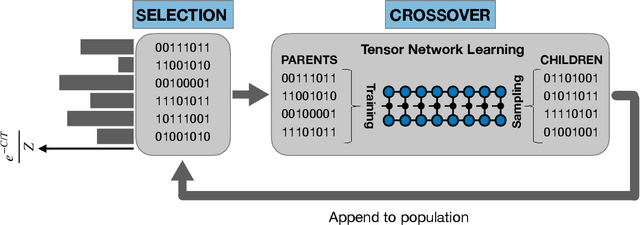
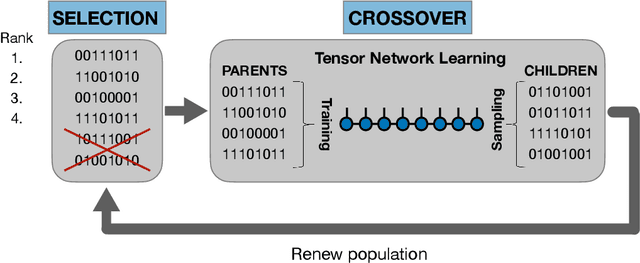
Tensor networks are a tool first employed in the context of many-body quantum physics that now have a wide range of uses across the computational sciences, from numerical methods to machine learning. Methods integrating tensor networks into evolutionary optimization algorithms have appeared in the recent literature. In essence, these methods can be understood as replacing the traditional crossover operation of a genetic algorithm with a tensor network-based generative model. We investigate these methods from the point of view that they are Estimation of Distribution Algorithms (EDAs). We find that optimization performance of these methods is not related to the power of the generative model in a straightforward way. Generative models that are better (in the sense that they better model the distribution from which their training data is drawn) do not necessarily result in better performance of the optimization algorithm they form a part of. This raises the question of how best to incorporate powerful generative models into optimization routines. In light of this we find that adding an explicit mutation operator to the output of the generative model often improves optimization performance.