 Add to Chrome
 Add to Firefox
 Add to Edge
MambaGaze: Bidirectional Mamba with Explicit Missing Data Modeling for Cognitive Load Assessment from Eye-Gaze Tracking Data
May 21, 2026
Real-time cognitive load assessment from eye-tracking signals could potentially enable adaptive human-centered-AI such as safety-critical applications such as driver vigilance monitoring or automated flight deck assistance, yet two challenges persist: handling frequent data missingness from blinks and tracking failures, and efficiently modeling long-range temporal dependencies. We propose MambaGaze, a framework that addresses these challenges through 1) XMD encoding, which augments raw features with observation masks and time-deltas to explicitly model data uncertainty, and 2) bidirectional Mamba-2, which captures temporal dependencies with linear computational complexity. Experiments on CLARE and CL-Drive datasets under leave-one-subject-out evaluation show that MambaGaze achieves 76.8% and 73.1% accuracy, respectively, outperforming CNN, Transformer, ResNet, and VGG baselines by 4-12 percentage points. Edge deployment benchmarks on NVIDIA Jetson platforms demonstrate real-time inference at 43-68 FPS with power consumption below 7.5W, confirming feasibility for wearable cognitive load monitoring.

CogAdapt: Transferring Clinical ECG Foundation Models to Wearable Cognitive Load Assessment via Lead Adaptation
May 21, 2026Real-time cognitive load assessment is essential for adaptive human-computer interaction but remains challenging due to limited labeled data and poor cross-subject generalization. Recent ECG foundation models pre-trained on millions of clinical recordings offer rich representations, but cannot be directly applied to wearable devices due to sensor configuration mismatch and task differences. In this paper, we propose CogAdapt, a framework that adapts clinical ECG foundation models to wearable cognitive load assessment. CogAdapt introduces LeadBridge, a learnable adapter that transforms 3-lead wearable signals into anatomically consistent 12-lead representations, and ProFine, a progressive fine-tuning strategy that gradually unfreezes encoder layers while preventing catastrophic forgetting. Evaluations on two public datasets (CLARE and CL-Drive) under leave-one-subject-out cross-validation show that CogAdapt substantially outperforms baselines trained from scratch, achieving macro-F1 scores of 0.626 and 0.768. These results demonstrate the promise of foundation model adaptation for subject-independent cognitive load assessment from wearable sensors.
Learning Over Dirty Data Without Cleaning
Apr 05, 2020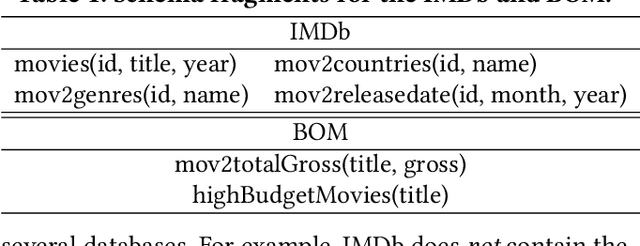
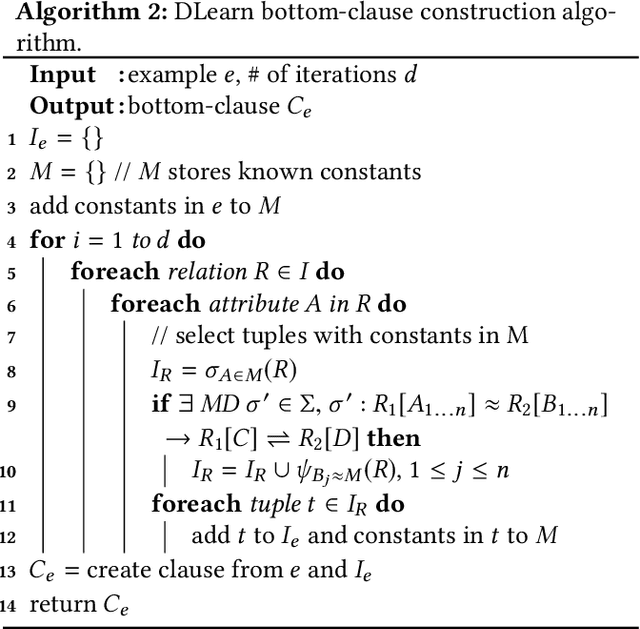
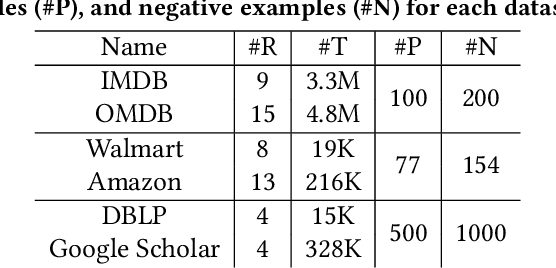
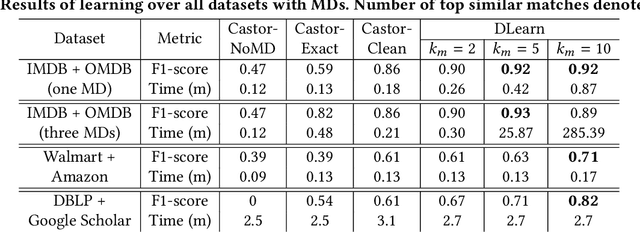
Real-world datasets are dirty and contain many errors. Examples of these issues are violations of integrity constraints, duplicates, and inconsistencies in representing data values and entities. Learning over dirty databases may result in inaccurate models. Users have to spend a great deal of time and effort to repair data errors and create a clean database for learning. Moreover, as the information required to repair these errors is not often available, there may be numerous possible clean versions for a dirty database. We propose DLearn, a novel relational learning system that learns directly over dirty databases effectively and efficiently without any preprocessing. DLearn leverages database constraints to learn accurate relational models over inconsistent and heterogeneous data. Its learned models represent patterns over all possible clean instances of the data in a usable form. Our empirical study indicates that DLearn learns accurate models over large real-world databases efficiently.