 Add to Chrome
 Add to Firefox
 Add to Edge
Robust Multi-view Camera Calibration from Dense Matches
Dec 17, 2025
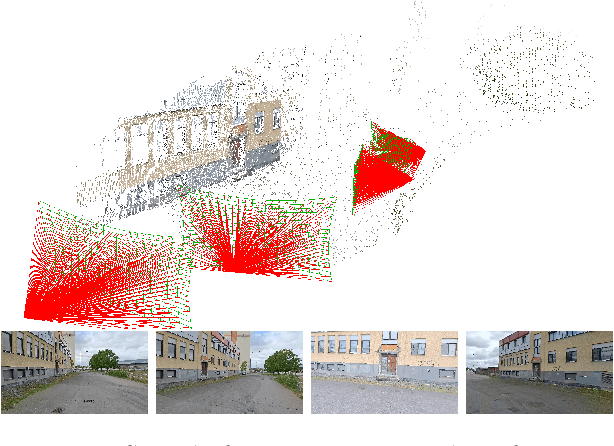
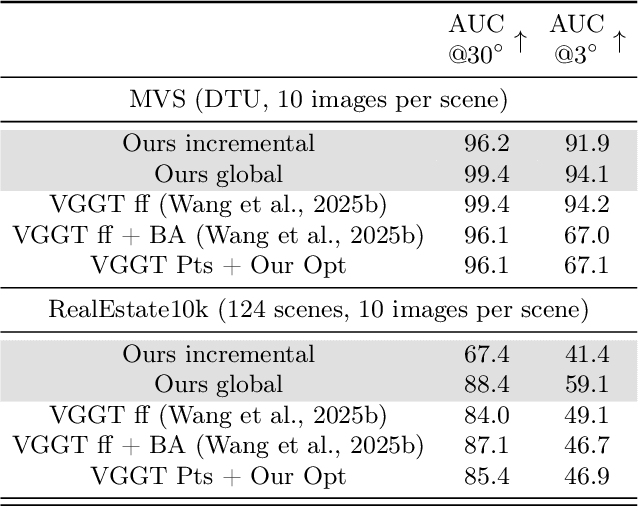
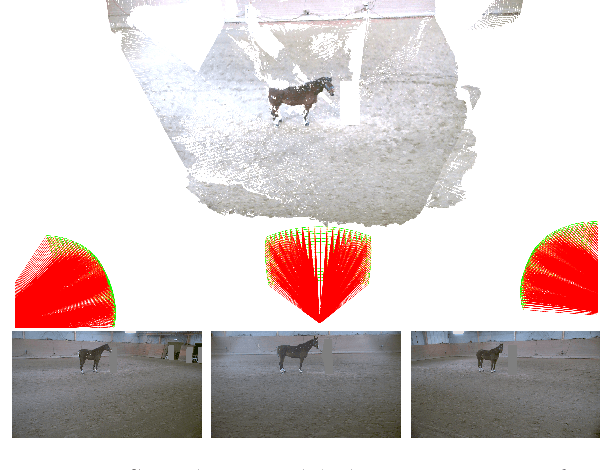
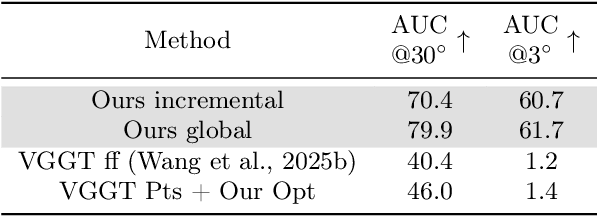
Estimating camera intrinsics and extrinsics is a fundamental problem in computer vision, and while advances in structure-from-motion (SfM) have improved accuracy and robustness, open challenges remain. In this paper, we introduce a robust method for pose estimation and calibration. We consider a set of rigid cameras, each observing the scene from a different perspective, which is a typical camera setup in animal behavior studies and forensic analysis of surveillance footage. Specifically, we analyse the individual components in a structure-from-motion (SfM) pipeline, and identify design choices that improve accuracy. Our main contributions are: (1) we investigate how to best subsample the predicted correspondences from a dense matcher to leverage them in the estimation process. (2) We investigate selection criteria for how to add the views incrementally. In a rigorous quantitative evaluation, we show the effectiveness of our changes, especially for cameras with strong radial distortion (79.9% ours vs. 40.4 vanilla VGGT). Finally, we demonstrate our correspondence subsampling in a global SfM setting where we initialize the poses using VGGT. The proposed pipeline generalizes across a wide range of camera setups, and could thus become a useful tool for animal behavior and forensic analysis.

Temporally-consistent 3D Reconstruction of Birds
Aug 24, 2024This paper deals with 3D reconstruction of seabirds which recently came into focus of environmental scientists as valuable bio-indicators for environmental change. Such 3D information is beneficial for analyzing the bird's behavior and physiological shape, for example by tracking motion, shape, and appearance changes. From a computer vision perspective birds are especially challenging due to their rapid and oftentimes non-rigid motions. We propose an approach to reconstruct the 3D pose and shape from monocular videos of a specific breed of seabird - the common murre. Our approach comprises a full pipeline of detection, tracking, segmentation, and temporally consistent 3D reconstruction. Additionally, we propose a temporal loss that extends current single-image 3D bird pose estimators to the temporal domain. Moreover, we provide a real-world dataset of 10000 frames of video observations on average capture nine birds simultaneously, comprising a large variety of motions and interactions, including a smaller test set with bird-specific keypoint labels. Using our temporal optimization, we achieve state-of-the-art performance for the challenging sequences in our dataset.