 Add to Chrome
 Add to Firefox
 Add to Edge
DeepForestVisionV2: Ecology-Driven Taxonomy Expansion for Camera-Trap Monitoring in African Tropical Forests
Jun 18, 2026
Camera-trap monitoring in African tropical forests increasingly extends beyond closed-canopy interiors to riverbanks, clearings, and park edges. Among available open tools for African forest camera-trap classification, DeepForestVision is the only one providing a matched offline workflow for both photographs and videos, and previous work showed that it outperformed other available baselines on a comparable benchmark. However, it was designed for closed-canopy, ground-level forest interiors and uses a 35-class prediction space that becomes too coarse when deployments encounter arboreal primates, birds, semi-aquatic taxa, or human-associated confounders such as livestock. We present DeepForestVisionV2, an ecology-driven expansion from 35 to 64 prediction classes (61 animal classes plus human, vehicle, and blank) designed to address three recurrent deployment gradients: vertical stratification, scene openness, and anthropogenic interfaces. DeepForestVisionV2 retains the same offline workflow and is trained on 1,535,010 photographs and 243,354 videos from multi-country African tropical-forest projects. Evaluation combines a cross-country cropped-photo validation set, used to assess robustness across sites and camera-trap settings, with three held-out Uganda video benchmarks spanning the targeted gradients. On the validation set, DeepForestVisionV2 reaches 0.86 accuracy, 0.82 macro-F1, and 0.81 balanced accuracy. On the deployment benchmarks, it preserves or improves baseline accuracy despite its harder classification task, while increasing the number of identified taxa from 22 to 29 in forest-interior videos and from 4 to 9 at riverbanks. In the park-edge use case, it raises accuracy from 0.62 to 0.86 and reduces false alarms from 11 to 0. These results show that DeepForestVisionV2 materially improves field utility while preserving robustness across sites, habitats, and camera-trap settings.

Introducing a Central African Primate Vocalisation Dataset for Automated Species Classification
Jan 25, 2021
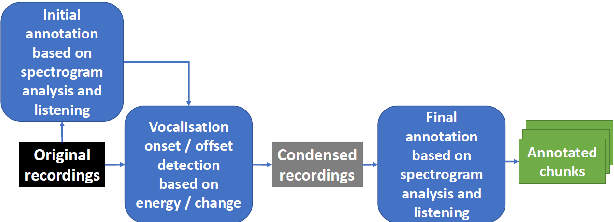
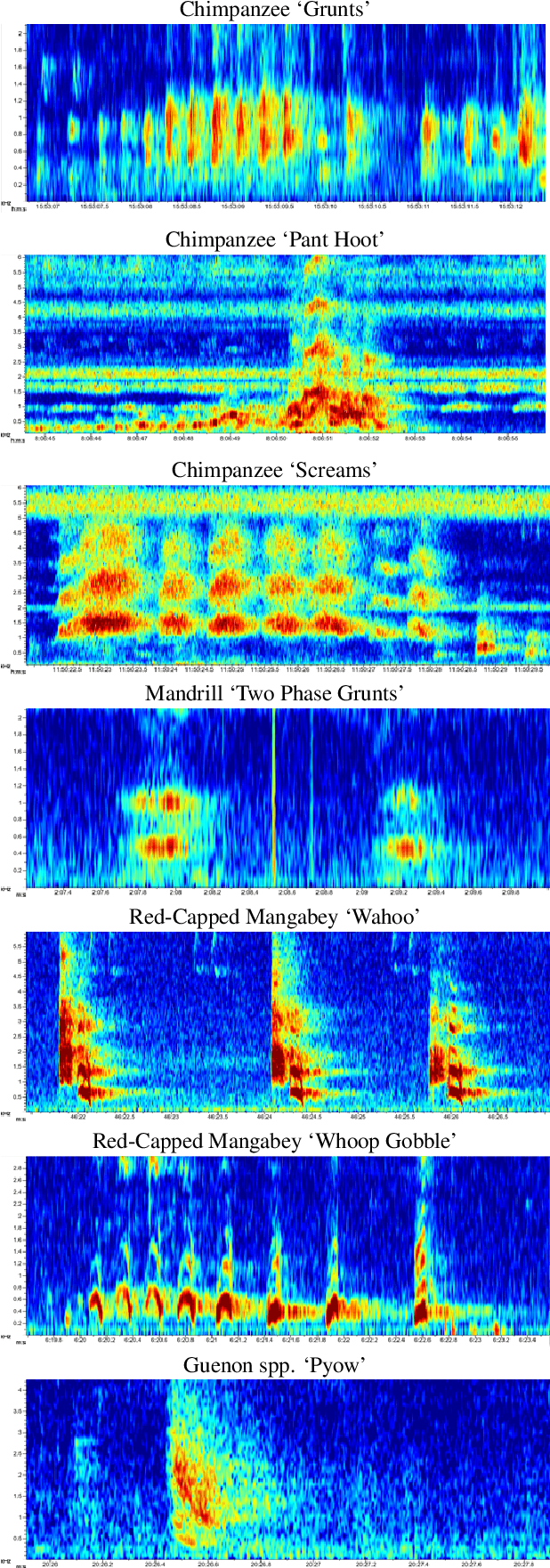
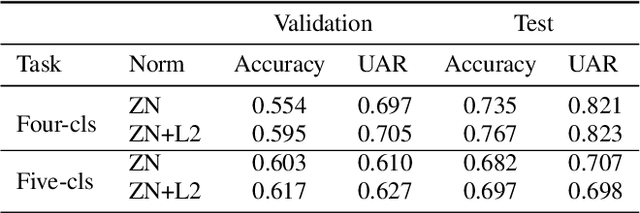
Automated classification of animal vocalisations is a potentially powerful wildlife monitoring tool. Training robust classifiers requires sizable annotated datasets, which are not easily recorded in the wild. To circumvent this problem, we recorded four primate species under semi-natural conditions in a wildlife sanctuary in Cameroon with the objective to train a classifier capable of detecting species in the wild. Here, we introduce the collected dataset, describe our approach and initial results of classifier development. To increase the efficiency of the annotation process, we condensed the recordings with an energy/change based automatic vocalisation detection. Segmenting the annotated chunks into training, validation and test sets, initial results reveal up to 82% unweighted average recall (UAR) test set performance in four-class primate species classification.