 Add to Chrome
 Add to Firefox
 Add to Edge
DeepForestVisionV2: Ecology-Driven Taxonomy Expansion for Camera-Trap Monitoring in African Tropical Forests
Jun 18, 2026
Camera-trap monitoring in African tropical forests increasingly extends beyond closed-canopy interiors to riverbanks, clearings, and park edges. Among available open tools for African forest camera-trap classification, DeepForestVision is the only one providing a matched offline workflow for both photographs and videos, and previous work showed that it outperformed other available baselines on a comparable benchmark. However, it was designed for closed-canopy, ground-level forest interiors and uses a 35-class prediction space that becomes too coarse when deployments encounter arboreal primates, birds, semi-aquatic taxa, or human-associated confounders such as livestock. We present DeepForestVisionV2, an ecology-driven expansion from 35 to 64 prediction classes (61 animal classes plus human, vehicle, and blank) designed to address three recurrent deployment gradients: vertical stratification, scene openness, and anthropogenic interfaces. DeepForestVisionV2 retains the same offline workflow and is trained on 1,535,010 photographs and 243,354 videos from multi-country African tropical-forest projects. Evaluation combines a cross-country cropped-photo validation set, used to assess robustness across sites and camera-trap settings, with three held-out Uganda video benchmarks spanning the targeted gradients. On the validation set, DeepForestVisionV2 reaches 0.86 accuracy, 0.82 macro-F1, and 0.81 balanced accuracy. On the deployment benchmarks, it preserves or improves baseline accuracy despite its harder classification task, while increasing the number of identified taxa from 22 to 29 in forest-interior videos and from 4 to 9 at riverbanks. In the park-edge use case, it raises accuracy from 0.62 to 0.86 and reduces false alarms from 11 to 0. These results show that DeepForestVisionV2 materially improves field utility while preserving robustness across sites, habitats, and camera-trap settings.

Automatic Individual Identification of Patterned Solitary Species Based on Unlabeled Video Data
Apr 19, 2023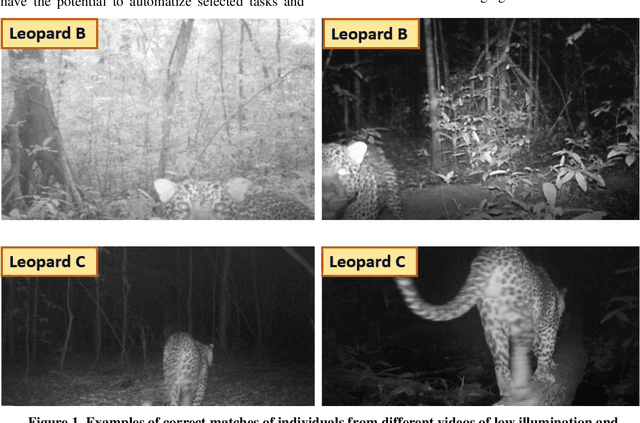


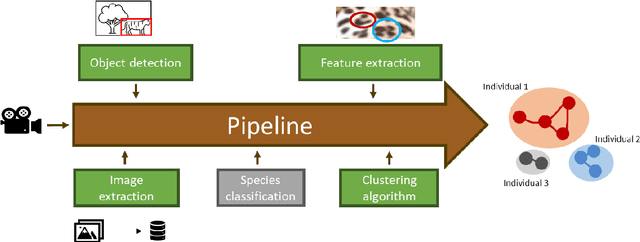
The manual processing and analysis of videos from camera traps is time-consuming and includes several steps, ranging from the filtering of falsely triggered footage to identifying and re-identifying individuals. In this study, we developed a pipeline to automatically analyze videos from camera traps to identify individuals without requiring manual interaction. This pipeline applies to animal species with uniquely identifiable fur patterns and solitary behavior, such as leopards (Panthera pardus). We assumed that the same individual was seen throughout one triggered video sequence. With this assumption, multiple images could be assigned to an individual for the initial database filling without pre-labeling. The pipeline was based on well-established components from computer vision and deep learning, particularly convolutional neural networks (CNNs) and scale-invariant feature transform (SIFT) features. We augmented this basis by implementing additional components to substitute otherwise required human interactions. Based on the similarity between frames from the video material, clusters were formed that represented individuals bypassing the open set problem of the unknown total population. The pipeline was tested on a dataset of leopard videos collected by the Pan African Programme: The Cultured Chimpanzee (PanAf) and achieved a success rate of over 83% for correct matches between previously unknown individuals. The proposed pipeline can become a valuable tool for future conservation projects based on camera trap data, reducing the work of manual analysis for individual identification, when labeled data is unavailable.