 Add to Chrome
 Add to Firefox
 Add to Edge
Exploring the impact of fairness-aware criteria in AutoML
Apr 11, 2026
Machine Learning (ML) systems are increasingly used to support decision-making processes that affect individuals. However, these systems often rely on biased data, which can lead to unfair outcomes against specific groups. With the growing adoption of Automated Machine Learning (AutoML), the risk of intensifying discriminatory behaviours increases, as most frameworks primarily focus on model selection to maximise predictive performance. Previous research on fairness in AutoML had largely followed this trend, integrating fairness awareness only in the model selection or hyperparameter tuning, while neglecting other critical stages of the ML pipeline. This paper aims to study the impact of integrating fairness directly into the optimisation component of an AutoML framework that constructs complete ML pipelines, from data selection and transformations to model selection and tuning. As selecting appropriate fairness metrics remains a key challenge, our work incorporates complementary fairness metrics to capture different dimensions of fairness during the optimisation. Their integration within AutoML resulted in measurable differences compared to a baseline focused solely on predictive performance. Despite a 9.4% decrease in predictive power, the average fairness improved by 14.5%, accompanied by a 35.7% reduction in data usage. Furthermore, fairness integration produced complete yet simpler final solutions, suggesting that model complexity is not always required to achieve balanced and fair ML solutions.

EDCA -- An Evolutionary Data-Centric AutoML Framework for Efficient Pipelines
Mar 06, 2025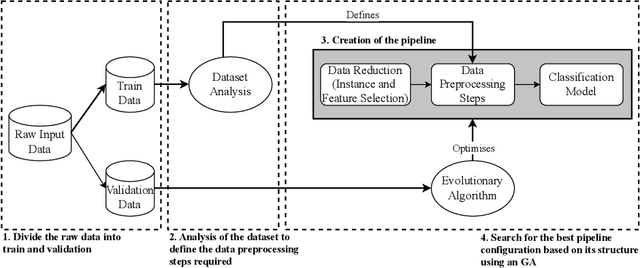
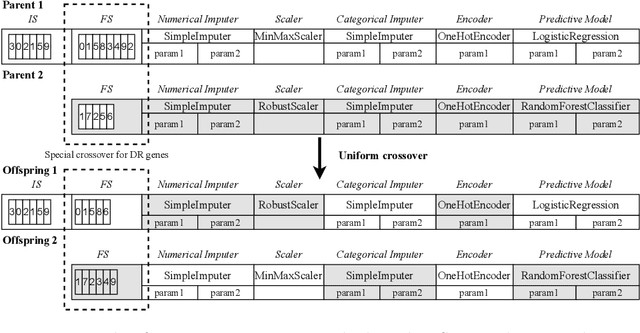
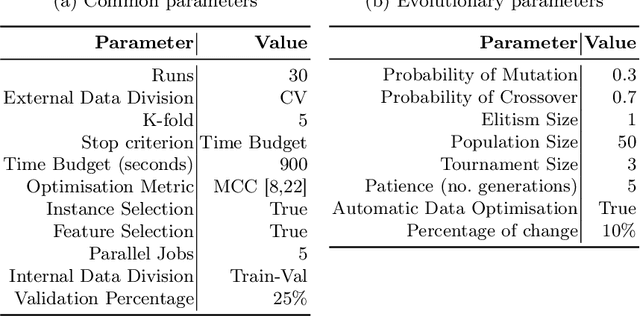
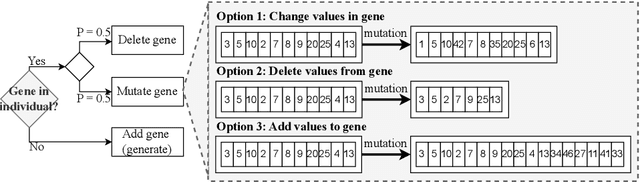
Automated Machine Learning (AutoML) gained popularity due to the increased demand for Machine Learning (ML) specialists, allowing them to apply ML techniques effortlessly and quickly. AutoML implementations use optimisation methods to identify the most effective ML solution for a given dataset, aiming to improve one or more predefined metrics. However, most implementations focus on model selection and hyperparameter tuning. Despite being an important factor in obtaining high-performance ML systems, data quality is usually an overlooked part of AutoML and continues to be a manual and time-consuming task. This work presents EDCA, an Evolutionary Data Centric AutoML framework. In addition to the traditional tasks such as selecting the best models and hyperparameters, EDCA enhances the given data by optimising data processing tasks such as data reduction and cleaning according to the problems' needs. All these steps create an ML pipeline that is optimised by an evolutionary algorithm. To assess its effectiveness, EDCA was compared to FLAML and TPOT, two frameworks at the top of the AutoML benchmarks. The frameworks were evaluated in the same conditions using datasets from AMLB classification benchmarks. EDCA achieved statistically similar results in performance to FLAML and TPOT but used significantly less data to train the final solutions. Moreover, EDCA experimental results reveal that a good performance can be achieved using less data and efficient ML algorithm aspects that align with Green AutoML guidelines