 Add to Chrome
 Add to Firefox
 Add to Edge
FairML: A Julia Package for Fair Classification
Dec 03, 2024
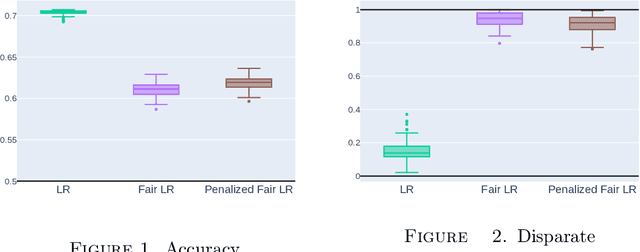
In this paper, we propose FairML.jl, a Julia package providing a framework for fair classification in machine learning. In this framework, the fair learning process is divided into three stages. Each stage aims to reduce unfairness, such as disparate impact and disparate mistreatment, in the final prediction. For the preprocessing stage, we present a resampling method that addresses unfairness coming from data imbalances. The in-processing phase consist of a classification method. This can be either one coming from the MLJ.jl package, or a user defined one. For this phase, we incorporate fair ML methods that can handle unfairness to a certain degree through their optimization process. In the post-processing, we discuss the choice of the cut-off value for fair prediction. With simulations, we show the performance of the single phases and their combinations.

Fair Generalized Linear Mixed Models
May 15, 2024
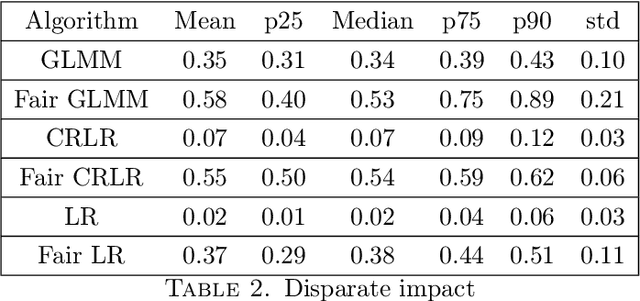
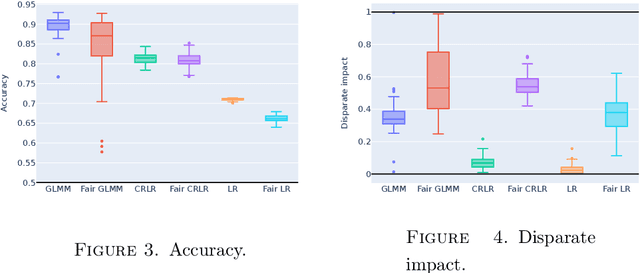
When using machine learning for automated prediction, it is important to account for fairness in the prediction. Fairness in machine learning aims to ensure that biases in the data and model inaccuracies do not lead to discriminatory decisions. E.g., predictions from fair machine learning models should not discriminate against sensitive variables such as sexual orientation and ethnicity. The training data often in obtained from social surveys. In social surveys, oftentimes the data collection process is a strata sampling, e.g. due to cost restrictions. In strata samples, the assumption of independence between the observation is not fulfilled. Hence, if the machine learning models do not account for the strata correlations, the results may be biased. Especially high is the bias in cases where the strata assignment is correlated to the variable of interest. We present in this paper an algorithm that can handle both problems simultaneously, and we demonstrate the impact of stratified sampling on the quality of fair machine learning predictions in a reproducible simulation study.
Fair Mixed Effects Support Vector Machine
May 10, 2024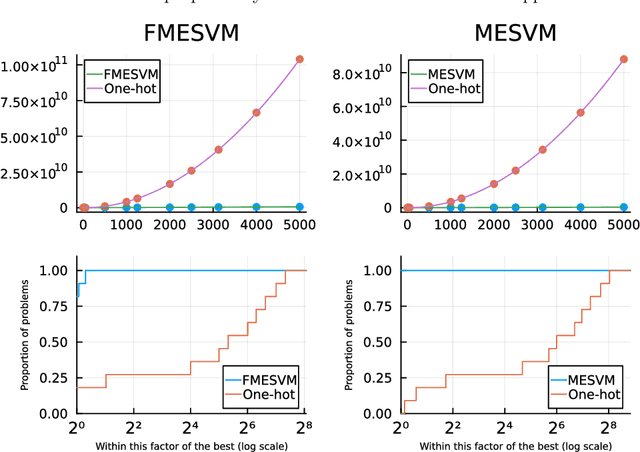
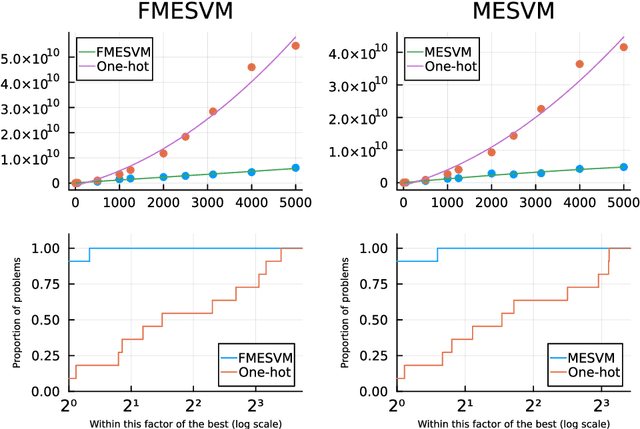
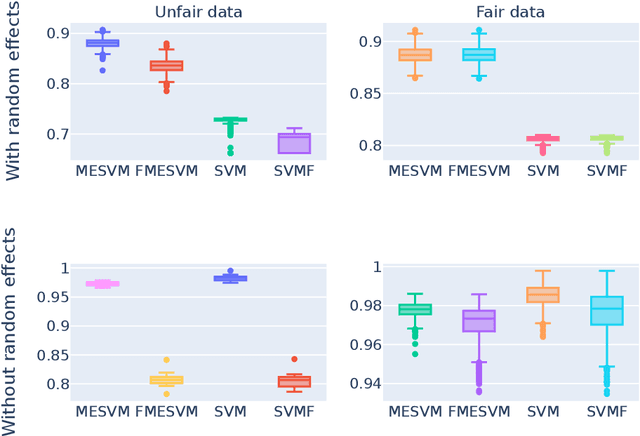
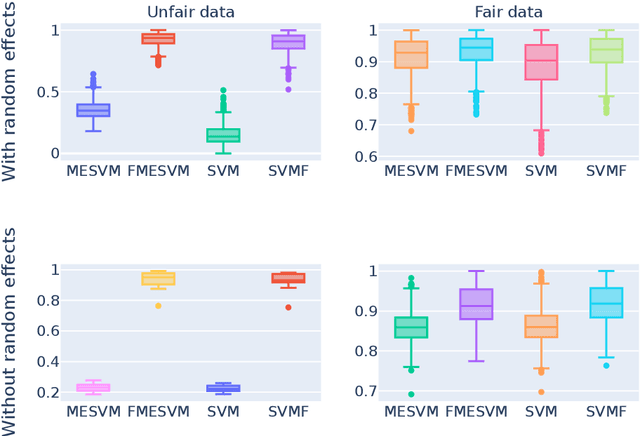
To ensure unbiased and ethical automated predictions, fairness must be a core principle in machine learning applications. Fairness in machine learning aims to mitigate biases present in the training data and model imperfections that could lead to discriminatory outcomes. This is achieved by preventing the model from making decisions based on sensitive characteristics like ethnicity or sexual orientation. A fundamental assumption in machine learning is the independence of observations. However, this assumption often does not hold true for data describing social phenomena, where data points are often clustered based. Hence, if the machine learning models do not account for the cluster correlations, the results may be biased. Especially high is the bias in cases where the cluster assignment is correlated to the variable of interest. We present a fair mixed effects support vector machine algorithm that can handle both problems simultaneously. With a reproducible simulation study we demonstrate the impact of clustered data on the quality of fair machine learning predictions.