 Add to Chrome
 Add to Firefox
 Add to Edge
Translating finite-domain integer constraint models to CP/SMT/ILP/PB/SAT solvers with CPMpy
Aug 15, 2026
Constraint solving is a declarative approach for solving combinatorial satisfaction and optimization problems. The user specifies their problem through constraints and decision variables, and a generic solver is used to find a solution. Several constraint-solving technologies exist, and certain solvers perform well on certain problems. Therefore, it is useful to try different solvers given a particular application. However, each solving paradigm supports different types of constraints and decision variables. Our goal is to translate high-level constraint satisfaction and optimization problems into any lower-level formalism, including CP, SMT QF-LIA, ILP, PB and (Max)SAT. This allows for comparing different solving technologies for a particular problem, without requiring a user to manually remodel it for each solving paradigm. We define a high-level language of logical and arithmetic operations, and useful additional functions and constraints, which are known as global constraints in the CP community. We then present a modular framework for transforming our high-level modeling language to CP/SMT/ILP/PB and (Max)SAT solvers. While many transformations are partly described in the literature, we observe that they can be implemented through a modular waterfall of smaller components, where lower-level paradigms reuse the transformations of higher-level paradigms. Two recurring challenges are handling the negation of arbitrary subexpressions and avoiding the introduction of auxiliary variables. Additionally, we take special care linearizing non-linear operators for ILP, PB and SAT-solvers. The transformation waterfall is implemented and evaluated in the open-source CPMpy library. Our results show that constraint models significantly change throughout the transformations, and that optimizations to the linearization of constraints are essential for ILP and PB solvers.

Transforming Constraint Programs to Input for Local Search
May 19, 2026Applying local search algorithms to combinatorial optimization problems is not an easy feat. Typically, human intervention is required to compile the constraints to input data for some metaheuristic algorithm. In this paper, we establish a link between symmetry properties of constraint optimization problems and local search neighborhoods, and we use this link to automatically generate neighborhoods from a constraint specification in the context of the IDP system. We evaluate the obtained neighborhoods for six classical optimization problems. The resulting observations support the viability of this technique.
FOLASP: FO as Input Language for Answer Ser Solvers
Aug 09, 2021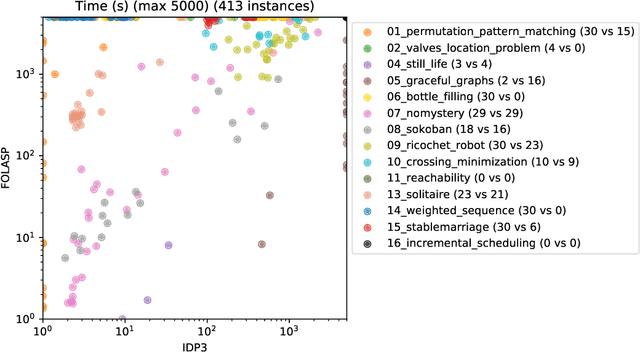
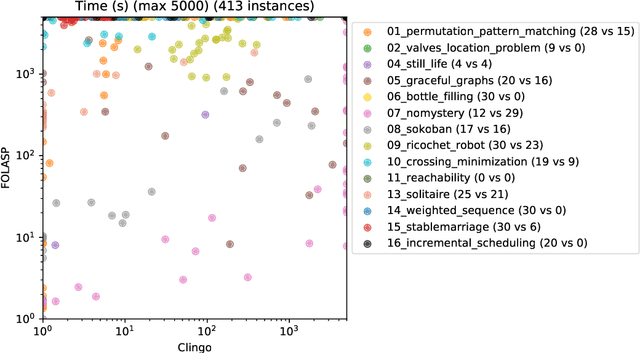
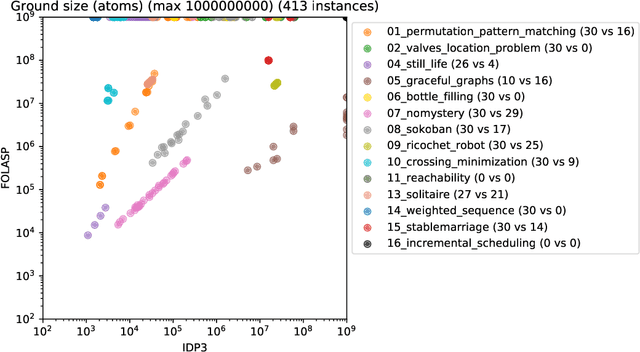
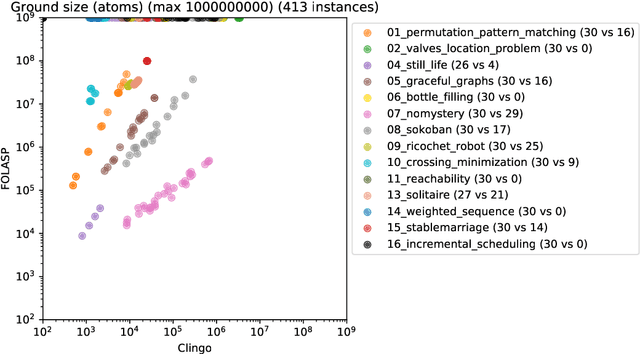
Over the past decades, Answer Set Programming (ASP) has emerged as an important paradigm for declarative problem solving. Technological progress in this area has been stimulated by the use of common standards, such as the ASP-Core-2 language. While ASP has its roots in non-monotonic reasoning, efforts have also been made to reconcile ASP with classical first-order logic (FO). This has resulted in the development of FO(.), an expressive extension of FO, which allows ASP-like problem solving in a purely classical setting. This language may be more accessible to domain experts already familiar with FO, and may be easier to combine with other formalisms that are based on classical logic. It is supported by the IDP inference system, which has successfully competed in a number of ASP competitions. Here, however, technological progress has been hampered by the limited number of systems that are available for FO(.). In this paper, we aim to address this gap by means of a translation tool that transforms an FO(.) specification into ASP-Core-2, thereby allowing ASP-Core-2 solvers to be used as solvers for FO(.) as well. We present experimental results to show that the resulting combination of our translation with an off-the-shelf ASP solver is competitive with the IDP system as a way of solving problems formulated in FO(.). Under consideration for acceptance in TPLP.
Planning with Learned Binarized Neural Networks Benchmarks for MaxSAT Evaluation 2021
Aug 02, 2021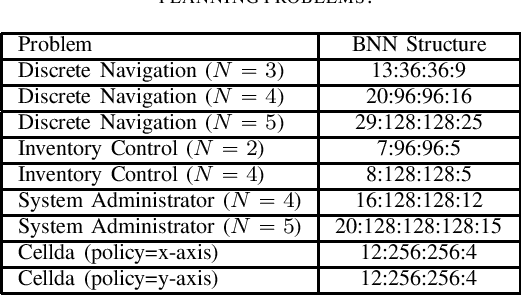
This document provides a brief introduction to learned automated planning problem where the state transition function is in the form of a binarized neural network (BNN), presents a general MaxSAT encoding for this problem, and describes the four domains, namely: Navigation, Inventory Control, System Administrator and Cellda, that are submitted as benchmarks for MaxSAT Evaluation 2021.
A MIP Backend for the IDP System
Sep 02, 2016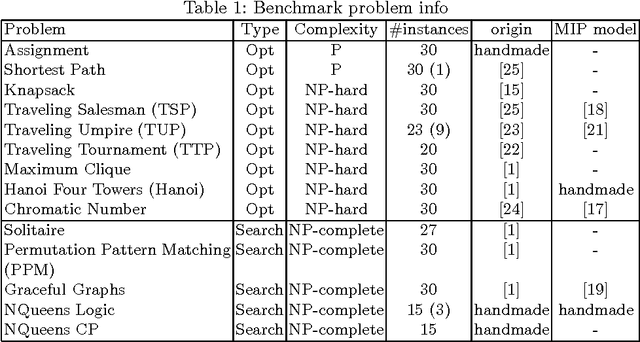
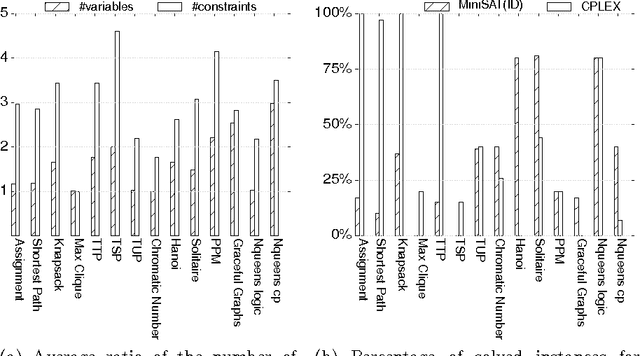

The IDP knowledge base system currently uses MiniSAT(ID) as its backend Constraint Programming (CP) solver. A few similar systems have used a Mixed Integer Programming (MIP) solver as backend. However, so far little is known about when the MIP solver is preferable. This paper explores this question. It describes the use of CPLEX as a backend for IDP and reports on experiments comparing both backends.
BreakID: Static Symmetry Breaking for ASP (System Description)
Aug 30, 2016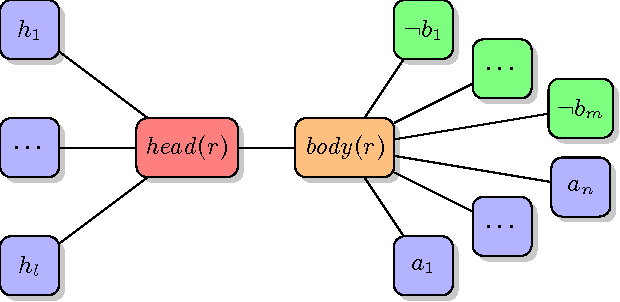
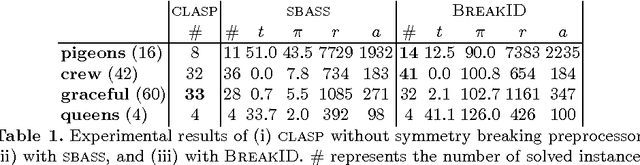
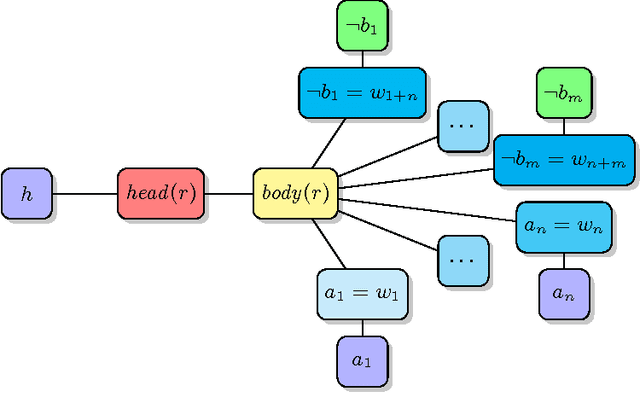
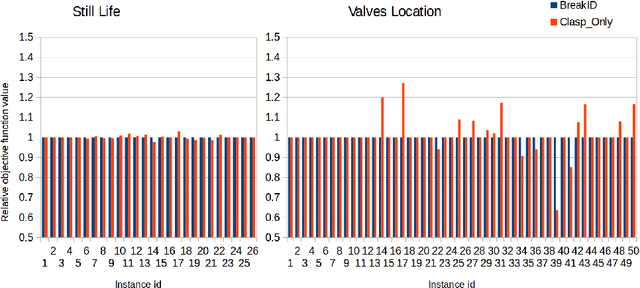
Symmetry breaking has been proven to be an efficient preprocessing technique for satisfiability solving (SAT). In this paper, we port the state-of-the-art SAT symmetry breaker BreakID to answer set programming (ASP). The result is a lightweight tool that can be plugged in between the grounding and the solving phases that are common when modelling in ASP. We compare our tool with sbass, the current state-of-the-art symmetry breaker for ASP.
Implementing a Relevance Tracker Module
Aug 19, 2016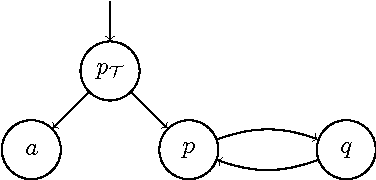
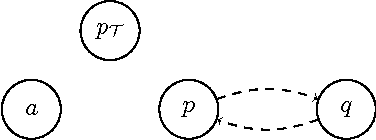
PC(ID) extends propositional logic with inductive definitions: rule sets under the well-founded semantics. Recently, a notion of relevance was introduced for this language. This notion determines the set of undecided literals that can still influence the satisfiability of a PC(ID) formula in a given partial assignment. The idea is that the PC(ID) solver can make decisions only on relevant literals without losing soundness and thus safely ignore irrelevant literals. One important insight that the relevance of a literal is completely determined by the current solver state. During search, the solver state changes have an effect on the relevance of literals. In this paper, we discuss an incremental, lightweight implementation of a relevance tracker module that can be added to and interact with an out-of-the-box SAT(ID) solver.