 Add to Chrome
 Add to Firefox
 Add to Edge
Translating finite-domain integer constraint models to CP/SMT/ILP/PB/SAT solvers with CPMpy
Aug 15, 2026
Constraint solving is a declarative approach for solving combinatorial satisfaction and optimization problems. The user specifies their problem through constraints and decision variables, and a generic solver is used to find a solution. Several constraint-solving technologies exist, and certain solvers perform well on certain problems. Therefore, it is useful to try different solvers given a particular application. However, each solving paradigm supports different types of constraints and decision variables. Our goal is to translate high-level constraint satisfaction and optimization problems into any lower-level formalism, including CP, SMT QF-LIA, ILP, PB and (Max)SAT. This allows for comparing different solving technologies for a particular problem, without requiring a user to manually remodel it for each solving paradigm. We define a high-level language of logical and arithmetic operations, and useful additional functions and constraints, which are known as global constraints in the CP community. We then present a modular framework for transforming our high-level modeling language to CP/SMT/ILP/PB and (Max)SAT solvers. While many transformations are partly described in the literature, we observe that they can be implemented through a modular waterfall of smaller components, where lower-level paradigms reuse the transformations of higher-level paradigms. Two recurring challenges are handling the negation of arbitrary subexpressions and avoiding the introduction of auxiliary variables. Additionally, we take special care linearizing non-linear operators for ILP, PB and SAT-solvers. The transformation waterfall is implemented and evaluated in the open-source CPMpy library. Our results show that constraint models significantly change throughout the transformations, and that optimizations to the linearization of constraints are essential for ILP and PB solvers.

Using Certifying Constraint Solvers for Generating Step-wise Explanations
Nov 13, 2025In the field of Explainable Constraint Solving, it is common to explain to a user why a problem is unsatisfiable. A recently proposed method for this is to compute a sequence of explanation steps. Such a step-wise explanation shows individual reasoning steps involving constraints from the original specification, that in the end explain a conflict. However, computing a step-wise explanation is computationally expensive, limiting the scope of problems for which it can be used. We investigate how we can use proofs generated by a constraint solver as a starting point for computing step-wise explanations, instead of computing them step-by-step. More specifically, we define a framework of abstract proofs, in which both proofs and step-wise explanations can be represented. We then propose several methods for converting a proof to a step-wise explanation sequence, with special attention to trimming and simplification techniques to keep the sequence and its individual steps small. Our results show our method significantly speeds up the generation of step-wise explanation sequences, while the resulting step-wise explanation has a quality similar to the current state-of-the-art.
Exploiting Symmetries in MUS Computation (Extended version)
Dec 18, 2024

In eXplainable Constraint Solving (XCS), it is common to extract a Minimal Unsatisfiable Subset (MUS) from a set of unsatisfiable constraints. This helps explain to a user why a constraint specification does not admit a solution. Finding MUSes can be computationally expensive for highly symmetric problems, as many combinations of constraints need to be considered. In the traditional context of solving satisfaction problems, symmetry has been well studied, and effective ways to detect and exploit symmetries during the search exist. However, in the setting of finding MUSes of unsatisfiable constraint programs, symmetries are understudied. In this paper, we take inspiration from existing symmetry-handling techniques and adapt well-known MUS-computation methods to exploit symmetries in the specification, speeding-up overall computation time. Our results display a significant reduction of runtime for our adapted algorithms compared to the baseline on symmetric problems.
Trustworthy and Explainable Decision-Making for Workforce allocation
Dec 13, 2024
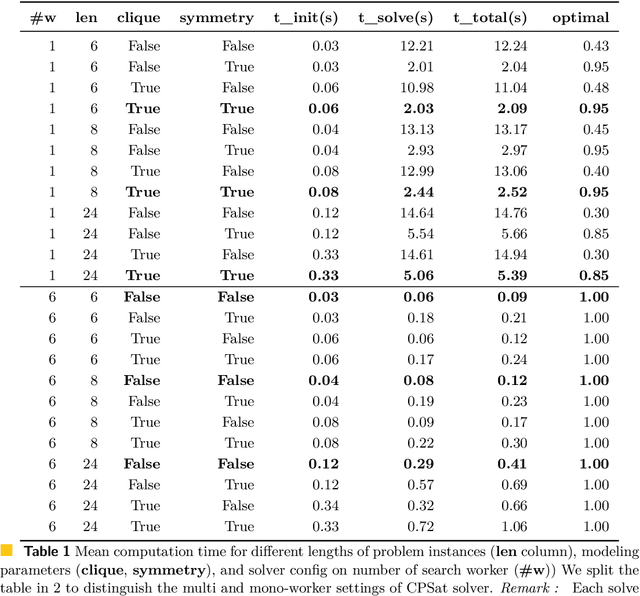
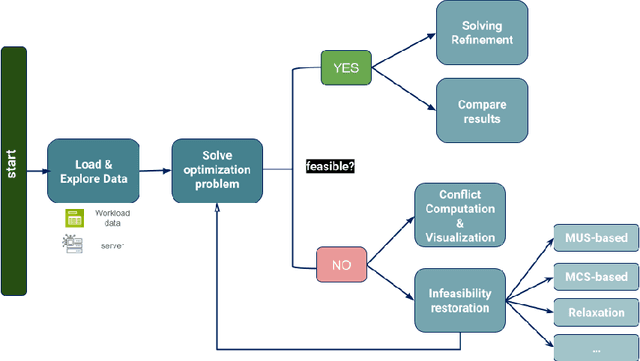
In industrial contexts, effective workforce allocation is crucial for operational efficiency. This paper presents an ongoing project focused on developing a decision-making tool designed for workforce allocation, emphasising the explainability to enhance its trustworthiness. Our objective is to create a system that not only optimises the allocation of teams to scheduled tasks but also provides clear, understandable explanations for its decisions, particularly in cases where the problem is infeasible. By incorporating human-in-the-loop mechanisms, the tool aims to enhance user trust and facilitate interactive conflict resolution. We implemented our approach on a prototype tool/digital demonstrator intended to be evaluated on a real industrial scenario both in terms of performance and user acceptability.