 Add to Chrome
 Add to Firefox
 Add to Edge
Spectral Consistent Flow for One-step 3D Medical Image Translation
Jul 12, 2026
We present Spectral Consistent Flow (SC-Flow), a 3D medical image translation framework with a single function evaluation (1-NFE) in the latent space. This approach reformulates medical image translation as a stochastic Brownian bridge process that directly constructs a mapping between source and target modalities by predicting the support regularized mean velocity field. To mitigate modality entanglement, over-smoothing, and artifacts induced by the implicit low-pass modulation of the latent average velocity, we introduce a Spectral Consistency Corrector that dynamically regularizes the evolution of the power spectral density via learnable frequency-domain gain modulation. This mechanism establishes an explicit bridge between spatial textures and spectral energy flow, enabling the model to recover fine-grained anatomical fidelity while maintaining global structural coherence. Extensive experiments on four datasets demonstrate that SC-Flow delivers significantly more accurate, consistent, and robust performance across various translation scenarios.

Causal Image Synthesis of Brain MR in 3D
Mar 25, 2023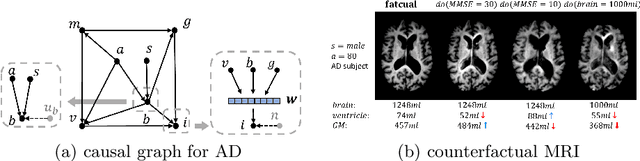



Clinical decision making requires counterfactual reasoning based on a factual medical image and thus necessitates causal image synthesis. To this end, we present a novel method for modeling the causality between demographic variables, clinical indices and brain MR images for Alzheimer's Diseases. Specifically, we leverage a structural causal model to depict the causality and a styled generator to synthesize the image. Furthermore, as a crucial step to reduce modeling complexity and make learning tractable, we propose the use of low dimensional latent feature representation of a high-dimensional 3D image, together with exogenous noise, to build causal relationship between the image and non image variables. We experiment the proposed method based on 1586 subjects and 3683 3D images and synthesize counterfactual brain MR images intervened on certain attributes, such as age, brain volume and cognitive test score. Quantitative metrics and qualitative evaluation of counterfactual images demonstrates the superiority of our generated images.