 Add to Chrome
 Add to Firefox
 Add to Edge
iPoster: Content-Aware Layout Generation for Interactive Poster Design via Graph-Enhanced Diffusion Models
Mar 31, 2026
We present iPoster, an interactive layout generation framework that empowers users to guide content-aware poster layout design by specifying flexible constraints. iPoster enables users to specify partial intentions within the intention module, such as element categories, sizes, positions, or coarse initial drafts. Then, the generation module instantly generates refined, context-sensitive layouts that faithfully respect these constraints. iPoster employs a unified graph-enhanced diffusion architecture that supports various design tasks under user-specified constraints. These constraints are enforced through masking strategies that precisely preserve user input at every denoising step. A cross content-aware attention module aligns generated elements with salient regions of the canvas, ensuring visual coherence. Extensive experiments show that iPoster not only achieves state-of-the-art layout quality, but offers a responsive and controllable framework for poster layout design with constraints.

Kairos: Practical Intrusion Detection and Investigation using Whole-system Provenance
Aug 13, 2023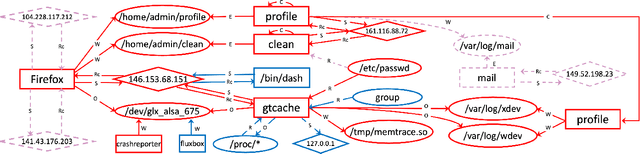

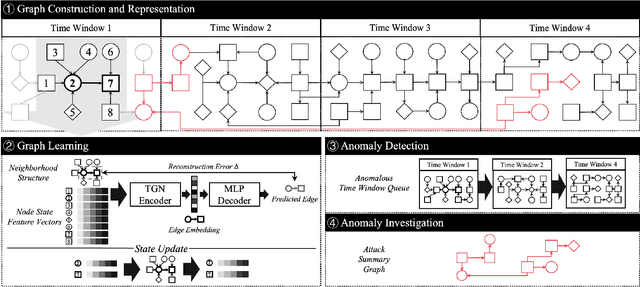
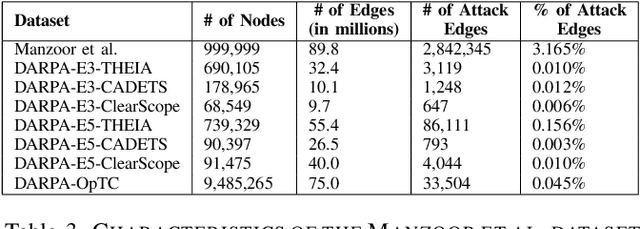
Provenance graphs are structured audit logs that describe the history of a system's execution. Recent studies have explored a variety of techniques to analyze provenance graphs for automated host intrusion detection, focusing particularly on advanced persistent threats. Sifting through their design documents, we identify four common dimensions that drive the development of provenance-based intrusion detection systems (PIDSes): scope (can PIDSes detect modern attacks that infiltrate across application boundaries?), attack agnosticity (can PIDSes detect novel attacks without a priori knowledge of attack characteristics?), timeliness (can PIDSes efficiently monitor host systems as they run?), and attack reconstruction (can PIDSes distill attack activity from large provenance graphs so that sysadmins can easily understand and quickly respond to system intrusion?). We present KAIROS, the first PIDS that simultaneously satisfies the desiderata in all four dimensions, whereas existing approaches sacrifice at least one and struggle to achieve comparable detection performance. Kairos leverages a novel graph neural network-based encoder-decoder architecture that learns the temporal evolution of a provenance graph's structural changes to quantify the degree of anomalousness for each system event. Then, based on this fine-grained information, Kairos reconstructs attack footprints, generating compact summary graphs that accurately describe malicious activity over a stream of system audit logs. Using state-of-the-art benchmark datasets, we demonstrate that Kairos outperforms previous approaches.