 Add to Chrome
 Add to Firefox
 Add to Edge
Covert Communication with Spatially Heterogeneous User Cooperation Against a Geometry-Aware Warden
Aug 11, 2026
This paper investigates covert communication in which a single covert user is assisted by multiple spatially distributed non-covert users against a geometry-aware warden. Unlike prior works based on receiver-centric activation, homogeneous channels, or averaged geometry, the proposed framework retains the individual user-to-warden large-scale fading coefficients in both cooperative user activation and the warden's detection analysis. Under the adopted analytical formulation for large-scale user deployments, we establish an on--off activation structure that balances the interference caused at Bob and the interference effectiveness at warden. Based on the resulting aggregate-interference statistics, we derive a closed-form approximation of the detection error probability, the detection threshold that minimizes it, and the minimum number of cooperative users required to satisfy the covert constraint. Then, we reduce the original high-dimensional power-control problem to a one-dimensional piecewise search and develop a low-complexity algorithm that avoids resolution-dependent grid search. The analysis shows that greater warden-side spatial dispersion can reduce the required cooperative users, whereas a larger average user-to-warden distance increases it. Numerical results validate the analysis and show that finite-sample detection approaches the large-sample benchmark, while imperfect user-to-Bob channel estimation mainly reduces the achievable rate through activation errors.

Challenge-Response Authentication for LEO Satellite Channels: Exploiting Orbit-Specific Uniqueness
Mar 26, 2026The number of low Earth orbit (LEO) satellite constellations has grown rapidly in recent years, bringing a major change to global wireless communications. As LEO satellite links take on a growing role in critical services such as emergency communications, navigation, wide-area data collection, and military operations, keeping these links secure has become an important concern. In particular, verifying the identity of a satellite transmitter is now a basic requirement for protecting the services that rely on satellite access. In this article, we propose an active challenge-response authentication framework in which the verifier checks the satellite at randomly chosen times that are not known in advance, removing the fixed measurement window that existing passive methods expose to adversaries. The proposed framework uses the deterministic yet unpredictably sampled nature of orbital observables to establish a physics based root of trust for satellite identity authentication. This approach transforms satellite authentication from static feature matching into a spatiotemporal consistency verification problem inherently constrained by orbital dynamics, providing robust protection even against trajectory-aware spoofing attacks.
Multi-User Covert Communication in Spatially Heterogeneous Wireless Networks
Mar 26, 2026This paper investigates an uplink multi-user covert communication system with spatially distributed users. Unlike prior works that approximate channel statistics using averaged parameters and homogeneous assumptions, this study explicitly models each user's geometric position and corresponding user-to-Willie and user-to-Bob channel variances. This approach enables an accurate characterization of spatially heterogeneous covert environments. We mathematically prove that a generalized on-off power control scheme, which jointly accounts for both Bob's and Willie's channels, constitutes the optimal transmission strategy in heterogeneous user configurations. Leveraging the optimal strategy, we derive closed-form expressions for the minimum detection error probability and the minimum number of cooperative users required to satisfy a covert constraint. With the closed-form expressions, comprehensive theoretical analyses are conducted, which are validated by Monte-Carlo simulations. One important insight obtained from the analysis is that user spatial heterogeneity can enhance covert communication performance. Building on these findings, a piecewise search algorithm is proposed to achieve exact optimality with significantly reduced computational complexity. We demonstrate that optimization considering user's spatial heterogeneity achieves substantially improved covert communication performance than that based on the assumption of spatial homogeneity.
Text-Aware Adapter for Few-Shot Keyword Spotting
Dec 24, 2024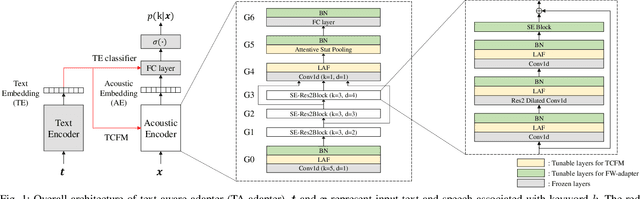
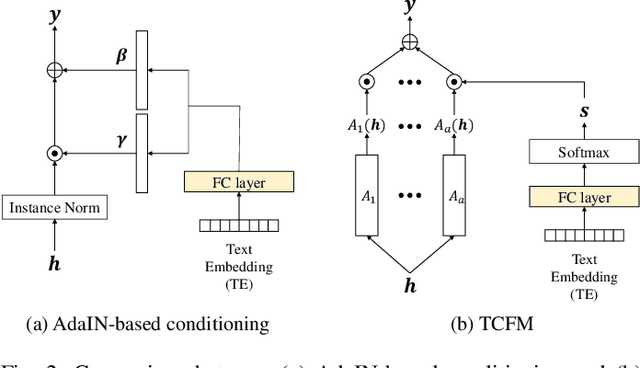
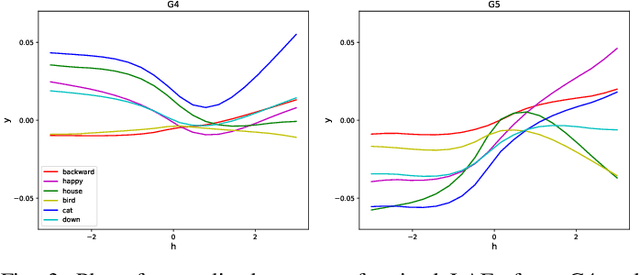
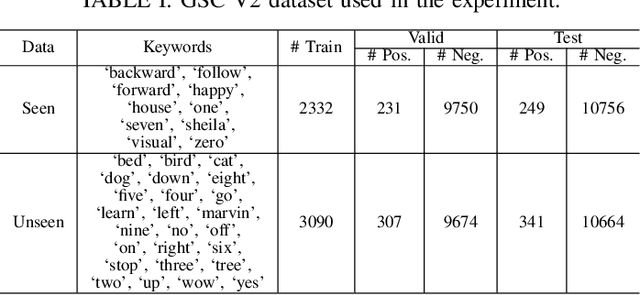
Recent advances in flexible keyword spotting (KWS) with text enrollment allow users to personalize keywords without uttering them during enrollment. However, there is still room for improvement in target keyword performance. In this work, we propose a novel few-shot transfer learning method, called text-aware adapter (TA-adapter), designed to enhance a pre-trained flexible KWS model for specific keywords with limited speech samples. To adapt the acoustic encoder, we leverage a jointly pre-trained text encoder to generate a text embedding that acts as a representative vector for the keyword. By fine-tuning only a small portion of the network while keeping the core components' weights intact, the TA-adapter proves highly efficient for few-shot KWS, enabling a seamless return to the original pre-trained model. In our experiments, the TA-adapter demonstrated significant performance improvements across 35 distinct keywords from the Google Speech Commands V2 dataset, with only a 0.14% increase in the total number of parameters.
Multi-User Cooperation for Covert Communication Under Quasi-Static Fading
Apr 10, 2023This work studies a covert communication scheme for an uplink multi-user scenario in which some users are opportunistically selected to help a covert user. In particular, the selected users emit interfering signals via an orthogonal resource dedicated to the covert user together with signals for their own communications using orthogonal resources allocated to the selected users, which helps the covert user hide the presence of the covert communication. For the covert communication scheme, we carry out extensive analysis and find system parameters in closed forms. The analytic derivation for the system parameters allow one to find the optimal combination of system parameters by performing a simple one-dimensional search. In addition, the analytic results elucidate relations among the system parameters. In particular, it will be proved that the optimal strategy for the non-covert users is an on-off scheme with equal transmit power. The theoretical results derived in this work are confirmed by comparing them with numerical results obtained with exhaustive searches. Finally, we demonstrate that the results of work can be utilized in versatile ways by demonstrating a design of covert communication with energy efficiency into account.