 Add to Chrome
 Add to Firefox
 Add to Edge
GeneSpeak-FP: Target and Compound Retrieval from Observed Cell-Level Perturbation Signatures
Jul 20, 2026
Large-scale single-cell perturbation atlases make it possible to ask an inverse question: given an observed transcriptional response, which annotated targets and compounds in a fixed library are most consistent with that response? We present \model, a Transformer retrieval model for this closed-library setting. Each input is a cell-level perturbation signature formed by contrasting one treated cell with a cell-line-specific mean DMSO reference. The encoder maps the signature to a target-retrieval vector and a molecular-embedding vector, trained jointly with supervised target losses and structure--transcriptome alignment. We evaluate on Tahoe-100M conditions with mapped target annotations using a within-compound stratified 90/10 condition-pair split of 10,505 training and 1,168 validation drug--cell-line pairs. Because compounds and cell lines can occur in both partitions, the experiment measures held-out condition-pair retrieval rather than generalization to unseen compounds or cellular contexts. In a Monte Carlo evaluation over 38,400 sampled validation cells, \model\ achieved target Recall@10 of 0.408 and Recall@20 of 0.544, together with compound Hit@1 of 0.129, Hit@10 of 0.343, and mean reciprocal rank of 0.205 over a 379-compound bank. A separate diagnostic evaluation produced nearly identical values for the main model and large gains over a random-vector control and post-hoc bag-of-genes controls. These results demonstrate that a single multi-task model can recover both mapped target annotations and recorded compound identities from observed cell-level responses in the evaluated Tahoe-100M closed-library setting. Generalization to unseen compounds and cellular contexts remains to be established.

Deepfake Detection for Facial Images with Facemasks
Feb 23, 2022
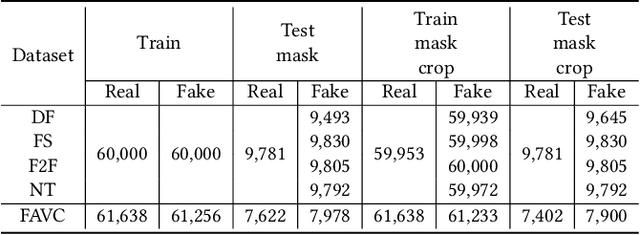
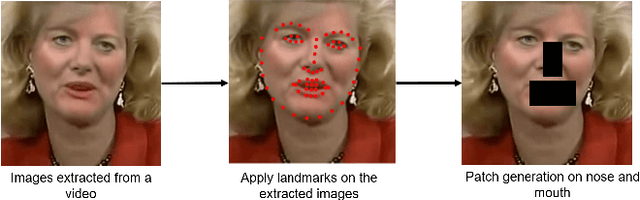
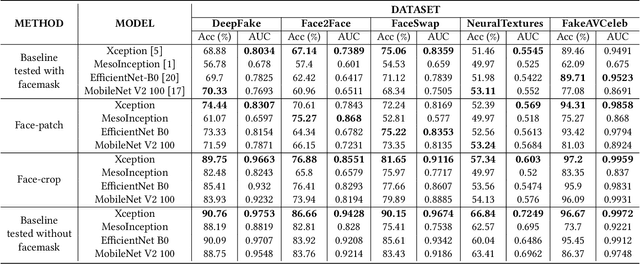
Hyper-realistic face image generation and manipulation have givenrise to numerous unethical social issues, e.g., invasion of privacy,threat of security, and malicious political maneuvering, which re-sulted in the development of recent deepfake detection methodswith the rising demands of deepfake forensics. Proposed deepfakedetection methods to date have shown remarkable detection perfor-mance and robustness. However, none of the suggested deepfakedetection methods assessed the performance of deepfakes withthe facemask during the pandemic crisis after the outbreak of theCovid-19. In this paper, we thoroughly evaluate the performance ofstate-of-the-art deepfake detection models on the deepfakes withthe facemask. Also, we propose two approaches to enhance themasked deepfakes detection:face-patchandface-crop. The experi-mental evaluations on both methods are assessed through the base-line deepfake detection models on the various deepfake datasets.Our extensive experiments show that, among the two methods,face-cropperforms better than theface-patch, and could be a trainmethod for deepfake detection models to detect fake faces withfacemask in real world.
Fast Perception, Planning, and Execution for a Robotic Butler: Wheeled Humanoid M-Hubo
Jan 02, 2020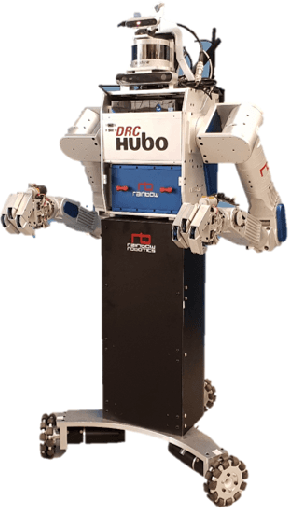
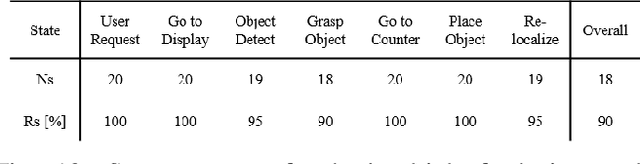
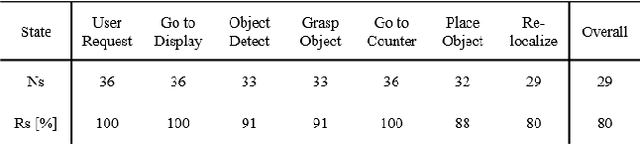
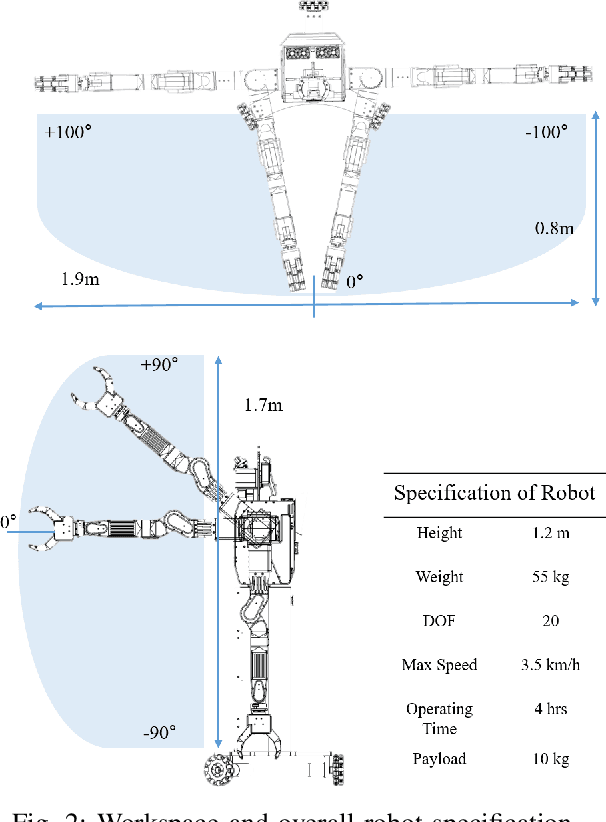
As the aging population grows at a rapid rate, there is an ever growing need for service robot platforms that can provide daily assistance at practical speed with reliable performance. In order to assist with daily tasks such as fetching a beverage, a service robot must be able to perceive its environment and generate corresponding motion trajectories. This becomes a challenging and computationally complex problem when the environment is unknown and thus the path planner must sample numerous trajectories that often are sub-optimal, extending the execution time. To address this issue, we propose a unique strategy of integrating a 3D object detection pipeline with a kinematically optimal manipulation planner to significantly increase speed performance at runtime. In addition, we develop a new robotic butler system for a wheeled humanoid that is capable of fetching requested objects at 24% of the speed a human needs to fulfill the same task. The proposed system was evaluated and demonstrated in a real-world environment setup as well as in public exhibition.