 Add to Chrome
 Add to Firefox
 Add to Edge
Computational Blueprints: Generating Isomorphic Mathematics Problems with Large Language Models
Nov 11, 2025
Personalized mathematics education is growing rapidly, creating a strong demand for large sets of similar practice problems. Yet existing studies on mathematics problem generation have focused on data augmentation for training neural language models rather than on direct educational deployment. To bridge this gap, we define a new task, Isomorphic Math Problem Generation (IMPG), designed to produce structurally consistent variants of source problems. Subsequently, we explored LLM-based frameworks for automatic IMPG through successive refinements, and established Computational Blueprints for Isomorphic Twins (CBIT). With meta-level generation and template-based selective variation, CBIT achieves high mathematical correctness and structural consistency while reducing the cost of generation. Empirical results across refinements demonstrate that CBIT is superior on generation accuracy and cost-effectiveness at scale. Most importantly, CBIT-generated problems exhibited an error rate 17.8% lower than expert-authored items, with deployment to 6,732 learners on a commercial education platform yielding 186,870 interactions.

Leveraging Skill-to-Skill Supervision for Knowledge Tracing
Jun 12, 2023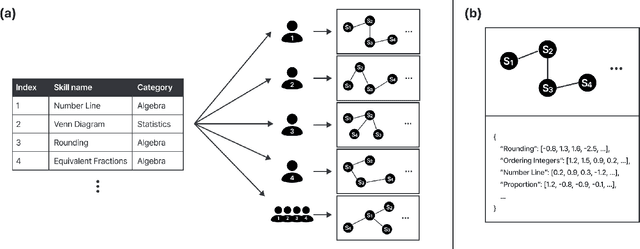


Knowledge tracing plays a pivotal role in intelligent tutoring systems. This task aims to predict the probability of students answering correctly to specific questions. To do so, knowledge tracing systems should trace the knowledge state of the students by utilizing their problem-solving history and knowledge about the problems. Recent advances in knowledge tracing models have enabled better exploitation of problem solving history. However, knowledge about problems has not been studied, as well compared to students' answering histories. Knowledge tracing algorithms that incorporate knowledge directly are important to settings with limited data or cold starts. Therefore, we consider the problem of utilizing skill-to-skill relation to knowledge tracing. In this work, we introduce expert labeled skill-to-skill relationships. Moreover, we also provide novel methods to construct a knowledge-tracing model to leverage human experts' insight regarding relationships between skills. The results of an extensive experimental analysis show that our method outperformed a baseline Transformer model. Furthermore, we found that the extent of our model's superiority was greater in situations with limited data, which allows a smooth cold start of our model.