 Add to Chrome
 Add to Firefox
 Add to Edge
Incorporating rank-free coupling and external field via an amplitude-only modulated spatial photonic Ising machine
Dec 25, 2025
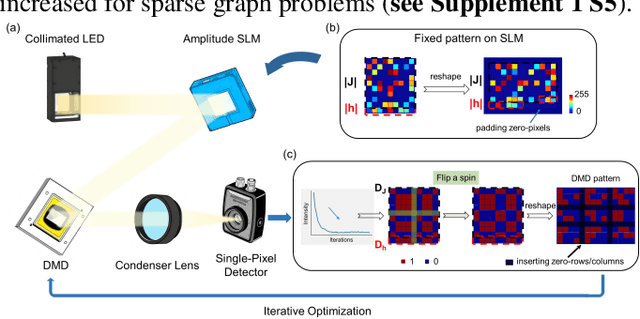
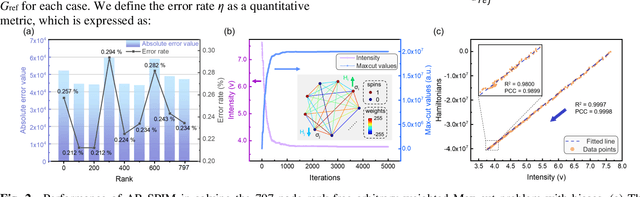
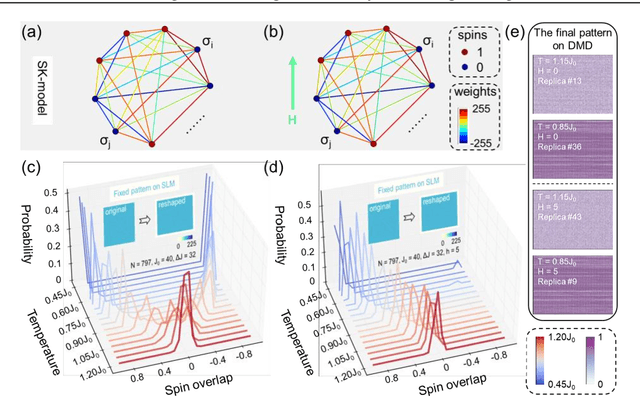
Ising machines have emerged as effective solvers for combinatorial optimization problems, such as NP-hard problems, machine learning, and financial modeling. Recent spatial photonic Ising machines (SPIMs) excel in multi-node optimization and spin glass simulations, leveraging their large-scale and fully connected characteristics. However, existing laser diffraction-based SPIMs usually sacrifice time efficiency or spin count to encode high-rank spin-spin coupling and external fields, limiting their scalability for real-world applications. Here, we demonstrate an amplitude-only modulated rank-free spatial photonic Ising machine (AR-SPIM) with 200 iterations per second. By re-formulating an arbitrary Ising Hamiltonian as the sum of Hadamard products, followed by loading the corresponding matrices/vectors onto an aligned amplitude spatial light modulator and digital micro-mirrors device, we directly map a 797-spin Ising model with external fields (nearly 9-bit precision, -255 to 255) into an incoherent light field, eliminating the need for repeated and auxiliary operations. Serving as encoding accuracy metrics, the linear coefficient of determination and Pearson correlation coefficient between measured light intensities and Ising Hamiltonians exceed 0.9800, with values exceed 0.9997 globally. The AR-SPIM achieves less than 0.3% error rate for ground-state search of biased Max-cut problems with arbitrary ranks and weights, enables complex phase transition observations, and facilitates scalable spin counts for sparse Ising problems via removing zero-valued Hadamard product terms. This reconfigurable AR-SPIM can be further developed to support large-scale machine-learning training and deployed for practical applications in discrete optimization and quantum many-body simulations.

Towards Heisenberg limit without critical slowing down via quantum reinforcement learning
Mar 04, 2025Critical ground states of quantum many-body systems have emerged as vital resources for quantum-enhanced sensing. Traditional methods to prepare these states often rely on adiabatic evolution, which may diminish the quantum sensing advantage. In this work, we propose a quantum reinforcement learning (QRL)-enhanced critical sensing protocol for quantum many-body systems with exotic phase diagrams. Starting from product states and utilizing QRL-discovered gate sequences, we explore sensing accuracy in the presence of unknown external magnetic fields, covering both local and global regimes. Our results demonstrate that QRL-learned sequences reach the finite quantum speed limit and generalize effectively across systems of arbitrary size, ensuring accuracy regardless of preparation time. This method can robustly achieve Heisenberg and super-Heisenberg limits, even in noisy environments with practical Pauli measurements. Our study highlights the efficacy of QRL in enabling precise quantum state preparation, thereby advancing scalable, high-accuracy quantum critical sensing.