 Add to Chrome
 Add to Firefox
 Add to Edge
A cross-modal network for facial expression recognition
May 06, 2026
Deep neural networks enriched with structural information have been widely employed for facial expression recognition tasks. However, these methods often depend on hierarchical information rather than face property to finish expression recognition. In this paper, we propose a cross-modal network with strong biological and structural information for facial expression recognition (CMNet). CMNet can respectively learn expression information via face symmetry on a whole face, left and right half faces to extract complementary facial features. To prevent negative effect of biological and structural information fusion, a salient facial information refinement module can obtain salient facial expression information to improve stability of an obtained facial expression classifier. To reduce reliance on unilateral facial features, a half-face alignment optimization mechanism is designed to align obtained expression information of learned left and right half faces. Our experimental results demonstrate that CMNet outperforms several novel methods, i.e., SCN and LAENet-SA for facial expression recognition. Codes can be obtained at https://github.com/hellloxiaotian/CMNet.

Silent Sabotage During Fine-Tuning: Few-Shot Rationale Poisoning of Compact Medical LLMs
Feb 28, 2026Supervised fine-tuning (SFT) is essential for the development of medical large language models (LLMs), yet prior poisoning studies have mainly focused on the detectable backdoor attacks. We propose a novel poisoning attack targeting the reasoning process of medical LLMs during SFT. Unlike backdoor attacks, our method injects poisoned rationales into few-shot training data, leading to stealthy degradation of model performance on targeted medical topics. Results showed that knowledge overwriting was ineffective, while rationale poisoning caused significant decline on the accuracy of the target subject, as long as no correct samples of the same subject appear in the dataset. A minimum number and ratio of poisoned samples was needed to carry out an effective and stealthy attack, which was more efficient and accurate than catastrophic forgetting. We demonstrate though this study the risk of SFT-stage poisoning, hoping to spur more studies of defense in the sensitive medical domain.
Bridge the Performance Gap in Peak-hour Series Forecasting: The Seq2Peak Framework
Jul 04, 2023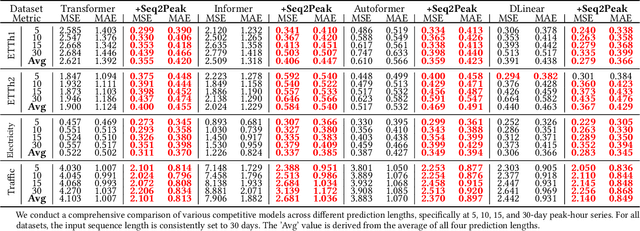

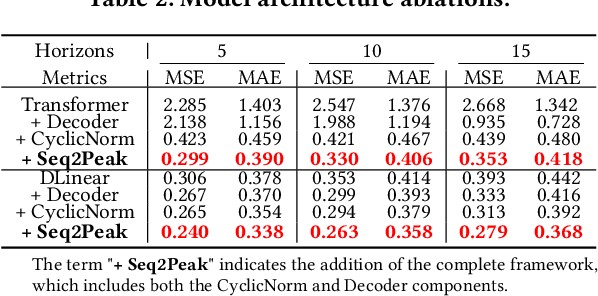
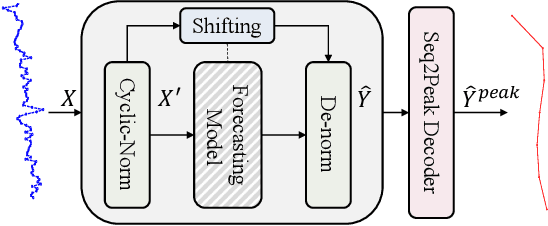
Peak-Hour Series Forecasting (PHSF) is a crucial yet underexplored task in various domains. While state-of-the-art deep learning models excel in regular Time Series Forecasting (TSF), they struggle to achieve comparable results in PHSF. This can be attributed to the challenges posed by the high degree of non-stationarity in peak-hour series, which makes direct forecasting more difficult than standard TSF. Additionally, manually extracting the maximum value from regular forecasting results leads to suboptimal performance due to models minimizing the mean deficit. To address these issues, this paper presents Seq2Peak, a novel framework designed specifically for PHSF tasks, bridging the performance gap observed in TSF models. Seq2Peak offers two key components: the CyclicNorm pipeline to mitigate the non-stationarity issue, and a simple yet effective trainable-parameter-free peak-hour decoder with a hybrid loss function that utilizes both the original series and peak-hour series as supervised signals. Extensive experimentation on publicly available time series datasets demonstrates the effectiveness of the proposed framework, yielding a remarkable average relative improvement of 37.7\% across four real-world datasets for both transformer- and non-transformer-based TSF models.