 Add to Chrome
 Add to Firefox
 Add to Edge
DVAO: Dynamic Variance-adaptive Advantage Optimization for Multi-reward Reinforcement Learning
May 25, 2026
Reinforcement Learning has become a standard paradigm for aligning Large Language Models with human intent and task requirements. While Group Relative Policy Optimization offers an efficient, value-model-free alternative to Proximal Policy Optimization, adapting it to real-world multi-reward settings remains challenging. Standard scalarization practices, such as Reward Combination and Advantage Combination, suffer from significant drawbacks: Reward Combination frequently generates advantages with excessively large squared magnitudes that lead to training instability, while Advantage Combination relies on static hyperparameters and ignores cross-objective correlations. To address these limitations, we propose Dynamic Variance-adaptive Advantage Optimization (DVAO), which dynamically adjusts combination weights based on the empirical reward variance of each objective within a rollout group, effectively up-weighting objectives with a stronger learning signal while suppressing noisy ones. We mathematically prove that DVAO maintains bounded advantage magnitudes for stable training and introduces a self-adaptive cross-objective regularization mechanism. Extensive experiments on mathematical reasoning and tool-use benchmarks using Qwen3 and Qwen2.5 models demonstrate that DVAO significantly outperforms baseline methods, achieving a superior multi-objective Pareto frontier and robust training stability.

AirRAG: Activating Intrinsic Reasoning for Retrieval Augmented Generation via Tree-based Search
Jan 17, 2025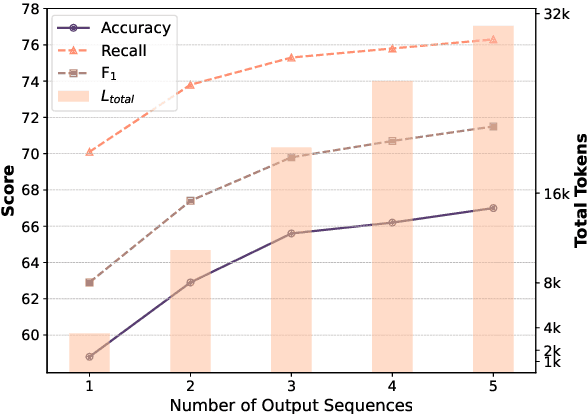

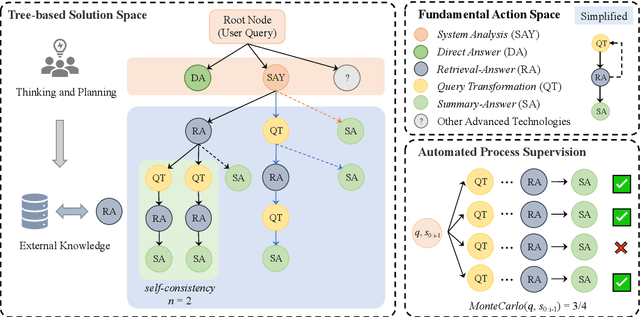
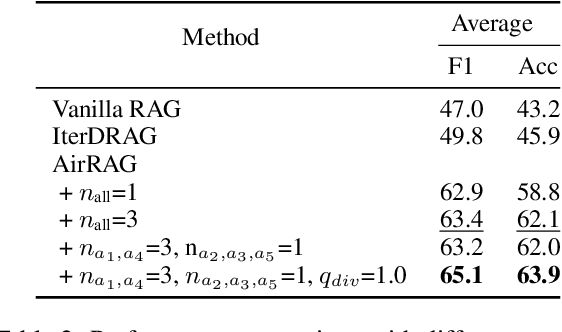
Leveraging the autonomous decision-making capabilities of large language models (LLMs) demonstrates superior performance in reasoning tasks. Despite the successes of iterative or recursive retrieval-augmented generation (RAG), they often are trapped in a single solution space when confronted with complex tasks. In this paper, we propose a novel thinking pattern in RAG which integrates system analysis with efficient reasoning actions, significantly activating intrinsic reasoning capabilities and expanding the solution space of specific tasks via Monte Carlo Tree Search (MCTS), dubbed AirRAG. Specifically, our approach designs five fundamental reasoning actions that are expanded to a wide tree-based reasoning spaces using MCTS. The extension also uses self-consistency verification to explore potential reasoning paths and implement inference scaling. In addition, computationally optimal strategies are used to apply more inference computation to key actions to achieve further performance improvements. Experimental results demonstrate the effectiveness of AirRAG through considerable performance gains over complex QA datasets. Furthermore, AirRAG is flexible and lightweight, making it easy to integrate with other advanced technologies.