 Add to Chrome
 Add to Firefox
 Add to Edge
VulnAgent-X: A Layered Agentic Framework for Repository-Level Vulnerability Detection
Mar 11, 2026
Software vulnerability detection is critical in software en- gineering as security flaws arise from complex interactions across code structure, repository context, and runtime conditions. Existing meth- ods are limited by local code views, one-shot prediction, and insuffi- cient validation, reducing reliability in realistic repository-level settings. This study proposes VulnAgentX, a layered agentic framework integrat- ing lightweight risk screening, bounded context expansion, specialised analysis agents, selective dynamic verification, and evidence fusion into a unified pipeline. Experiments on function-level and just-in-time vul- nerability benchmarks show VulnAgent-X outperforms static baselines, encoder-based models, and simpler agentic variants, with better local- isation and balanced performance-cost trade-offs. Treating vulnerabil- ity detection as a staged, evidence-driven auditing process improves de- tection quality, reduces false positives, and produces interpretable re- sults for repository-level software security analysis. Code is available at https://github.com/xiaolu-666113/Vlun-Agent-X.

Fitting networks with a cancellation trick
Feb 23, 2025
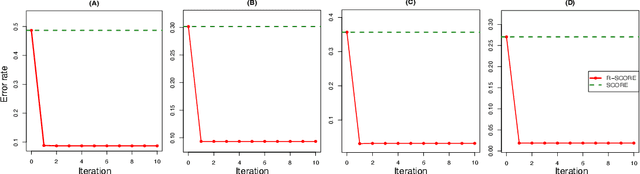
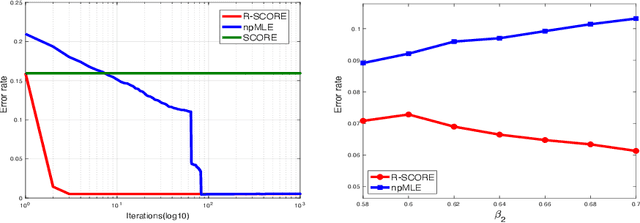
The degree-corrected block model (DCBM), latent space model (LSM), and $\beta$-model are all popular network models. We combine their modeling ideas and propose the logit-DCBM as a new model. Similar as the $\beta$-model and LSM, the logit-DCBM contains nonlinear factors, where fitting the parameters is a challenging open problem. We resolve this problem by introducing a cancellation trick. We also propose R-SCORE as a recursive community detection algorithm, where in each iteration, we first use the idea above to update our parameter estimation, and then use the results to remove the nonlinear factors in the logit-DCBM so the renormalized model approximately satisfies a low-rank model, just like the DCBM. Our numerical study suggests that R-SCORE significantly improves over existing spectral approaches in many cases. Also, theoretically, we show that the Hamming error rate of R-SCORE is faster than that of SCORE in a specific sparse region, and is at least as fast outside this region.
Improved Algorithm and Bounds for Successive Projection
Mar 16, 2024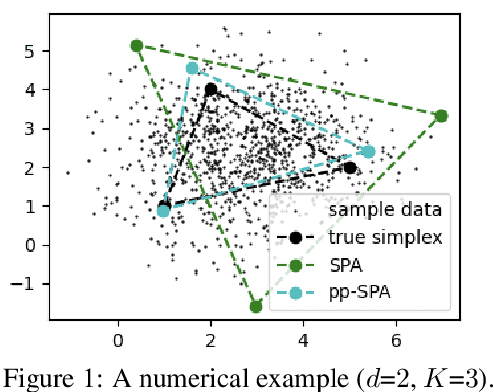

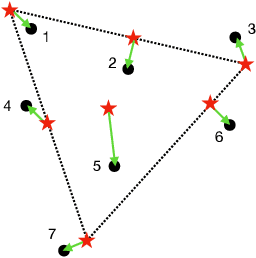
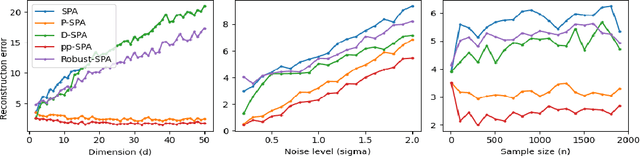
Given a $K$-vertex simplex in a $d$-dimensional space, suppose we measure $n$ points on the simplex with noise (hence, some of the observed points fall outside the simplex). Vertex hunting is the problem of estimating the $K$ vertices of the simplex. A popular vertex hunting algorithm is successive projection algorithm (SPA). However, SPA is observed to perform unsatisfactorily under strong noise or outliers. We propose pseudo-point SPA (pp-SPA). It uses a projection step and a denoise step to generate pseudo-points and feed them into SPA for vertex hunting. We derive error bounds for pp-SPA, leveraging on extreme value theory of (possibly) high-dimensional random vectors. The results suggest that pp-SPA has faster rates and better numerical performances than SPA. Our analysis includes an improved non-asymptotic bound for the original SPA, which is of independent interest.