 Add to Chrome
 Add to Firefox
 Add to Edge
Scale-Aware Relay and Scale-Adaptive Loss for Tiny Object Detection in Aerial Images
Nov 13, 2025
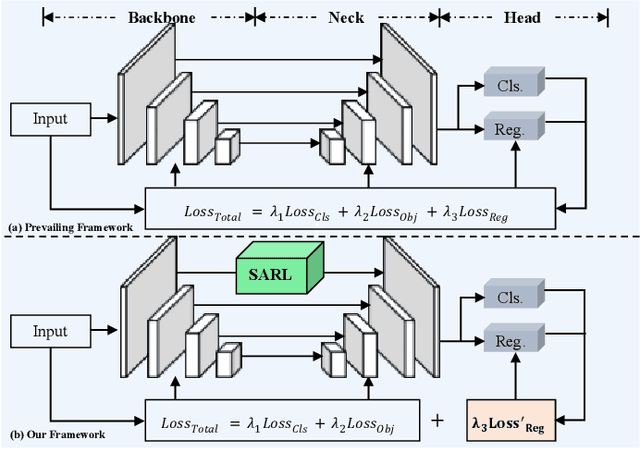
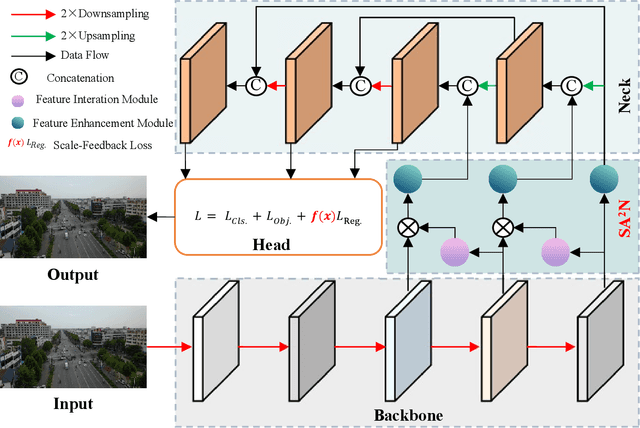
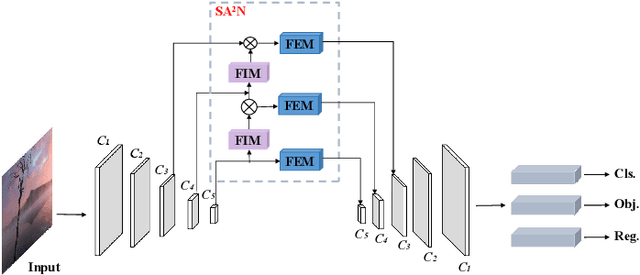
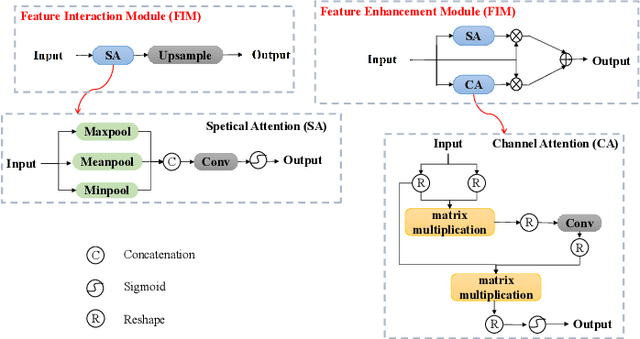
Recently, despite the remarkable advancements in object detection, modern detectors still struggle to detect tiny objects in aerial images. One key reason is that tiny objects carry limited features that are inevitably degraded or lost during long-distance network propagation. Another is that smaller objects receive disproportionately greater regression penalties than larger ones during training. To tackle these issues, we propose a Scale-Aware Relay Layer (SARL) and a Scale-Adaptive Loss (SAL) for tiny object detection, both of which are seamlessly compatible with the top-performing frameworks. Specifically, SARL employs a cross-scale spatial-channel attention to progressively enrich the meaningful features of each layer and strengthen the cross-layer feature sharing. SAL reshapes the vanilla IoU-based losses so as to dynamically assign lower weights to larger objects. This loss is able to focus training on tiny objects while reducing the influence on large objects. Extensive experiments are conducted on three benchmarks (\textit{i.e.,} AI-TOD, DOTA-v2.0 and VisDrone2019), and the results demonstrate that the proposed method boosts the generalization ability by 5.5\% Average Precision (AP) when embedded in YOLOv5 (anchor-based) and YOLOx (anchor-free) baselines. Moreover, it also promotes the robust performance with 29.0\% AP on the real-world noisy dataset (\textit{i.e.,} AI-TOD-v2.0).

Sculpting Margin Penalty: Intra-Task Adapter Merging and Classifier Calibration for Few-Shot Class-Incremental Learning
Aug 07, 2025Real-world applications often face data privacy constraints and high acquisition costs, making the assumption of sufficient training data in incremental tasks unrealistic and leading to significant performance degradation in class-incremental learning. Forward-compatible learning, which prospectively prepares for future tasks during base task training, has emerged as a promising solution for Few-Shot Class-Incremental Learning (FSCIL). However, existing methods still struggle to balance base-class discriminability and new-class generalization. Moreover, limited access to original data during incremental tasks often results in ambiguous inter-class decision boundaries. To address these challenges, we propose SMP (Sculpting Margin Penalty), a novel FSCIL method that strategically integrates margin penalties at different stages within the parameter-efficient fine-tuning paradigm. Specifically, we introduce the Margin-aware Intra-task Adapter Merging (MIAM) mechanism for base task learning. MIAM trains two sets of low-rank adapters with distinct classification losses: one with a margin penalty to enhance base-class discriminability, and the other without margin constraints to promote generalization to future new classes. These adapters are then adaptively merged to improve forward compatibility. For incremental tasks, we propose a Margin Penalty-based Classifier Calibration (MPCC) strategy to refine decision boundaries by fine-tuning classifiers on all seen classes' embeddings with a margin penalty. Extensive experiments on CIFAR100, ImageNet-R, and CUB200 demonstrate that SMP achieves state-of-the-art performance in FSCIL while maintaining a better balance between base and new classes.