 Add to Chrome
 Add to Firefox
 Add to Edge
CORE: Robust Out-of-Distribution Detection via Confidence and Orthogonal Residual Scoring
Mar 18, 2026
Out-of-distribution (OOD) detection is essential for deploying deep learning models reliably, yet no single method performs consistently across architectures and datasets -- a scorer that leads on one benchmark often falters on another. We attribute this inconsistency to a shared structural limitation: logit-based methods see only the classifier's confidence signal, while feature-based methods attempt to measure membership in the training distribution but do so in the full feature space where confidence and membership are entangled, inheriting architecture-sensitive failure modes. We observe that penultimate features naturally decompose into two orthogonal subspaces: a classifier-aligned component encoding confidence, and a residual the classifier discards. We discover that this residual carries a class-specific directional signature for in-distribution data -- a membership signal invisible to logit-based methods and entangled with noise in feature-based methods. We propose CORE (COnfidence + REsidual), which disentangles the two signals by scoring each subspace independently and combines them via normalized summation. Because the two signals are orthogonal by construction, their failure modes are approximately independent, producing robust detection where either view alone is unreliable. CORE achieves competitive or state-of-the-art performance across five architectures and five benchmark configurations, ranking first in three of five settings and achieving the highest grand average AUROC with negligible computational overhead.

Tracking the Discriminative Axis: Dual Prototypes for Test-Time OOD Detection Under Covariate Shift
Mar 17, 2026For reliable deployment of deep-learning systems, out-of-distribution (OOD) detection is indispensable. In the real world, where test-time inputs often arrive as streaming mixtures of in-distribution (ID) and OOD samples under evolving covariate shifts, OOD samples are domain-constrained and bounded by the environment, and both ID and OOD are jointly affected by the same covariate factors. Existing methods typically assume a stationary ID distribution, but this assumption breaks down in such settings, leading to severe performance degradation. We empirically discover that, even under covariate shift, covariate-shifted ID (csID) and OOD (csOOD) samples remain separable along a discriminative axis in feature space. Building on this observation, we propose DART, a test-time, online OOD detection method that dynamically tracks dual prototypes -- one for ID and the other for OOD -- to recover the drifting discriminative axis, augmented with multi-layer fusion and flip correction for robustness. Extensive experiments on a wide range of challenging benchmarks, where all datasets are subjected to 15 common corruption types at severity level 5, demonstrate that our method significantly improves performance, yielding 15.32 percentage points (pp) AUROC gain and 49.15 pp FPR@95TPR reduction on ImageNet-C vs. Textures-C compared to established baselines. These results highlight the potential of the test-time discriminative axis tracking for dependable OOD detection in dynamically changing environments.
ALERT Open Dataset and Input-Size-Agnostic Vision Transformer for Driver Activity Recognition using IR-UWB
Dec 13, 2025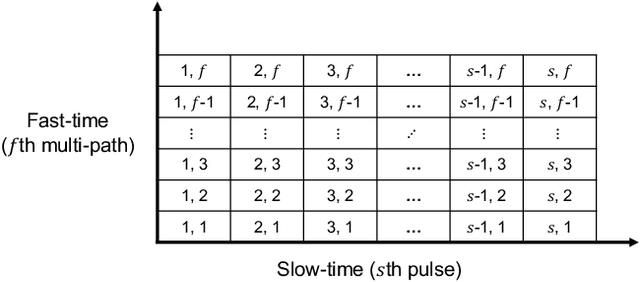
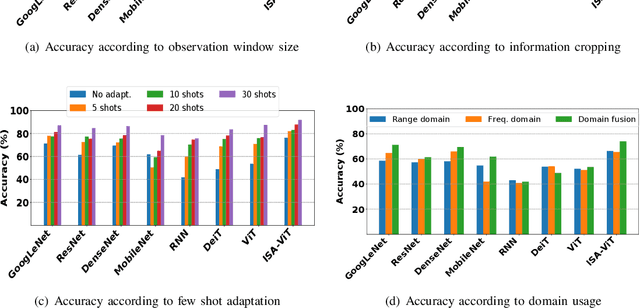
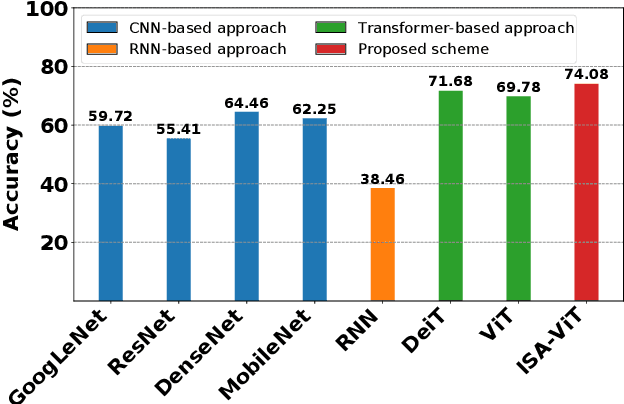
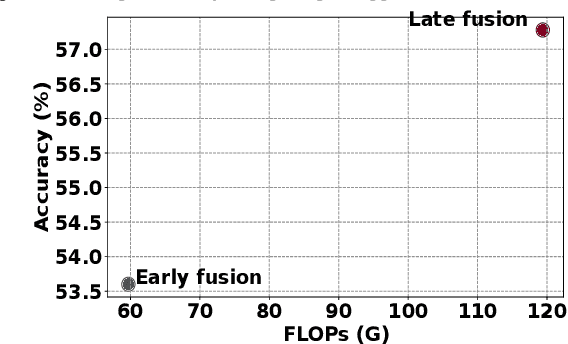
Distracted driving contributes to fatal crashes worldwide. To address this, researchers are using driver activity recognition (DAR) with impulse radio ultra-wideband (IR-UWB) radar, which offers advantages such as interference resistance, low power consumption, and privacy preservation. However, two challenges limit its adoption: the lack of large-scale real-world UWB datasets covering diverse distracted driving behaviors, and the difficulty of adapting fixed-input Vision Transformers (ViTs) to UWB radar data with non-standard dimensions. This work addresses both challenges. We present the ALERT dataset, which contains 10,220 radar samples of seven distracted driving activities collected in real driving conditions. We also propose the input-size-agnostic Vision Transformer (ISA-ViT), a framework designed for radar-based DAR. The proposed method resizes UWB data to meet ViT input requirements while preserving radar-specific information such as Doppler shifts and phase characteristics. By adjusting patch configurations and leveraging pre-trained positional embedding vectors (PEVs), ISA-ViT overcomes the limitations of naive resizing approaches. In addition, a domain fusion strategy combines range- and frequency-domain features to further improve classification performance. Comprehensive experiments demonstrate that ISA-ViT achieves a 22.68% accuracy improvement over an existing ViT-based approach for UWB-based DAR. By publicly releasing the ALERT dataset and detailing our input-size-agnostic strategy, this work facilitates the development of more robust and scalable distracted driving detection systems for real-world deployment.