 Add to Chrome
 Add to Firefox
 Add to Edge
A Metalens-based Bicycle Safety Reflector for Autonomous Vehicle Radars
May 21, 2026
With the rising number of interactions between autonomous or sensor-assisted vehicles -- especially in poor weather conditions -- come the need and opportunity for a new class of bicycle safety reflectors designed to enhance cyclist visibility to radars. To this effect, the first retrodirective planar metalens-based tag operating in the millimeter-wave automotive frequency range is proposed. The compact, lightweight ($0.61~\mathrm{g}$) design consists of two layers: a metalens layer and a patch antenna pixel layer. The metalens focuses incoming plane waves from different incidence angles onto corresponding patch antenna pixels on the second layer, which re-radiate the signal back through the metalens, enabling retrodirective operation. The proposed tag was thoroughly evaluated, demonstrating reliable detection beyond 70 m and a peak monostatic radar cross section (RCS) of $3.54~\mathrm{dBsm}$ with stable retrodirectivity over $\pm 40^\circ$, providing an average gain improvement of $7.58~\mathrm{dB}$ and an RCS enhancement of $15.16~\mathrm{dB}$ relative to a lens-less reference. A realistic deployment scenario on a metallic bicycle demonstrated up to a 110x improvement in its detectability at broadside. These results highlight the potential of the proposed passive tag to operate as a low-cost, lightweight, and easily integrable bicycle safety reflector for next-generation autonomous vehicle radar systems.

3D Self-Localization of Drones using a Single Millimeter-Wave Anchor
Oct 12, 2023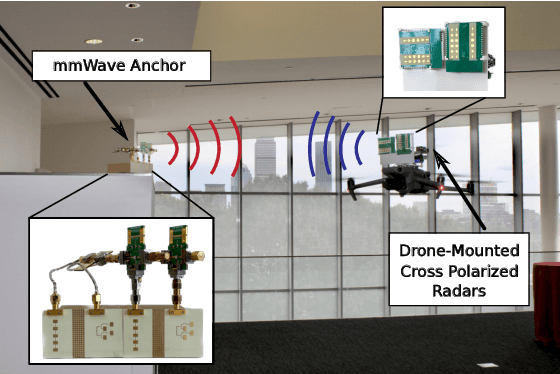
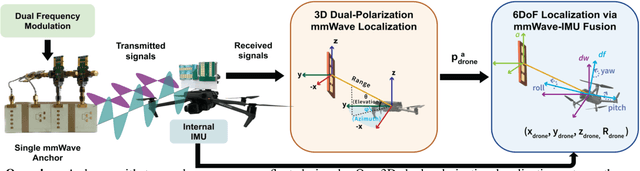
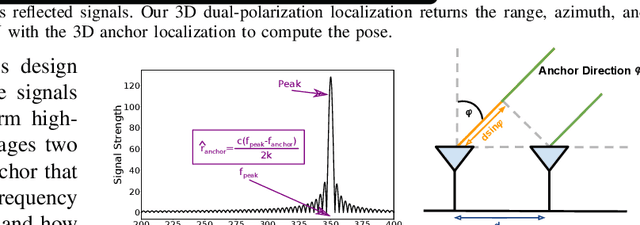
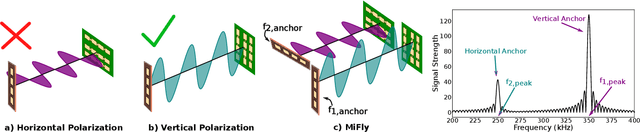
We present the design, implementation, and evaluation of MiFly, a self-localization system for autonomous drones that works across indoor and outdoor environments, including low-visibility, dark, and GPS-denied settings. MiFly performs 6DoF self-localization by leveraging a single millimeter-wave (mmWave) anchor in its vicinity - even if that anchor is visually occluded. MmWave signals are used in radar and 5G systems and can operate in the dark and through occlusions. MiFly introduces a new mmWave anchor design and mounts light-weight high-resolution mmWave radars on a drone. By jointly designing the localization algorithms and the novel low-power mmWave anchor hardware (including its polarization and modulation), the drone is capable of high-speed 3D localization. Furthermore, by intelligently fusing the location estimates from its mmWave radars and its IMUs, it can accurately and robustly track its 6DoF trajectory. We implemented and evaluated MiFly on a DJI drone. We demonstrate a median localization error of 7cm and a 90th percentile less than 15cm, even when the anchor is fully occluded (visually) from the drone.