 Add to Chrome
 Add to Firefox
 Add to Edge
Setup-Independent Full Projector Compensation
Apr 02, 2026
Projector compensation seeks to correct geometric and photometric distortions that occur when images are projected onto nonplanar or textured surfaces. However, most existing methods are highly setup-dependent, requiring fine-tuning or retraining whenever the surface, lighting, or projector-camera pose changes. Progress has been limited by two key challenges: (1) the absence of large, diverse training datasets and (2) existing geometric correction models are typically constrained by specific spatial setups; without further retraining or fine-tuning, they often fail to generalize directly to novel geometric configurations. We introduce SIComp, the first Setup-Independent framework for full projector Compensation, capable of generalizing to unseen setups without fine-tuning or retraining. To enable this, we construct a large-scale real-world dataset spanning 277 distinct projector-camera setups. SIComp adopts a co-adaptive design that decouples geometry and photometry: A carefully tailored optical flow module performs online geometric correction, while a novel photometric network handles photometric compensation. To further enhance robustness under varying illumination, we integrate intensity-varying surface priors into the network design. Extensive experiments demonstrate that SIComp consistently produces high-quality compensation across diverse unseen setups, substantially outperforming existing methods in terms of generalization ability and establishing the first generalizable solution to projector compensation. The code and dataset are available on our project page: https://hai-bo-li.github.io/SIComp/

DPCS: Path Tracing-Based Differentiable Projector-Camera Systems
Mar 15, 2025Projector-camera systems (ProCams) simulation aims to model the physical project-and-capture process and associated scene parameters of a ProCams, and is crucial for spatial augmented reality (SAR) applications such as ProCams relighting and projector compensation. Recent advances use an end-to-end neural network to learn the project-and-capture process. However, these neural network-based methods often implicitly encapsulate scene parameters, such as surface material, gamma, and white balance in the network parameters, and are less interpretable and hard for novel scene simulation. Moreover, neural networks usually learn the indirect illumination implicitly in an image-to-image translation way which leads to poor performance in simulating complex projection effects such as soft-shadow and interreflection. In this paper, we introduce a novel path tracing-based differentiable projector-camera systems (DPCS), offering a differentiable ProCams simulation method that explicitly integrates multi-bounce path tracing. Our DPCS models the physical project-and-capture process using differentiable physically-based rendering (PBR), enabling the scene parameters to be explicitly decoupled and learned using much fewer samples. Moreover, our physically-based method not only enables high-quality downstream ProCams tasks, such as ProCams relighting and projector compensation, but also allows novel scene simulation using the learned scene parameters. In experiments, DPCS demonstrates clear advantages over previous approaches in ProCams simulation, offering better interpretability, more efficient handling of complex interreflection and shadow, and requiring fewer training samples.
GS-ProCams: Gaussian Splatting-based Projector-Camera Systems
Dec 16, 2024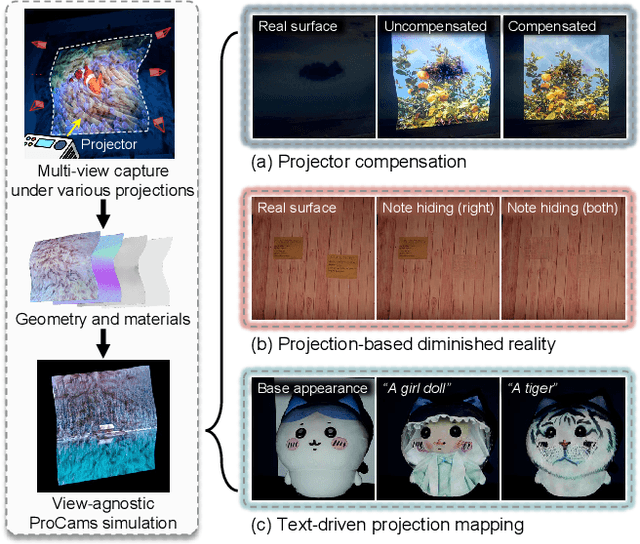

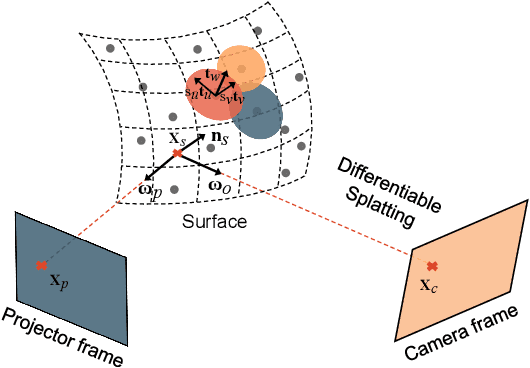
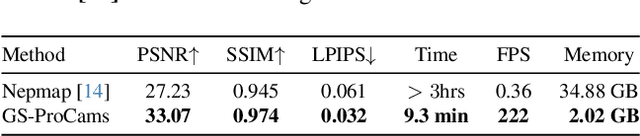
We present GS-ProCams, the first Gaussian Splatting-based framework for projector-camera systems (ProCams). GS-ProCams significantly enhances the efficiency of projection mapping (PM) that requires establishing geometric and radiometric mappings between the projector and the camera. Previous CNN-based ProCams are constrained to a specific viewpoint, limiting their applicability to novel perspectives. In contrast, NeRF-based ProCams support view-agnostic projection mapping, however, they require an additional colocated light source and demand significant computational and memory resources. To address this issue, we propose GS-ProCams that employs 2D Gaussian for scene representations, and enables efficient view-agnostic ProCams applications. In particular, we explicitly model the complex geometric and photometric mappings of ProCams using projector responses, the target surface's geometry and materials represented by Gaussians, and global illumination component. Then, we employ differentiable physically-based rendering to jointly estimate them from captured multi-view projections. Compared to state-of-the-art NeRF-based methods, our GS-ProCams eliminates the need for additional devices, achieving superior ProCams simulation quality. It is also 600 times faster and uses only 1/10 of the GPU memory.