 Add to Chrome
 Add to Firefox
 Add to Edge
Ontology-Based Knowledge Graph Framework for Industrial Standard Documents via Hierarchical and Propositional Structuring
Dec 22, 2025
Ontology-based knowledge graph (KG) construction is a core technology that enables multidimensional understanding and advanced reasoning over domain knowledge. Industrial standards, in particular, contain extensive technical information and complex rules presented in highly structured formats that combine tables, scopes of application, constraints, exceptions, and numerical calculations, making KG construction especially challenging. In this study, we propose a method that organizes such documents into a hierarchical semantic structure, decomposes sentences and tables into atomic propositions derived from conditional and numerical rules, and integrates them into an ontology-knowledge graph through LLM-based triple extraction. Our approach captures both the hierarchical and logical structures of documents, effectively representing domain-specific semantics that conventional methods fail to reflect. To verify its effectiveness, we constructed rule, table, and multi-hop QA datasets, as well as a toxic clause detection dataset, from industrial standards, and implemented an ontology-aware KG-RAG framework for comparative evaluation. Experimental results show that our method achieves significant performance improvements across all QA types compared to existing KG-RAG approaches. This study demonstrates that reliable and scalable knowledge representation is feasible even for industrial documents with intertwined conditions, constraints, and scopes, contributing to future domain-specific RAG development and intelligent document management.

A Scalable Unsupervised Framework for multi-aspect labeling of Multilingual and Multi-Domain Review Data
May 14, 2025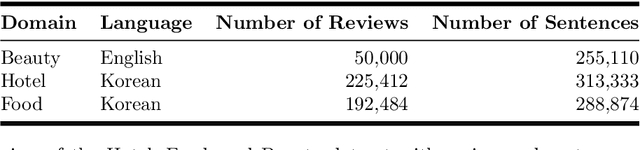

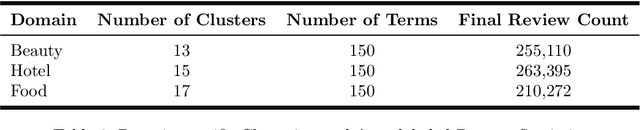

Effectively analyzing online review data is essential across industries. However, many existing studies are limited to specific domains and languages or depend on supervised learning approaches that require large-scale labeled datasets. To address these limitations, we propose a multilingual, scalable, and unsupervised framework for cross-domain aspect detection. This framework is designed for multi-aspect labeling of multilingual and multi-domain review data. In this study, we apply automatic labeling to Korean and English review datasets spanning various domains and assess the quality of the generated labels through extensive experiments. Aspect category candidates are first extracted through clustering, and each review is then represented as an aspect-aware embedding vector using negative sampling. To evaluate the framework, we conduct multi-aspect labeling and fine-tune several pretrained language models to measure the effectiveness of the automatically generated labels. Results show that these models achieve high performance, demonstrating that the labels are suitable for training. Furthermore, comparisons with publicly available large language models highlight the framework's superior consistency and scalability when processing large-scale data. A human evaluation also confirms that the quality of the automatic labels is comparable to those created manually. This study demonstrates the potential of a robust multi-aspect labeling approach that overcomes limitations of supervised methods and is adaptable to multilingual, multi-domain environments. Future research will explore automatic review summarization and the integration of artificial intelligence agents to further improve the efficiency and depth of review analysis.