 Add to Chrome
 Add to Firefox
 Add to Edge
Physics-Informed Chebyshev Polynomial Neural Operator for Parametric Partial Differential Equations
Feb 02, 2026
Neural operators have emerged as powerful deep learning frameworks for approximating solution operators of parameterized partial differential equations (PDE). However, current methods predominantly rely on multilayer perceptrons (MLPs) for mapping inputs to solutions, which impairs training robustness in physics-informed settings due to inherent spectral biases and fixed activation functions. To overcome the architectural limitations, we introduce the Physics-Informed Chebyshev Polynomial Neural Operator (CPNO), a novel mesh-free framework that leverages a basis transformation to replace unstable monomial expansions with the numerically stable Chebyshev spectral basis. By integrating parameter dependent modulation mechanism to main net, CPNO constructs PDE solutions in a near-optimal functional space, decoupling the model from MLP-specific constraints and enhancing multi-scale representation. Theoretical analysis demonstrates the Chebyshev basis's near-minimax uniform approximation properties and superior conditioning, with Lebesgue constants growing logarithmically with degree, thereby mitigating spectral bias and ensuring stable gradient flow during optimization. Numerical experiments on benchmark parameterized PDEs show that CPNO achieves superior accuracy, faster convergence, and enhanced robustness to hyperparameters. The experiment of transonic airfoil flow has demonstrated the capability of CPNO in characterizing complex geometric problems.

Joint Range and Doppler Adaptive Processing for CBM based DFRC systems
Jul 22, 2021
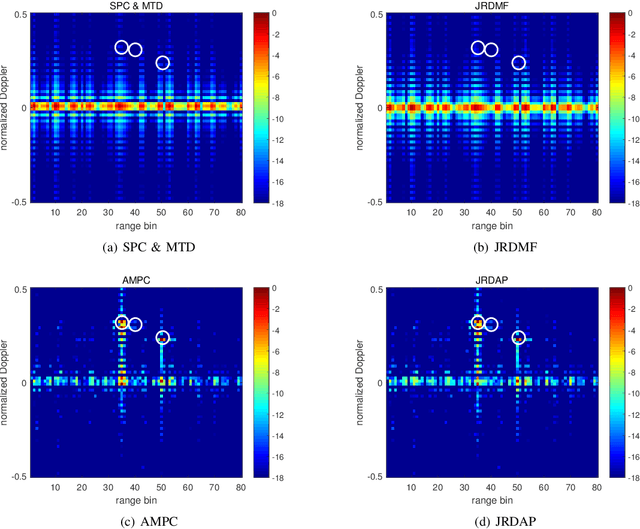
Recently, dual-function radar communication (DFRC) systems have been proposed to integrate radar and communication into one platform for spectrum sharing. Various signalling strategies have been proposed to embed communication information into the radar transmitted waveforms. Among these, complex beampattern modulation (CBM) embeds communication information into the complex transmit beampattens via changing the amplitude and phase of the beampatterns towards the communication receiver. The embedding of random communication information causes the clutter modulation and high range-Doppler sidelobe. What's more, transmitting different waveforms on a pulse to pulse basis degrades the radar target detection capacity when traditional sequential pulse compression (SPC) and moving-target detection (MTD) is utilized. In this paper, a minimum mean square error (MMSE) based filter, denoted as joint range and Doppler adaptive processing (JRDAP) is proposed. The proposed method estimates the targets' impulse response coefficients at each range-Doppler cell adaptively to suppress high range-Doppler sidelobe and clutter modulation. The performance of proposed method is very close to the full-dimension adaptive multiple pulses compression (AMPC) while reducing computational complexity greatly.
Beampattern and Robust Doppler Filter Design for Spatial Modulation Based Joint RadCom Systems
May 20, 2021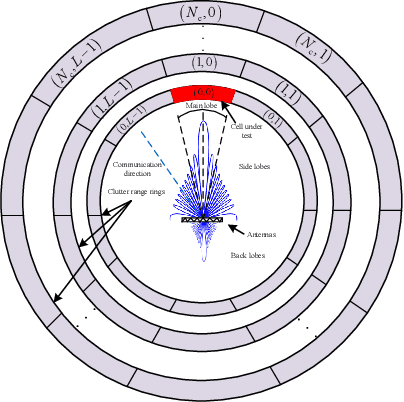
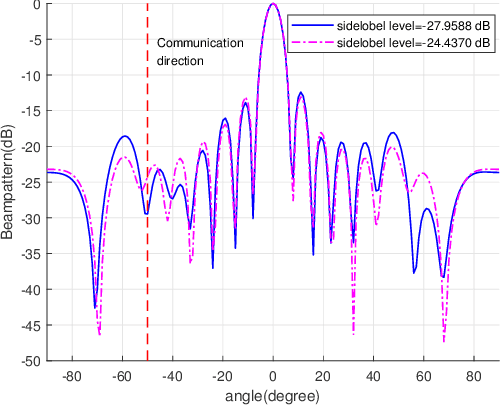
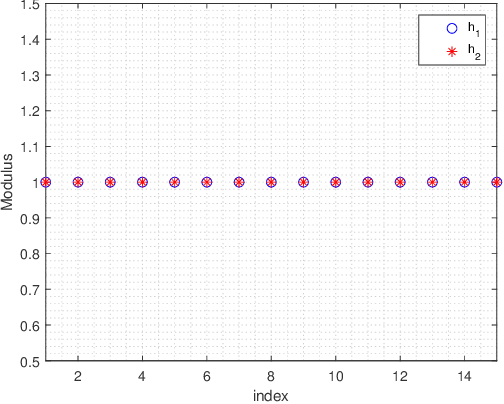
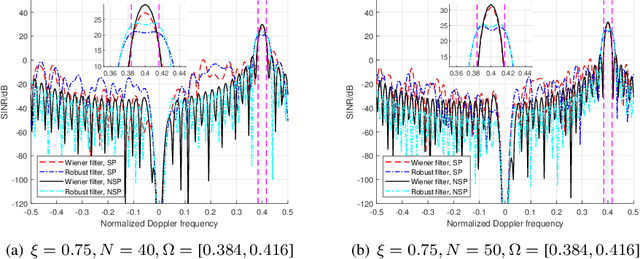
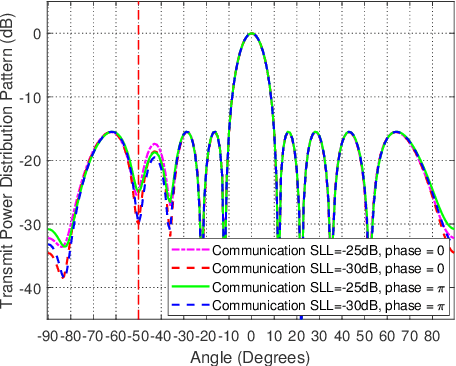
Joint radar and communication (RadCom) systems have been proposed to achieve the spectrum sharing between radar and communication in recent years. However, the joint RadCom systems cause the clutter modulation and the performance degradation of both radar and communication. As a consequence, it's very critical to improve the performance of both radar and communication when designing joint RadCom systems. Firstly, this paper designs the constant modulus dual function waveforms for spatial modulation based joint RadCom systems. In order to solve the nonsmooth and nonconvex optimization problem, we propose a method based on alternating direction method of multipliers (ADMM) to obtain a suboptimal solution. Secondly, this paper analyses the effect of beampattern variation on clutter modulation for spatial modulation based joint RadCom systems. Besides, this paper considers the design of robust doppler filter for joint RadCom systems when the receive temporal steering vector is mismatched to the desired temporal steering vector. This paper aims to maximize the worst signal-to-interference-plus-noise-ratio (SINR) of the doppler filter in the specific doppler interval under the similarity constraint and constant white noise gain constraint. In order to solve the nonconvex optimization problem, we relax the original optimization problem to a semidefinite programming (SDP), which is convex and can be solved using off-the-shelf optimization solvers. What's more, the rank-one decomposition method is utilized to synthesize the weight vector of the proposed robust doppler filter. Finally, lots of simulation results are presented to show the robustness of the designed doppler filter.
Clutter Mitigation for Joint RadCom Systems Based On Spatial Modulation
May 16, 2021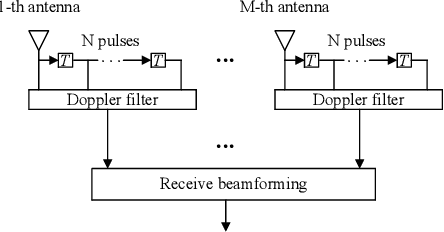
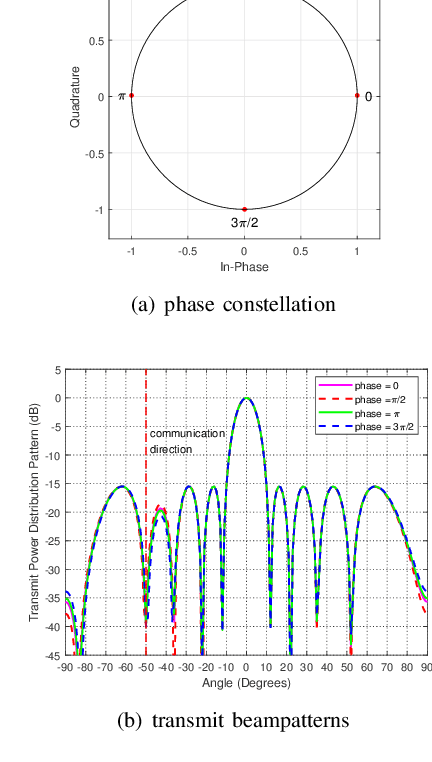
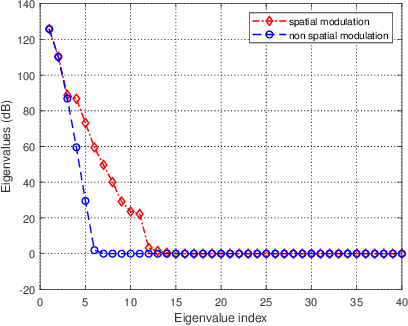
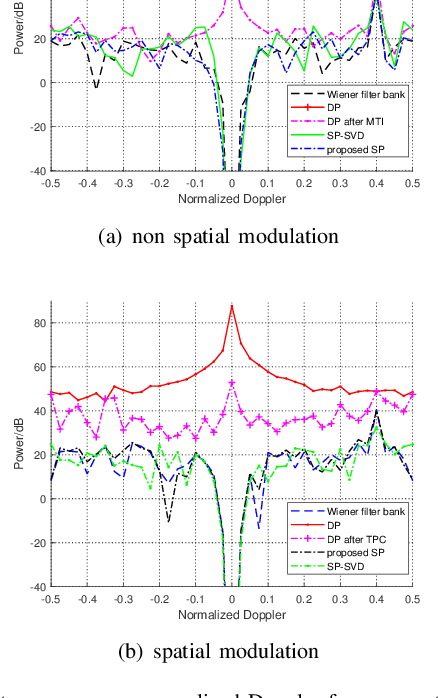
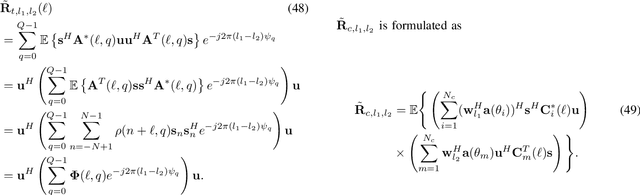
Joint radar and communication (RadCom) systems have been proposed to integrate radar and communication into one platform and achieve spectrum sharing in recent years. However, the joint RadCom systems cause the clutter modulation and the performance degradation of radar. Therefore, it's very essential to improve the performance of radar when designing joint RadCom systems. This paper deals with the clutter mitigation for joint RadCom systems based on spatial modulation. The communication information embedding introduces variation of transmit beampatterns in a coherent processing interval (CPI) and causes the clutter modulation and spreading of the clutter spectrum. This paper propose a reduced dimension spatial temporal adaptive processing (RD-STAP) method, i.e., we firstly perform time domain filtering and then perform spatial domain filtering on received data. As for time domain filtering, this paper mitigates the extended clutter by subspace projection (SP) and proposes a more effective eigen-decomposition algorithm based on Power method than singular value decomposition (SVD) to obtain clutter subspace basis vectors. And the matched filter is performed on the data after clutter mitigation to display the moving target. And receive beamforming is utilized for spatial domain filtering. Simulation results highlight the effectiveness of the proposed RD-STAP method and the eigen-decomposition algorithm.