 Add to Chrome
 Add to Firefox
 Add to Edge
Avoiding Non-Integrable Beliefs in Expectation Propagation
Apr 05, 2026
Expectation Propagation (EP) is a widely used iterative message-passing algorithm that decomposes a global inference problem into multiple local ones. It approximates marginal distributions as ``beliefs'' using intermediate functions called ``messages''. It has been shown that the stationary points of EP are the same as corresponding constrained Bethe Free Energy (BFE) optimization problem. Therefore, EP is an iterative method of optimizing the constrained BFE. However, the iterative method may fall out of the feasible set of the BFE optimization problem, i.e., the beliefs are not integrable. In most literature, the authors use various methods to keep all the messages integrable. In most Bayesian estimation problems, limiting the messages to be integrable shrinks the actual feasible set. Furthermore, in extreme cases where the factors are not integrable, making the message itself integrable is not enough to have integrable beliefs. In this paper, two EP frameworks are proposed to ensure that EP has integrable beliefs. Both of the methods allows non-integrable messages. We then investigate the signal recovery problem in Generalized Linear Model (GLM) using our proposed methods.

FashionPose: Text to Pose to Relight Image Generation for Personalized Fashion Visualization
Jul 17, 2025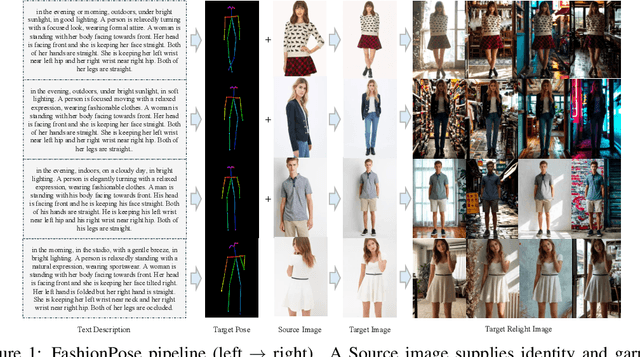
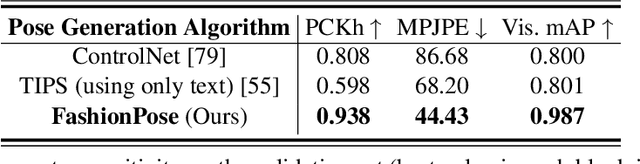
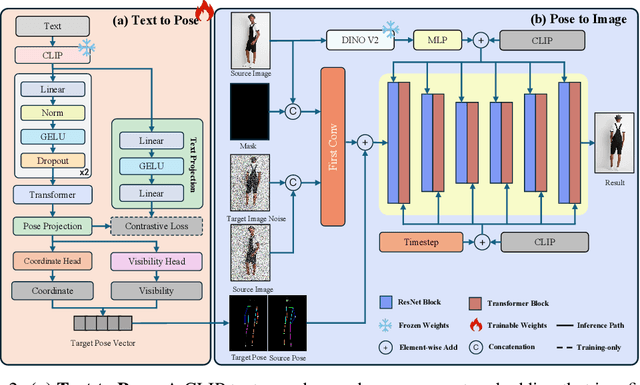
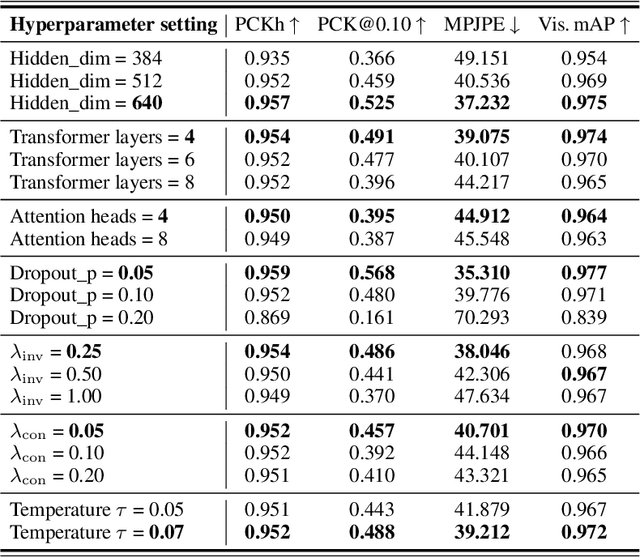
Realistic and controllable garment visualization is critical for fashion e-commerce, where users expect personalized previews under diverse poses and lighting conditions. Existing methods often rely on predefined poses, limiting semantic flexibility and illumination adaptability. To address this, we introduce FashionPose, the first unified text-to-pose-to-relighting generation framework. Given a natural language description, our method first predicts a 2D human pose, then employs a diffusion model to generate high-fidelity person images, and finally applies a lightweight relighting module, all guided by the same textual input. By replacing explicit pose annotations with text-driven conditioning, FashionPose enables accurate pose alignment, faithful garment rendering, and flexible lighting control. Experiments demonstrate fine-grained pose synthesis and efficient, consistent relighting, providing a practical solution for personalized virtual fashion display.
Model-aided Federated Reinforcement Learning for Multi-UAV Trajectory Planning in IoT Networks
Jun 03, 2023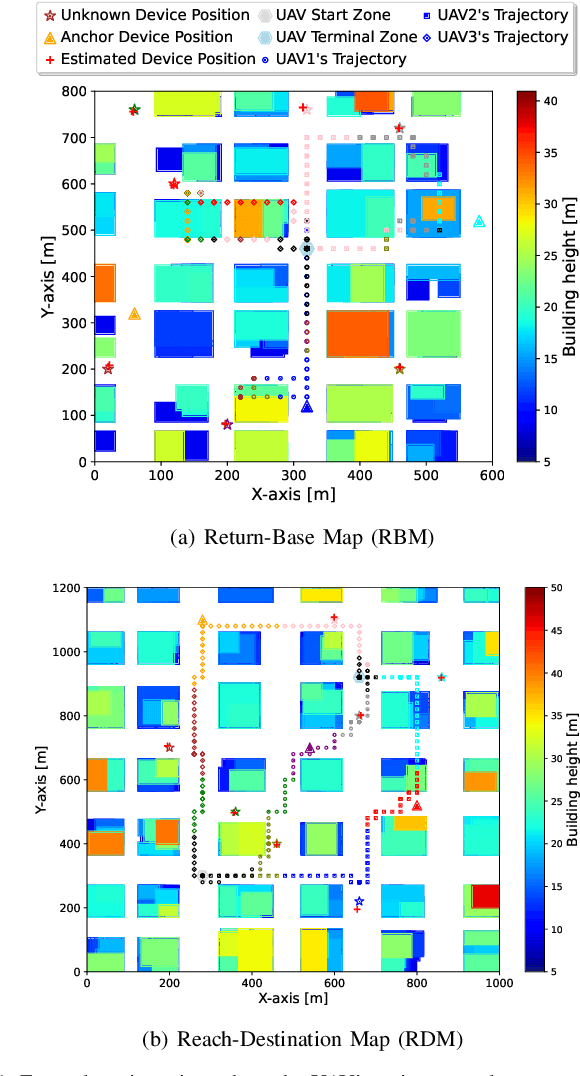
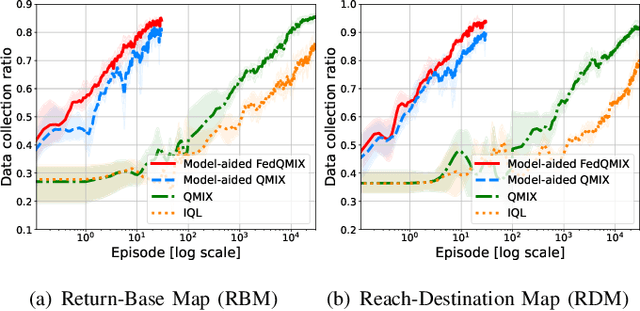
Deploying teams of cooperative unmanned aerial vehicles (UAVs) to harvest data from distributed Internet of Things (IoT) devices requires efficient trajectory planning and coordination algorithms. Multi-agent reinforcement learning (MARL) has emerged as an effective solution, but often requires extensive and costly real-world training data. In this paper, we propose a novel model-aided federated MARL algorithm to coordinate multiple UAVs on a data harvesting mission with limited knowledge about the environment, significantly reducing the real-world training data demand. The proposed algorithm alternates between learning an environment model from real-world measurements and federated QMIX training in the simulated environment. Specifically, collected measurements from the real-world environment are used to learn the radio channel and estimate unknown IoT device locations to create a simulated environment. Each UAV agent trains a local QMIX model in its simulated environment and continuously consolidates it through federated learning with other agents, accelerating the learning process and further improving training sample efficiency. Simulation results demonstrate that our proposed model-aided FedQMIX algorithm substantially reduces the need for real-world training experiences while attaining similar data collection performance as standard MARL algorithms.