 Add to Chrome
 Add to Firefox
 Add to Edge
Distributed Image Compression with Multimodal Side Information at Extremely Low Bitrates
May 21, 2026
Distributed Image Compression (DIC) is crucial for multi-view transmission, especially when operating at extremely low bitrates (< 0.1 bpp). Its core challenge is effectively utilizing side information to achieve high-quality reconstruction under strict bitrate budgets. However, existing DIC approaches struggle to exploit global context and object-level details from side information, leading to local blurring and the loss of fine details in the reconstruction. To address these limitations, we propose a Multimodal DIC framework (MDIC), which, for the first time, leverages side information in a multimodal manner into the DIC paradigm, effectively preserving fine-grained local details and enhancing global perceptual quality in reconstructed images. Specifically, we introduce a text-to-image diffusion-based decoder conditioned on textual side information extracted from correlated images to capture shared global semantics. Moreover, we design a feature-mask generator, supervised by a multimodal fine-grained alignment task, to strengthen the exploitation of visual side information. The generated mask serves two purposes: first, it guides the extraction of fine-grained details from losslessly transmitted side information to preserve the semantic consistency of reconstructed details; second, it regulates the extraction of clustered feature representations from the quantized VQ-VAE embeddings, compensating for category information lost under the extreme compression of the primary image. Extensive experiments on the widely used KITTI Stereo and Cityscapes datasets demonstrate that MDIC achieves state-of-the-art perceptual quality at extremely low bitrates.

Known Meets Unknown: Mitigating Overconfidence in Open Set Recognition
Nov 15, 2025Open Set Recognition (OSR) requires models not only to accurately classify known classes but also to effectively reject unknown samples. However, when unknown samples are semantically similar to known classes, inter-class overlap in the feature space often causes models to assign unjustifiably high confidence to them, leading to misclassification as known classes -- a phenomenon known as overconfidence. This overconfidence undermines OSR by blurring the decision boundary between known and unknown classes. To address this issue, we propose a framework that explicitly mitigates overconfidence caused by inter-class overlap. The framework consists of two components: a perturbation-based uncertainty estimation module, which applies controllable parameter perturbations to generate diverse predictions and quantify predictive uncertainty, and an unknown detection module with distinct learning-based classifiers, implemented as a two-stage procedure, which leverages the estimated uncertainty to improve discrimination between known and unknown classes, thereby enhancing OSR performance. Experimental results on three public datasets show that the proposed framework achieves superior performance over existing OSR methods.
Using Context Information to Enhance Simple Question Answering
Apr 27, 2019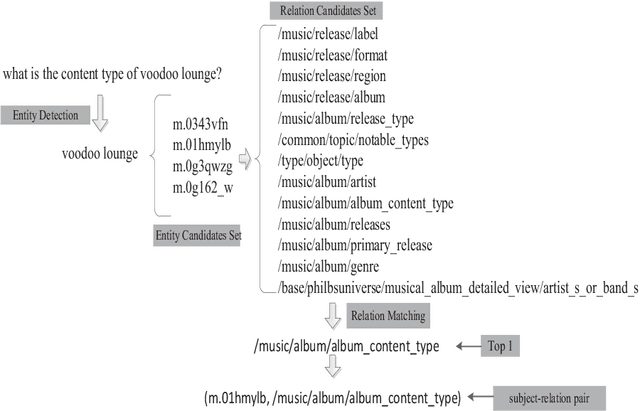
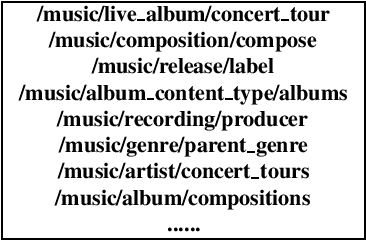
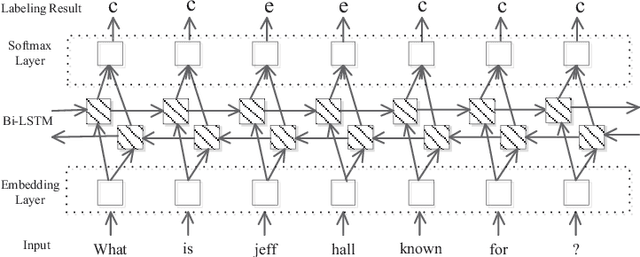
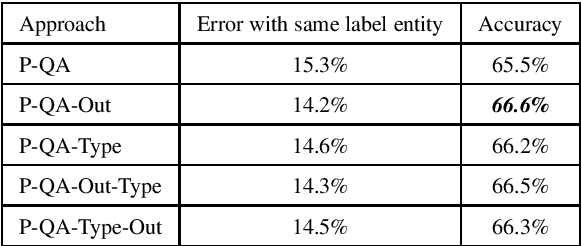
With the rapid development of knowledge bases(KBs),question answering(QA)based on KBs has become a hot research issue. In this paper,we propose two frameworks(i.e.,pipeline framework,an end-to-end framework)to focus answering single-relation factoid question. In both of two frameworks,we study the effect of context information on the quality of QA,such as the entity's notable type,out-degree. In the end-to-end framework,we combine char-level encoding and self-attention mechanisms,using weight sharing and multi-task strategies to enhance the accuracy of QA. Experimental results show that context information can get better results of simple QA whether it is the pipeline framework or the end-to-end framework. In addition,we find that the end-to-end framework achieves results competitive with state-of-the-art approaches in terms of accuracy and take much shorter time than them.