 Add to Chrome
 Add to Firefox
 Add to Edge
Video2Sim2Real: Full-Stack Autonomous Dexterous Skill Acquisition from a Single Human Video
Jun 07, 2026
Human manipulation videos are a convenient and intuitive source for robot learning. However, directly transferring human dexterity to robots remains challenging due to perception errors and embodiment gap. To address this, we introduce Video2Sim2Real, a full-stack framework for autonomous skill acquisition from a single human manipulation video. Our framework first uses off-the-shelf foundation models to reconstruct a simulator-ready digital twin and extract robot and object motion priors. Rather than treating the extracted robot motion as a reliable reference throughout execution, our key idea is to recover and leverage the most fundamental sources of supervision from the demonstrated skill: We identify object-centric keyframes to optimize the corresponding robot configurations using object information from the simulator, and use these configurations as anchors that refine the robot motion such that it ultimately has the desired impact on the environment. To bridge the remaining sim-to-real gap, we introduce a sim-to-real strategy that decouples robustness to noisy and incomplete perception from variations in hand-object interaction dynamics. Specifically, we learn to recalibrate robot configurations from noisy real-world point clouds via IL, and leverage residual RL to perform local finger-level adaptations to ensure for robust and effective interactions. Finally, a collision-aware motion planning module enables spatial generalization to novel object configurations. Across several everyday manipulation tasks, Video2Sim2Real improves simulated task success, safety, and trajectory coherence over numerous baselines, and achieves better sim-to-real transfer than existing techniques. These results demonstrate a promising path toward autonomous dexterous skill acquisition from human videos.

Evolutionary Morphology Towards Overconstrained Locomotion via Large-Scale, Multi-Terrain Deep Reinforcement Learning
Jul 01, 2024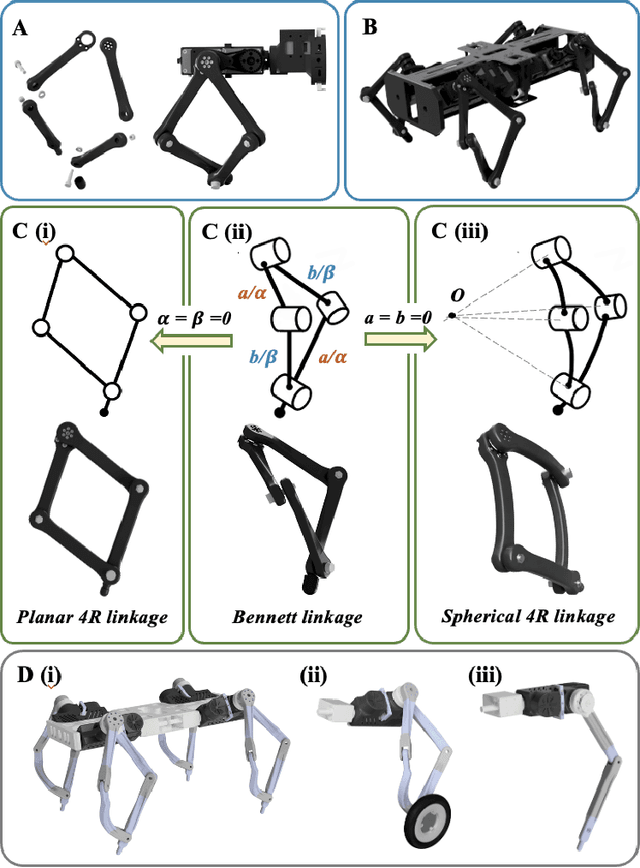
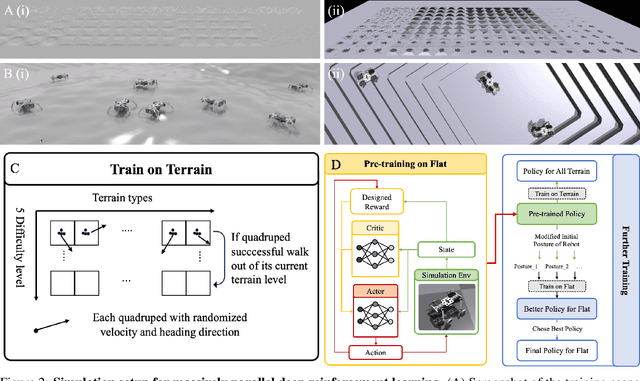
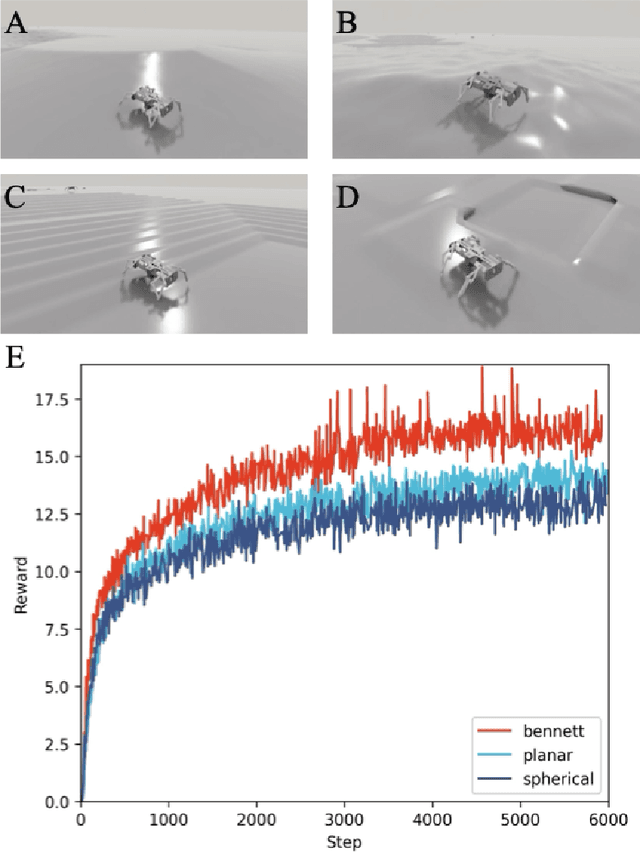
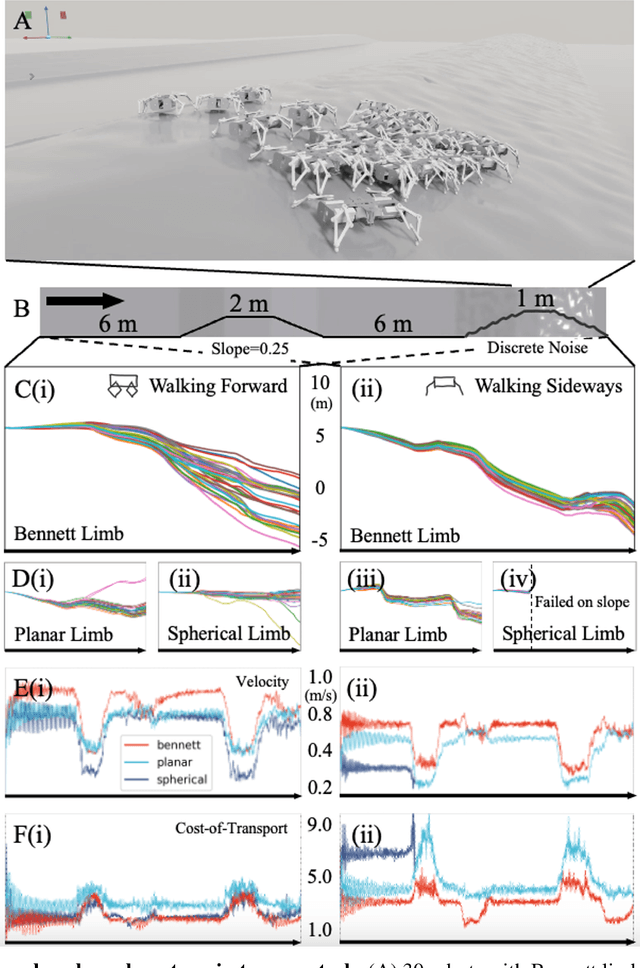
While the animals' Fin-to-Limb evolution has been well-researched in biology, such morphological transformation remains under-adopted in the modern design of advanced robotic limbs. This paper investigates a novel class of overconstrained locomotion from a design and learning perspective inspired by evolutionary morphology, aiming to integrate the concept of `intelligent design under constraints' - hereafter referred to as constraint-driven design intelligence - in developing modern robotic limbs with superior energy efficiency. We propose a 3D-printable design of robotic limbs parametrically reconfigurable as a classical planar 4-bar linkage, an overconstrained Bennett linkage, and a spherical 4-bar linkage. These limbs adopt a co-axial actuation, identical to the modern legged robot platforms, with the added capability of upgrading into a wheel-legged system. Then, we implemented a large-scale, multi-terrain deep reinforcement learning framework to train these reconfigurable limbs for a comparative analysis of overconstrained locomotion in energy efficiency. Results show that the overconstrained limbs exhibit more efficient locomotion than planar limbs during forward and sideways walking over different terrains, including floors, slopes, and stairs, with or without random noises, by saving at least 22% mechanical energy in completing the traverse task, with the spherical limbs being the least efficient. It also achieves the highest average speed of 0.85 meters per second on flat terrain, which is 20% faster than the planar limbs. This study paves the path for an exciting direction for future research in overconstrained robotics leveraging evolutionary morphology and reconfigurable mechanism intelligence when combined with state-of-the-art methods in deep reinforcement learning.