 Add to Chrome
 Add to Firefox
 Add to Edge
Time-varying Interaction Graph ODE for Dynamic Graph Representation Learning
Apr 27, 2026
Graph neural Ordinary Differential Equations (ODE) combine neural ODE with the message passing mechanism of Graph Neural Networks (GNN), providing a continuous-time modeling method for graph representation learning. However, in dynamic graph scenarios, existing graph neural ODEs typically employ a unified message passing mechanism, assuming that inter-node interactions share the same message passing function at any time, which makes it challenging to capture the diversity and time-varying nature of inter-node interaction patterns. To address this, we propose Time-varying Interaction Graph Ordinary Differential Equations (TI-ODE). The core idea of TI-ODE is to decompose the evolution function of a graph ODE into a set of learnable interaction basis functions, where each basis function corresponds to a distinct type of inter-node interaction. These basis functions are dynamically combined through time-dependent learnable weights, enabling inter-node interaction patterns to adaptively evolve over time. Experimental results on six dynamic graph datasets demonstrate that TI-ODE consistently outperforms existing methods and achieves state-of-the-art performance on attribute prediction tasks, and experiments on the \textit{Covid} dataset further verify the interpretability and generalizability of our TI-ODE. Furthermore, we demonstrate both theoretically and empirically that TI-ODE exhibits superior robustness compared to models utilizing a unified message-passing mechanism.

GNN-Transformer Cooperative Architecture for Trustworthy Graph Contrastive Learning
Dec 24, 2024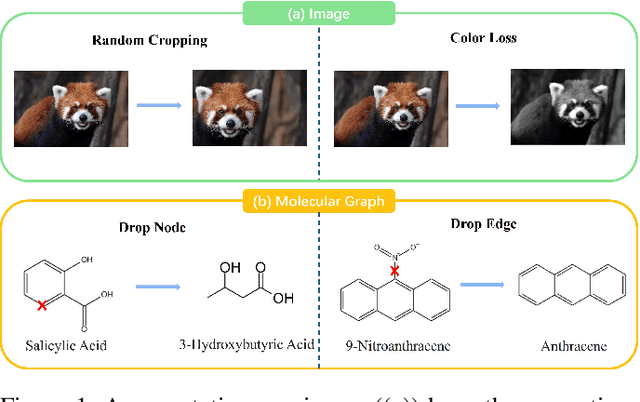
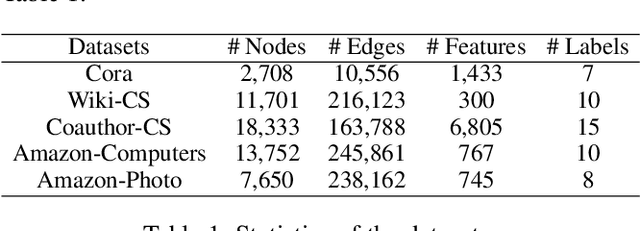
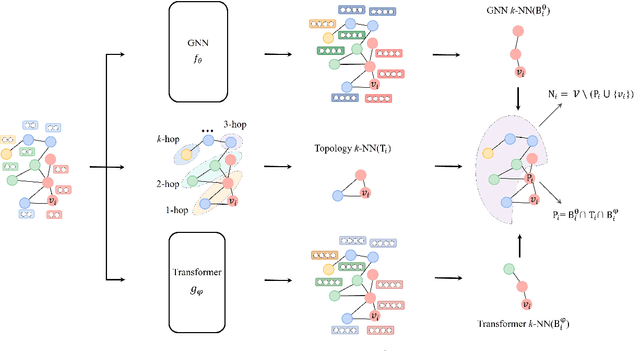
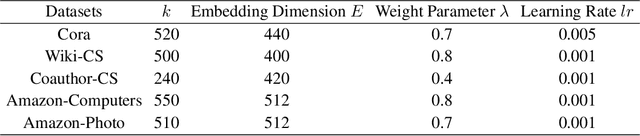
Graph contrastive learning (GCL) has become a hot topic in the field of graph representation learning. In contrast to traditional supervised learning relying on a large number of labels, GCL exploits augmentation strategies to generate multiple views and positive/negative pairs, both of which greatly influence the performance. Unfortunately, commonly used random augmentations may disturb the underlying semantics of graphs. Moreover, traditional GNNs, a type of widely employed encoders in GCL, are inevitably confronted with over-smoothing and over-squashing problems. To address these issues, we propose GNN-Transformer Cooperative Architecture for Trustworthy Graph Contrastive Learning (GTCA), which inherits the advantages of both GNN and Transformer, incorporating graph topology to obtain comprehensive graph representations. Theoretical analysis verifies the trustworthiness of the proposed method. Extensive experiments on benchmark datasets demonstrate state-of-the-art empirical performance.
Graph External Attention Enhanced Transformer
Jun 03, 2024The Transformer architecture has recently gained considerable attention in the field of graph representation learning, as it naturally overcomes several limitations of Graph Neural Networks (GNNs) with customized attention mechanisms or positional and structural encodings. Despite making some progress, existing works tend to overlook external information of graphs, specifically the correlation between graphs. Intuitively, graphs with similar structures should have similar representations. Therefore, we propose Graph External Attention (GEA) -- a novel attention mechanism that leverages multiple external node/edge key-value units to capture inter-graph correlations implicitly. On this basis, we design an effective architecture called Graph External Attention Enhanced Transformer (GEAET), which integrates local structure and global interaction information for more comprehensive graph representations. Extensive experiments on benchmark datasets demonstrate that GEAET achieves state-of-the-art empirical performance. The source code is available for reproducibility at: https://github.com/icm1018/GEAET.