 Add to Chrome
 Add to Firefox
 Add to Edge
ESOM: Efficiently Understanding Streaming Video Anomalies with Open-world Dynamic Definitions
Apr 09, 2026
Open-world video anomaly detection (OWVAD) aims to detect and explain abnormal events under different anomaly definitions, which is important for applications such as intelligent surveillance and live-streaming content moderation. Recent MLLM-based methods have shown promising open-world generalization, but still suffer from three major limitations: inefficiency for practical deployment, lack of streaming processing adaptation, and limited support for dynamic anomaly definitions in both modeling and evaluation. To address these issues, this paper proposes ESOM, an efficient streaming OWVAD model that operates in a training-free manner. ESOM includes a Definition Normalization module to structure user prompts for reducing hallucination, an Inter-frame-matched Intra-frame Token Merging module to compress redundant visual tokens, a Hybrid Streaming Memory module for efficient causal inference, and a Probabilistic Scoring module that converts interval-level textual outputs into frame-level anomaly scores. In addition, this paper introduces OpenDef-Bench, a new benchmark with clean surveillance videos and diverse natural anomaly definitions for evaluating performance under varying conditions. Extensive experiments show that ESOM achieves real-time efficiency on a single GPU and state-of-the-art performance in anomaly temporal localization, classification, and description generation. The code and benchmark will be released at https://github.com/Kamino666/ESOM_OpenDef-Bench.

Language-guided Open-world Video Anomaly Detection
Mar 17, 2025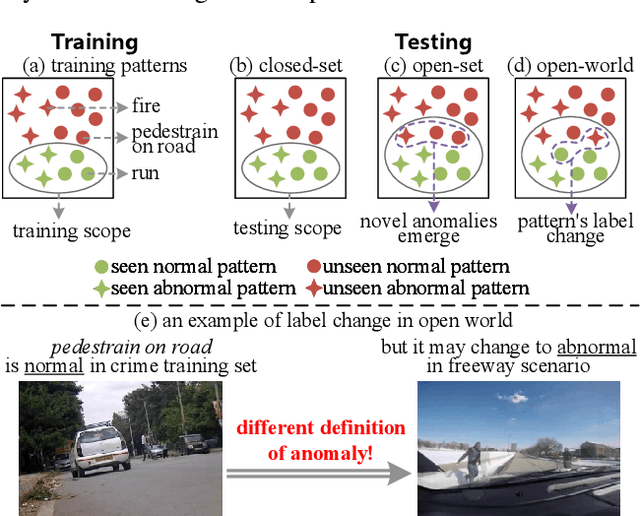
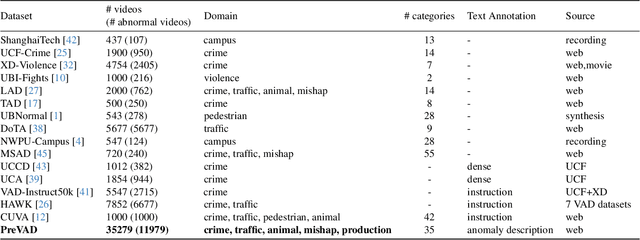
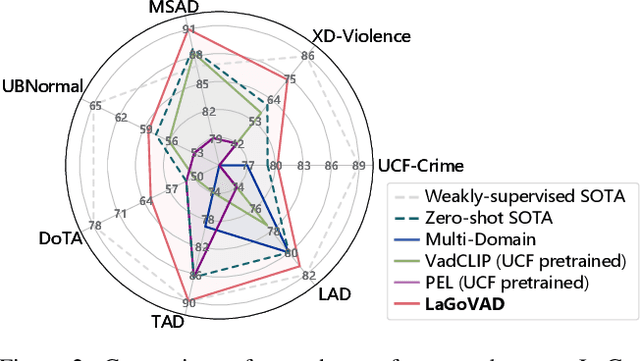
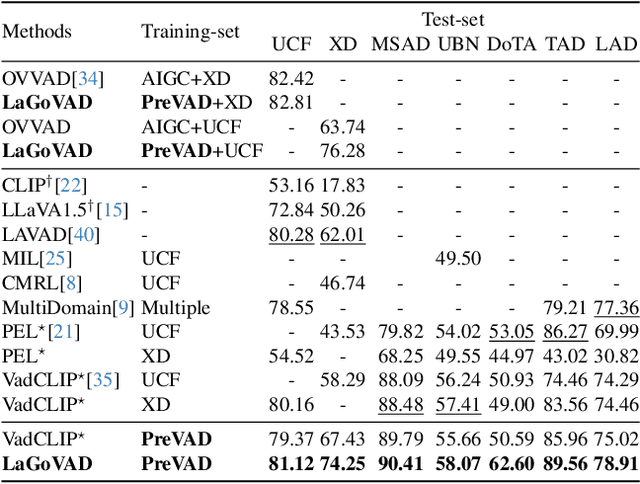
Video anomaly detection models aim to detect anomalies that deviate from what is expected. In open-world scenarios, the expected events may change as requirements change. For example, not wearing a mask is considered abnormal during a flu outbreak but normal otherwise. However, existing methods assume that the definition of anomalies is invariable, and thus are not applicable to the open world. To address this, we propose a novel open-world VAD paradigm with variable definitions, allowing guided detection through user-provided natural language at inference time. This paradigm necessitates establishing a robust mapping from video and textual definition to anomaly score. Therefore, we propose LaGoVAD (Language-guided Open-world VAD), a model that dynamically adapts anomaly definitions through two regularization strategies: diversifying the relative durations of anomalies via dynamic video synthesis, and enhancing feature robustness through contrastive learning with negative mining. Training such adaptable models requires diverse anomaly definitions, but existing datasets typically provide given labels without semantic descriptions. To bridge this gap, we collect PreVAD (Pre-training Video Anomaly Dataset), the largest and most diverse video anomaly dataset to date, featuring 35,279 annotated videos with multi-level category labels and descriptions that explicitly define anomalies. Zero-shot experiments on seven datasets demonstrate SOTA performance. Data and code will be released.