 Add to Chrome
 Add to Firefox
 Add to Edge
Hamiltonian Graph Inference Networks: Joint structure discovery and dynamics prediction for lattice Hamiltonian systems from trajectory data
Apr 26, 2026
Lattice Hamiltonian systems underpin models across condensed matter, nonlinear optics, and biophysics, yet learning their dynamics from data is obstructed by two unknowns: the interaction topology and whether node dynamics are homogeneous. Existing graph-based approaches either assume the graph is given or, as in $α$-separable graph Hamiltonian network, infer it only for separable Hamiltonians with homogeneous node dynamics. We introduce the Hamiltonian Graph Inference Network (HGIN), which jointly recovers the interaction graph and predicts long-time trajectories from state data alone, for both separable and non-separable Hamiltonians and under heterogeneous node dynamics. HGIN couples a structure-learning module -- a learnable weighted adjacency matrix trained under a Hamilton's-equations loss -- with a trajectory-prediction module that partitions edges into physically distinct subgraphs via $k$-means clustering, assigning each subgraph its own encoder and thereby breaking the parameter-sharing bottleneck of conventional GNNs. On three benchmarks -- a Klein--Gordon lattice with long-range interactions and two discrete nonlinear Schrödinger lattices (homogeneous and heterogeneous) -- HGIN reduces long-time energy prediction error and trajectory prediction error by six to thirteen orders of magnitude relative to baselines. A symmetry argument on the Hamiltonian loss further shows that the learned weights encode the parity of the underlying pair potential, yielding an interpretable readout of the system's interaction structure.

Graph Attention Hamiltonian Neural Networks: A Lattice System Analysis Model Based on Structural Learning
Dec 14, 2024A deep understanding of the intricate interactions between particles within a system is a key approach to revealing the essential characteristics of the system, whether it is an in-depth analysis of molecular properties in the field of chemistry or the design of new materials for specific performance requirements in materials science. To this end, we propose Graph Attention Hamiltonian Neural Network (GAHN), a neural network method that can understand the underlying structure of lattice Hamiltonian systems solely through the dynamic trajectories of particles. We can determine which particles in the system interact with each other, the proportion of interactions between different particles, and whether the potential energy of interactions between particles exhibits even symmetry or not. The obtained structure helps the neural network model to continue predicting the trajectory of the system and further understand the dynamic properties of the system. In addition to understanding the underlying structure of the system, it can be used for detecting lattice structural abnormalities, such as link defects, abnormal interactions, etc. These insights benefit system optimization, design, and detection of aging or damage. Moreover, this approach can integrate other components to deduce the link structure needed for specific parts, showcasing its scalability and potential. We tested it on a challenging molecular dynamics dataset, and the results proved its ability to accurately infer molecular bond connectivity, highlighting its scientific research potential.
Analysis of the Spatio-temporal Dynamics of COVID-19 in Massachusetts via Spectral Graph Wavelet Theory
Jul 28, 2022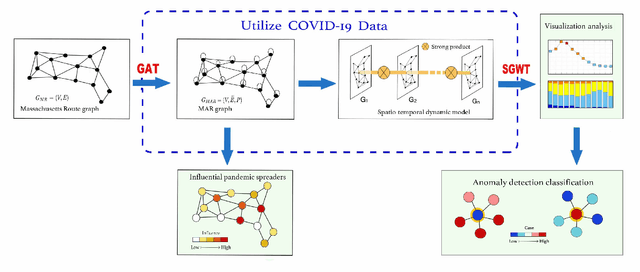
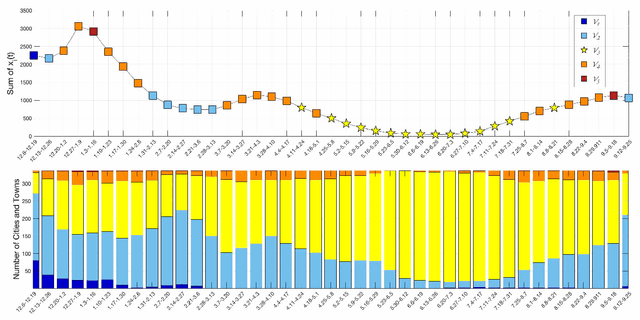
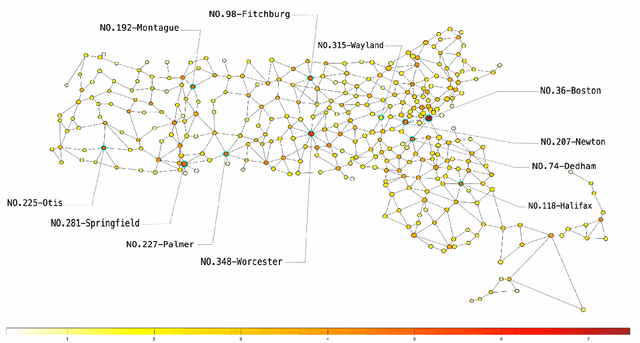
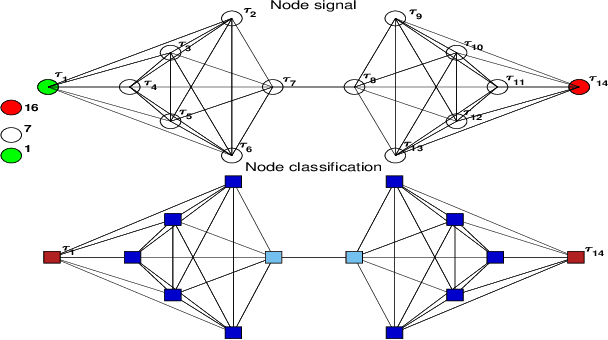
The rapid spread of COVID-19 disease has had a significant impact on the world. In this paper, we study COVID-19 data interpretation and visualization using open-data sources for 351 cities and towns in Massachusetts from December 6, 2020 to September 25, 2021. Because cities are embedded in rather complex transportation networks, we construct the spatio-temporal dynamic graph model, in which the graph attention neural network is utilized as a deep learning method to learn the pandemic transition probability among major cities in Massachusetts. Using the spectral graph wavelet transform (SGWT), we process the COVID-19 data on the dynamic graph, which enables us to design effective tools to analyze and detect spatio-temporal patterns in the pandemic spreading. We design a new node classification method, which effectively identifies the anomaly cities based on spectral graph wavelet coefficients. It can assist administrations or public health organizations in monitoring the spread of the pandemic and developing preventive measures. Unlike most work focusing on the evolution of confirmed cases over time, we focus on the spatio-temporal patterns of pandemic evolution among cities. Through the data analysis and visualization, a better understanding of the epidemiological development at the city level is obtained and can be helpful with city-specific surveillance.