 Add to Chrome
 Add to Firefox
 Add to Edge
Entity-Faithful Repair of Synthetic Supervision for Zero-Shot Image Captioning
Aug 02, 2026
Zero-shot image captioning aims to generate image descriptions without annotated image-text pairs. Recent approaches exploit text-to-image models to synthesize training data from text-only corpora, but most focus on improving overall data quality. In contrast, we observe that synthetic image-text misalignment is often structured and fine-grained: pairs may remain globally plausible while containing missing entities or misgrounded attributes, thereby degrading supervision fidelity. As a result, methods based on global similarity for image rematching or regeneration may improve apparent plausibility, but cannot systematically repair entity-level misalignment. To address this issue, we propose ReCap, a plug-and-play framework that shifts synthetic data refinement from implicit global matching to explicit fine-grained realignment. Specifically, ReCap enforces entity-level correspondence by using detected image-supported entities to guide caption rewriting, yielding more faithful synthetic supervision. In addition, we introduce an adaptive dynamic weighted learning strategy to downweight unreliable synthetic pairs during training. As a general framework, ReCap can be integrated into existing synthetic-data pipelines. Extensive experiments show that ReCap consistently improves image-text consistency and achieves state-of-the-art performance on both in-domain and cross-domain zero-shot image captioning benchmarks.

BEV Lane Det: Fast Lane Detection on BEV Ground
Oct 12, 2022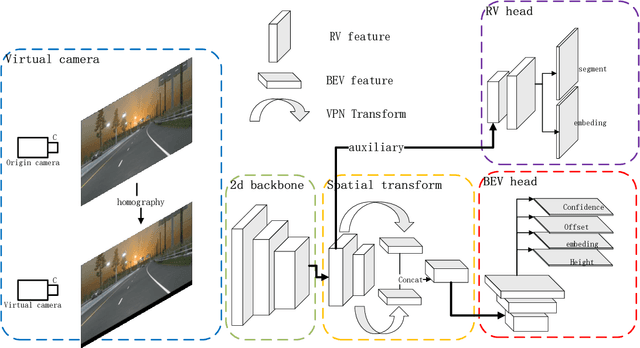
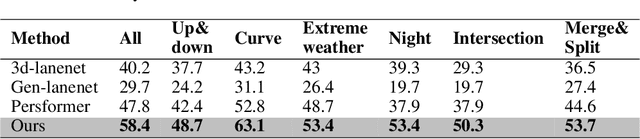
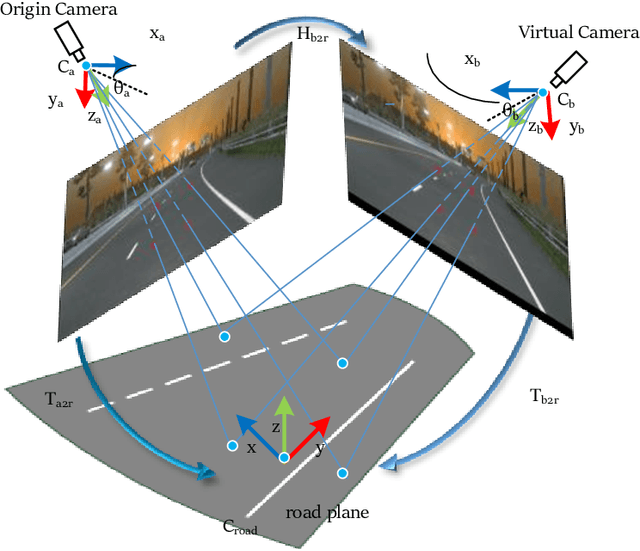

Recently, 3D lane detection has been an actively developing area in autonomous driving which is the key to routing the vehicle. This work proposes a deployment-oriented monocular 3D lane detector with only naive CNN and FC layers. This detector achieved state-of-the-art results on the Apollo 3D Lane Synthetic dataset and OpenLane real-world dataset with 96 FPS runtime speed. We conduct three techniques in our detector: (1) Virtual Camera eliminates the difference in poses of cameras mounted on different vehicles. (2) Spatial Feature Pyramid Transform as a light-weighed image-view to bird-eye view transformer can utilize scales of image-view featmaps. (3) Yolo Style Lane Representation makes a good balance between bird-eye view resolution and runtime speed. Meanwhile, it can reduce the inefficiency caused by the class imbalance due to the sparsity of the lane detection task during training. Combining these three techniques, we obtained a 58.4% F1-score on the OpenLane dataset, which is a 10.6% improvement over the baseline. On the Apollo dataset, we achieved an F1-score of 96.9%, which is 4% points of supremacy over the best on the leaderboard. The source code will release soon.