 Add to Chrome
 Add to Firefox
 Add to Edge
Breaking the Quality--Intelligibility Trade-off in Streaming Target Speaker Extraction via Deep-Feature-Anchored Preference Optimization
Jul 11, 2026
Generative streaming models for Target Speaker Extraction (TSE) commonly exhibit a quality--intelligibility trade-off, wherein naive optimization for perceptual audio quality tends to degrade speech intelligibility, and conversely. We reveal that this trade-off arises not from the constraints of streaming architectures, but from an inappropriate choice of optimization anchor. Directly optimizing against audio quality metrics induces catastrophic reward hacking, where content critical to pronunciation and intelligibility is systematically erased to maximize a proxy score. To break this bottleneck, we propose two complementary improvements: an enlarged Conformer convolution kernel for richer local spectro-temporal modeling, and WavLM-anchored Direct Preference Optimization (DPO) fine-tuning strategy. DPO preference pairs are ranked by WavLM cosine similarity, a deep acoustic feature encoding both phonetic structure and speaker identity, providing an optimization anchor that resists hacking. Under a 560 ms streaming chunk size, the proposed method achieves a 10.9% relative intelligibility improvement (word error rate: 0.138 to 0.123), with marginal simultaneous gains in audio quality and speaker similarity.

Towards Streaming Target Speaker Extraction via Chunk-wise Interleaved Splicing of Autoregressive Language Model
Apr 21, 2026While generative models have set new benchmarks for Target Speaker Extraction (TSE), their inherent reliance on global context precludes deployment in real-time applications. Direct adaptation to streaming scenarios often leads to catastrophic inference performance degradation due to the severe mismatch between training and streaming inference. To bridge this gap, we present the first autoregressive (AR) models tailored for streaming TSE. Our approach introduces a Chunk-wise Interleaved Splicing Paradigm that ensures highly efficient and stable streaming inference. To ensure the coherence between the extracted speech segments, we design a historical context refinement mechanism that mitigates boundary discontinuities by leveraging historical information. Experiments on Libri2Mix show that while AR generative baseline exhibits performance degradation at low latencies, our approach maintains 100% stability and superior intelligibility. Furthermore, our streaming results are comparable to or even surpass offline baselines. Additionally, our model achieves a Real-Time-Factor (RTF) of 0.248 on consumer-level GPUs. This work provides empirical evidence that AR generative backbones are viable for latency-sensitive applications through the Chunk-wise Interleaved Splicing Paradigm.
CheapNET: Improving Light-weight speech enhancement network by projected loss function
Nov 27, 2023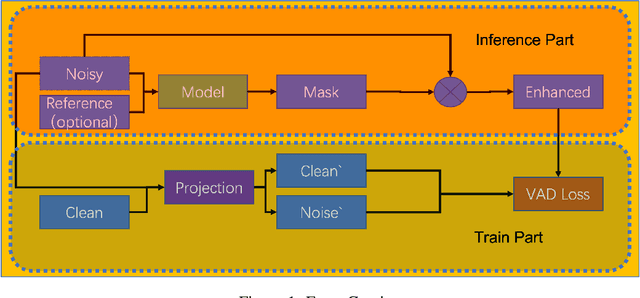
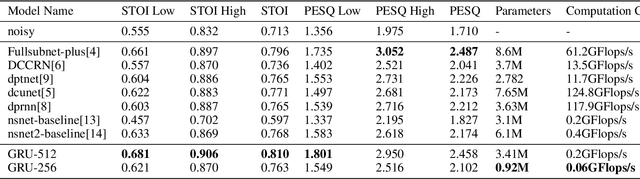
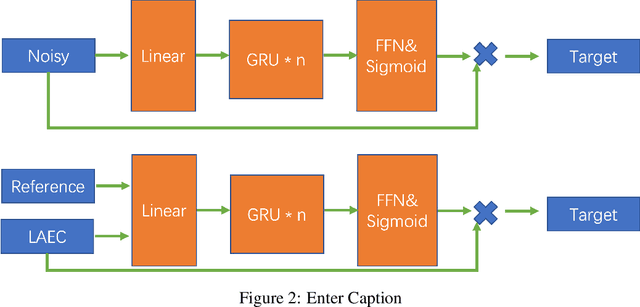
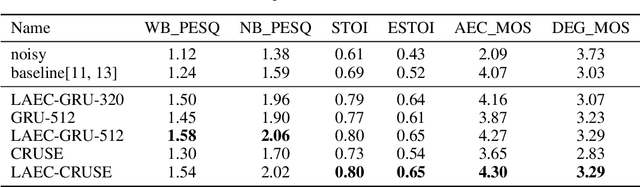
Noise suppression and echo cancellation are critical in speech enhancement and essential for smart devices and real-time communication. Deployed in voice processing front-ends and edge devices, these algorithms must ensure efficient real-time inference with low computational demands. Traditional edge-based noise suppression often uses MSE-based amplitude spectrum mask training, but this approach has limitations. We introduce a novel projection loss function, diverging from MSE, to enhance noise suppression. This method uses projection techniques to isolate key audio components from noise, significantly improving model performance. For echo cancellation, the function enables direct predictions on LAEC pre-processed outputs, substantially enhancing performance. Our noise suppression model achieves near state-of-the-art results with only 3.1M parameters and 0.4GFlops/s computational load. Moreover, our echo cancellation model outperforms replicated industry-leading models, introducing a new perspective in speech enhancement.