 Add to Chrome
 Add to Firefox
 Add to Edge
RoboHitch: Learning Visual Affordance from Disordered Keypoints for Hitch Knots Tying
May 23, 2026
Robotic manipulation of deformable linear objects (DLOs) presents significant challenges due to complex dynamics and frequent self-occlusions. Existing robotic knot tying methods typically rely on precise topological state tracking with ordered keypoints and explicit edge connectivity. This reliance makes them prone to failures due to tracking drift and topology mismatch caused by repeated bending and crossings during knot formation.To address these limitations, we introduce RoboHitch, a novel framework that learns to perform hitch knot tying from human demonstrations using only disordered 3D keypoints and RGB images. This eliminates the need for explicit topological order, allowing for more flexible manipulation. Our method employs a dynamic Graph Autoencoder to extract geometric features from untracked keypoints, complemented by a Convolutional Autoencoder that captures essential visual context. A bidirectional cross-attention mechanism then fuses these modalities to jointly predict pick and place affordances, facilitating implicit reasoning about the rope's state and enabling knot tying under occlusion.Real-world experiments demonstrate the effectiveness and generalizability of our approach, successfully completing hitch knots in scenarios with self-occlusions.

A Vision-Based Collision Sensing Method for Stable Circular Object Grasping with A Soft Gripper System
Aug 07, 2025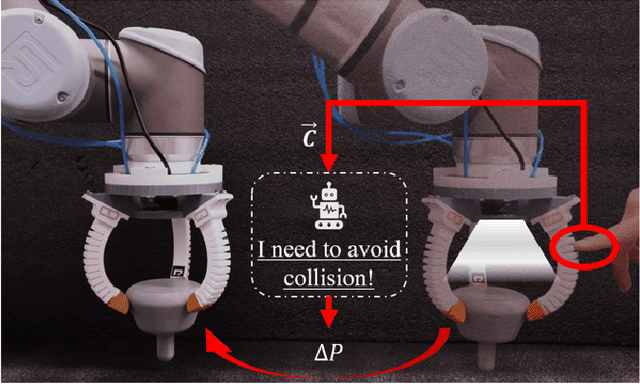
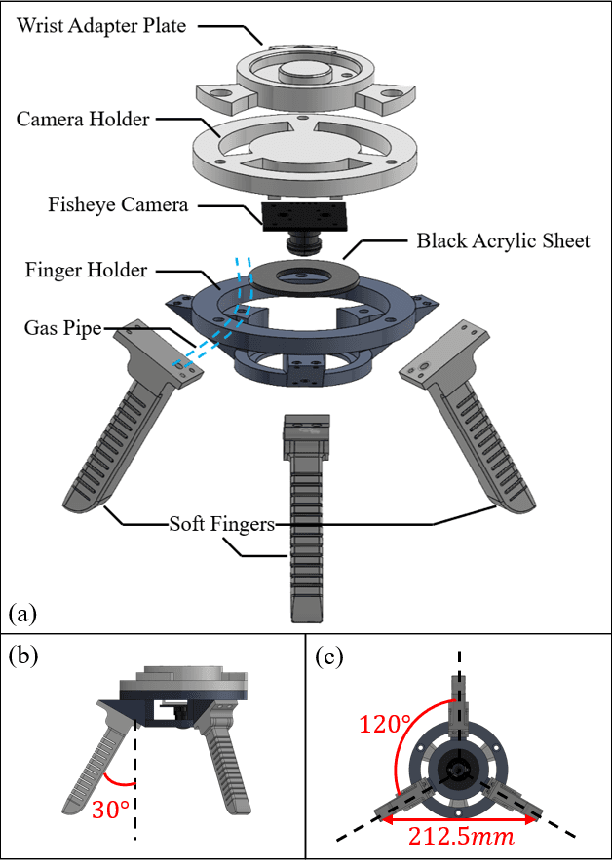
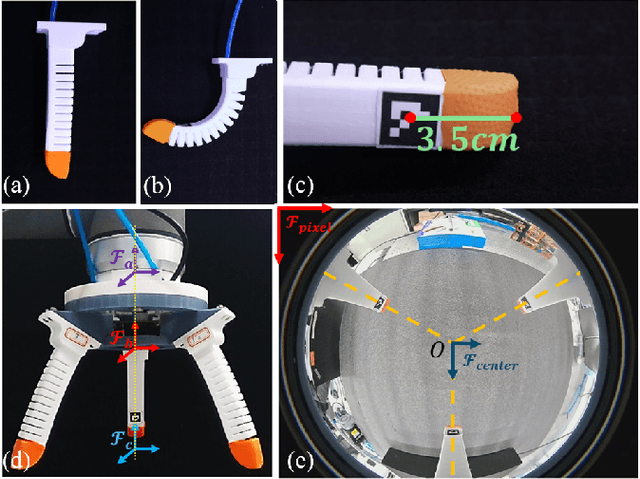
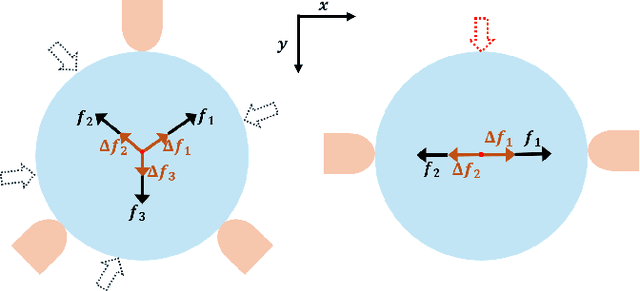
External collisions to robot actuators typically pose risks to grasping circular objects. This work presents a vision-based sensing module capable of detecting collisions to maintain stable grasping with a soft gripper system. The system employs an eye-in-palm camera with a broad field of view to simultaneously monitor the motion of fingers and the grasped object. Furthermore, we have developed a collision-rich grasping strategy to ensure the stability and security of the entire dynamic grasping process. A physical soft gripper was manufactured and affixed to a collaborative robotic arm to evaluate the performance of the collision detection mechanism. An experiment regarding testing the response time of the mechanism confirmed the system has the capability to react to the collision instantaneously. A dodging test was conducted to demonstrate the gripper can detect the direction and scale of external collisions precisely.