 Add to Chrome
 Add to Firefox
 Add to Edge
Interpretable Convolutional Neural Networks for Subject-Independent Motor Imagery Classification
Dec 14, 2021
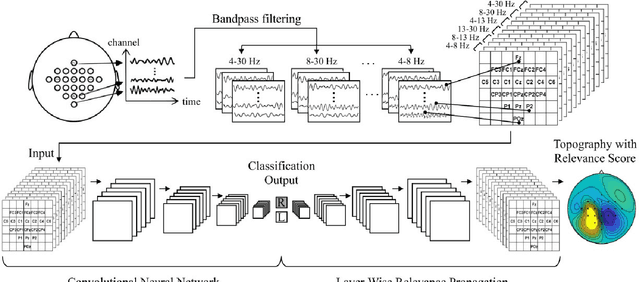


Deep learning frameworks have become increasingly popular in brain computer interface (BCI) study thanks to their outstanding performance. However, in terms of the classification model alone, they are treated as black box as they do not provide any information on what led them to reach a particular decision. In other words, we cannot convince whether the high performance was aroused by the neuro-physiological factors or simply noise. Because of this disadvantage, it is difficult to ensure adequate reliability compared to their high performance. In this study, we propose an explainable deep learning model for BCI. Specifically, we aim to classify EEG signal which is obtained from the motor-imagery (MI) task. In addition, we adopted layer-wise relevance propagation (LRP) to the model to interpret the reason that the model derived certain classification output. We visualized the heatmap which indicates the output of the LRP in form of topography to certify neuro-physiological factors. Furthermore, we classified EEG with the subject-independent manner to learn robust and generalized EEG features by avoiding subject dependency. The methodology also provides the advantage of avoiding the expense of building training data for each subject. With our proposed model, we obtained generalized heatmap patterns for all subjects. As a result, we can conclude that our proposed model provides neuro-physiologically reliable interpretation.

Motor Imagery Classification based on CNN-GRU Network with Spatio-Temporal Feature Representation
Jul 15, 2021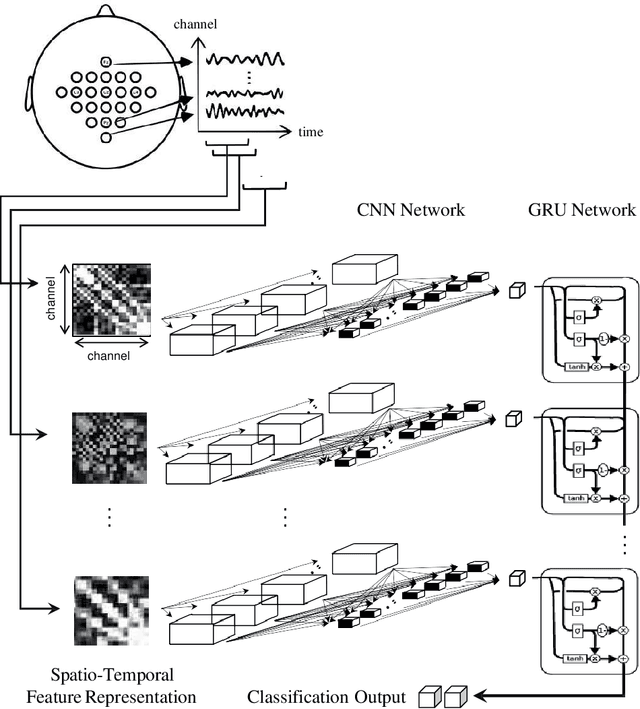

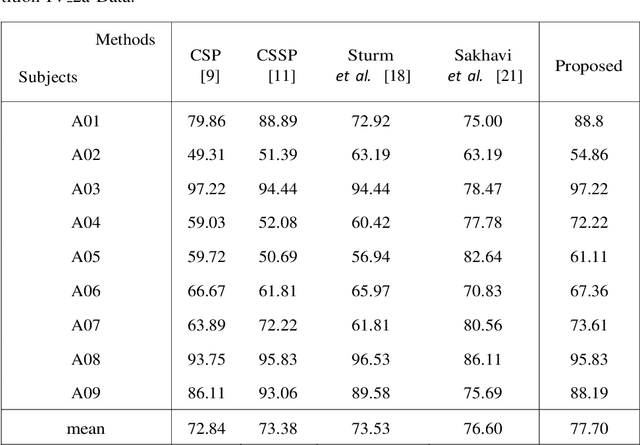

Recently, various deep neural networks have been applied to classify electroencephalogram (EEG) signal. EEG is a brain signal that can be acquired in a non-invasive way and has a high temporal resolution. It can be used to decode the intention of users. As the EEG signal has a high dimension of feature space, appropriate feature extraction methods are needed to improve classification performance. In this study, we obtained spatio-temporal feature representation and classified them with the combined convolutional neural networks (CNN)-gated recurrent unit (GRU) model. To this end, we obtained covariance matrices in each different temporal band and then concatenated them on the temporal axis to obtain a final spatio-temporal feature representation. In the classification model, CNN is responsible for spatial feature extraction and GRU is responsible for temporal feature extraction. Classification performance was improved by distinguishing spatial data processing and temporal data processing. The average accuracy of the proposed model was 77.70% for the BCI competition IV_2a data set. The proposed method outperformed all other methods compared as a baseline method.