 Add to Chrome
 Add to Firefox
 Add to Edge
BrainFIBRE: A Foundation Model via Information Decomposition for Brain Microstructure
Jul 01, 2026
Diffusion MRI probes brain microstructure with particular sensitivity to early cerebrovascular and neurodegenerative changes. Neurite Orientation Dispersion and Density Imaging (NODDI) decomposes the diffusion signal into three biophysically interpretable maps: neurite density index (NDI), orientation dispersion index (ODI), and free water fraction (FWF), capturing neurite packing, fiber coherence, and extracellular fluid. These 3D maps offer a rich substrate for transferable microstructural representations, yet integrating them is challenging: standard representation learning struggles to disentangle the unique information in each map from their shared and synergistic interactions. We present BrainFIBRE, the first foundation model for brain microstructure, pretrained on NODDI-derived maps from 55,592 UK Biobank participants. We propose Self-supervised Partial Information Decomposition (SPID), which extends PID-guided multimodal learning to the self-supervised regime for the first time. A novel Counterfactual Candidate Construction (CCC) paradigm perturbs inter-modality alignment through modality dropping and swapping, providing the contrastive signal for a Mixture-of-Experts architecture to disentangle unique, synergistic, and redundant information without any downstream label. On both Caucasian and Asian cohorts, BrainFIBRE achieves state-of-the-art performance across diverse tasks predicting age, sex, cerebrovascular and neurodegenerative markers, and cognition, while yielding neurobiologically interpretable representations that reveal task- and cohort-specific interaction patterns. BrainFIBRE establishes a versatile foundation for neuroimaging analysis at the microstructural level.

Service resource allocation problem in the IoT driven personalized healthcare information platform
Apr 05, 2022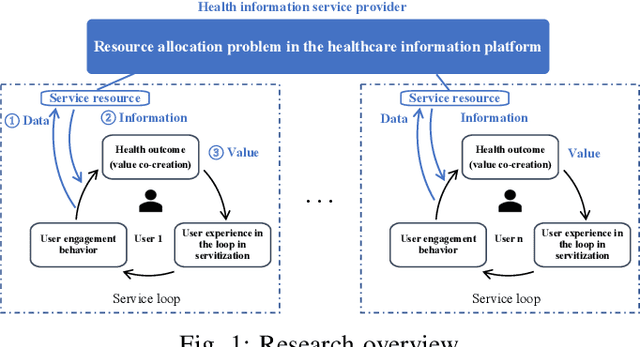
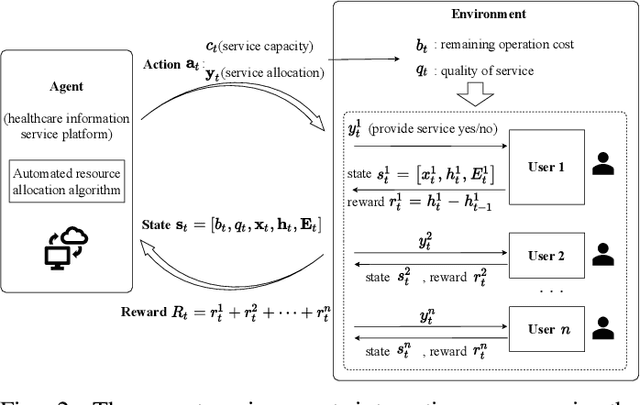
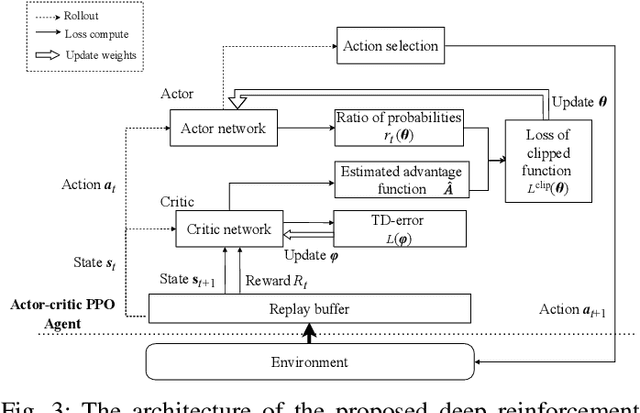
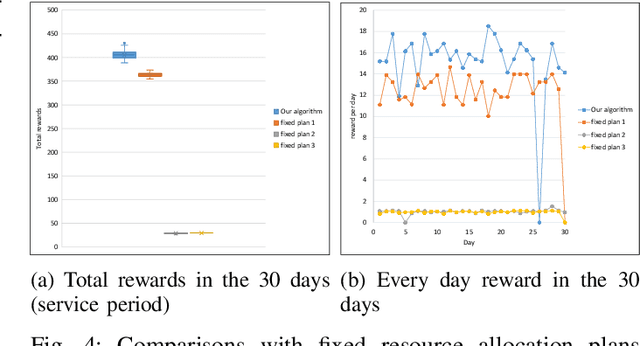
With real-time monitoring of the personalized healthcare condition, the IoT wearables collect the health data and transfer it to the healthcare information platform. The platform processes the data into healthcare recommendations and then delivers them to the users. The IoT structures in the personalized healthcare information service allows the users to engage in the loop in servitization more convenient in the COVID-19 pandemic. However, the uncertainty of the engagement behavior among the individual may result in inefficient of the service resource allocation. This paper seeks an efficient way to allocate the service resource by controlling the service capacity and pushing the service to the active users automatically. In this study, we propose a deep reinforcement learning method to solve the service resource allocation problem based on the proximal policy optimization (PPO) algorithm. Experimental results using the real world (open source) sport dataset reveal that our proposed proximal policy optimization adapts well to the users' changing behavior and with improved performance over fixed service resource policies.
Dynamic physical activity recommendation on personalised mobile health information service: A deep reinforcement learning approach
Apr 03, 2022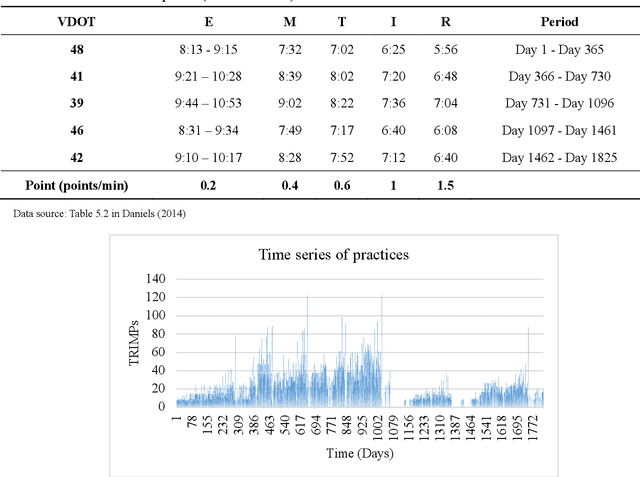
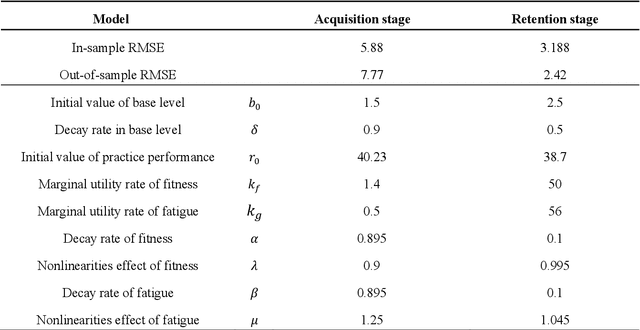
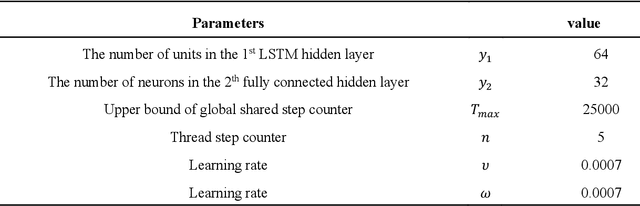
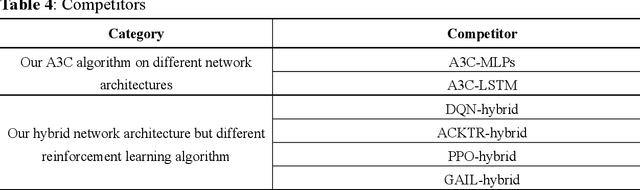
Mobile health (mHealth) information service makes healthcare management easier for users, who want to increase physical activity and improve health. However, the differences in activity preference among the individual, adherence problems, and uncertainty of future health outcomes may reduce the effect of the mHealth information service. The current health service system usually provides recommendations based on fixed exercise plans that do not satisfy the user specific needs. This paper seeks an efficient way to make physical activity recommendation decisions on physical activity promotion in personalised mHealth information service by establishing data-driven model. In this study, we propose a real-time interaction model to select the optimal exercise plan for the individual considering the time-varying characteristics in maximising the long-term health utility of the user. We construct a framework for mHealth information service system comprising a personalised AI module, which is based on the scientific knowledge about physical activity to evaluate the individual exercise performance, which may increase the awareness of the mHealth artificial intelligence system. The proposed deep reinforcement learning (DRL) methodology combining two classes of approaches to improve the learning capability for the mHealth information service system. A deep learning method is introduced to construct the hybrid neural network combing long-short term memory (LSTM) network and deep neural network (DNN) techniques to infer the individual exercise behavior from the time series data. A reinforcement learning method is applied based on the asynchronous advantage actor-critic algorithm to find the optimal policy through exploration and exploitation.