 Add to Chrome
 Add to Firefox
 Add to Edge
Leaderless Collective Motion in Affine Formation Control over the Complex Plane
Apr 07, 2026
We propose a method for the collective maneuvering of affine formations in the plane by modifying the original weights of the Laplacian matrix used to achieve static formations of robot swarms. Specifically, the resulting collective motion is characterized as a time-varying affine transformation of a reference configuration, or shape. Unlike the traditional leader-follower strategy, our leaderless scheme allows agents to maintain distinct and possibly time-varying velocities, enabling a broader range of collective motions, including all the linear combinations of translations, rotations, scaling and shearing of a reference shape. Our analysis provides the analytic solution governing the resulting collective motion, explicitly designing the eigenvectors and eigenvalues that define this motion as a function of the modified weights in the new Laplacian matrix. To facilitate a more tractable analysis and design of affine formations in 2D, we propose the use of complex numbers to represent all relevant information. Simulations with up to 20 agents validate the theoretical results.

SO(3) attitude controllers and the alignment of robots with non-constant 3D vector fields
Jun 21, 2024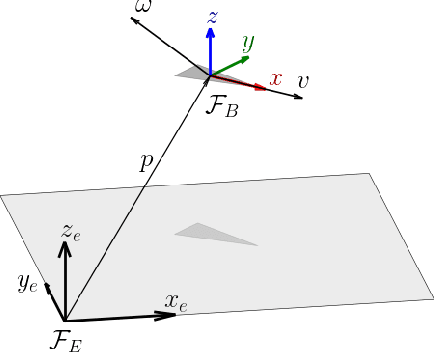
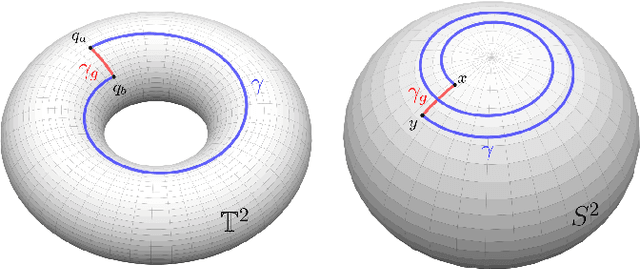
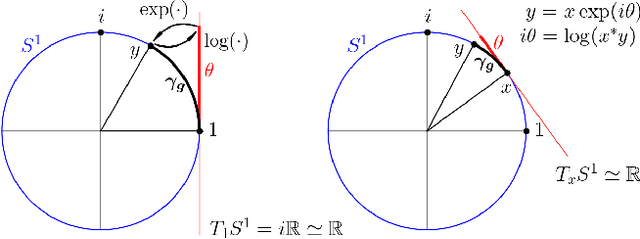

This technical note aims to introduce geometric controllers to roboticists for aligning \emph{3D robots} with non-constant 3D vector fields. This alignment entails the control of the robot's 3D attitude. We derive with excessive detail all the calculations needed for the analysis and implementation of the controllers.
Resilient source seeking with robot swarms
Sep 06, 2023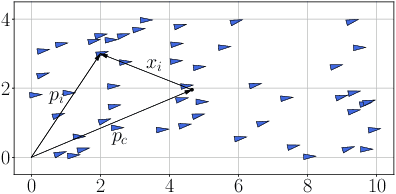

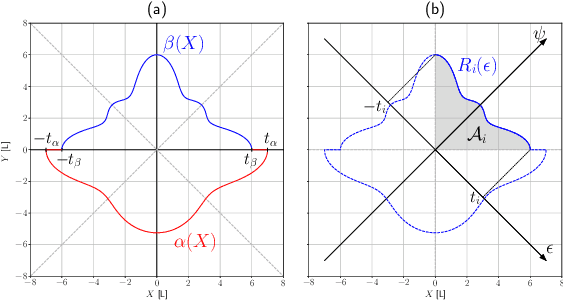

We present a solution for locating the source, or maximum, of an unknown scalar field using a swarm of mobile robots. Unlike relying on the traditional gradient information, the swarm determines an ascending direction to approach the source with arbitrary precision. The ascending direction is calculated from measurements of the field strength at the robot locations and their relative positions concerning the centroid. Rather than focusing on individual robots, we focus the analysis on the density of robots per unit area to guarantee a more resilient swarm, i.e., the functionality remains even if individuals go missing or are misplaced during the mission. We reinforce the robustness of the algorithm by providing sufficient conditions for the swarm shape so that the ascending direction is almost parallel to the gradient. The swarm can respond to an unexpected environment by morphing its shape and exploiting the existence of multiple ascending directions. Finally, we validate our approach numerically with hundreds of robots. The fact that a large number of robots always calculate an ascending direction compensates for the loss of individuals and mitigates issues arising from the actuator and sensor noises.