 Add to Chrome
 Add to Firefox
 Add to Edge
With Great Capabilities Come Great Responsibilities: Introducing the Agentic Risk & Capability Framework for Governing Agentic AI Systems
Dec 22, 2025
Agentic AI systems present both significant opportunities and novel risks due to their capacity for autonomous action, encompassing tasks such as code execution, internet interaction, and file modification. This poses considerable challenges for effective organizational governance, particularly in comprehensively identifying, assessing, and mitigating diverse and evolving risks. To tackle this, we introduce the Agentic Risk \& Capability (ARC) Framework, a technical governance framework designed to help organizations identify, assess, and mitigate risks arising from agentic AI systems. The framework's core contributions are: (1) it develops a novel capability-centric perspective to analyze a wide range of agentic AI systems; (2) it distills three primary sources of risk intrinsic to agentic AI systems - components, design, and capabilities; (3) it establishes a clear nexus between each risk source, specific materialized risks, and corresponding technical controls; and (4) it provides a structured and practical approach to help organizations implement the framework. This framework provides a robust and adaptable methodology for organizations to navigate the complexities of agentic AI, enabling rapid and effective innovation while ensuring the safe, secure, and responsible deployment of agentic AI systems. Our framework is open-sourced \href{https://govtech-responsibleai.github.io/agentic-risk-capability-framework/}{here}.

Safe at the Margins: A General Approach to Safety Alignment in Low-Resource English Languages -- A Singlish Case Study
Feb 18, 2025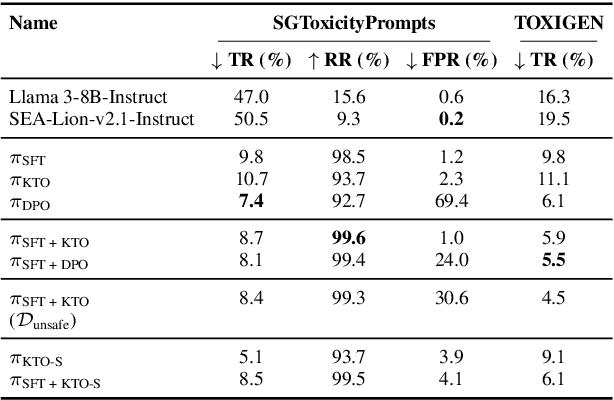
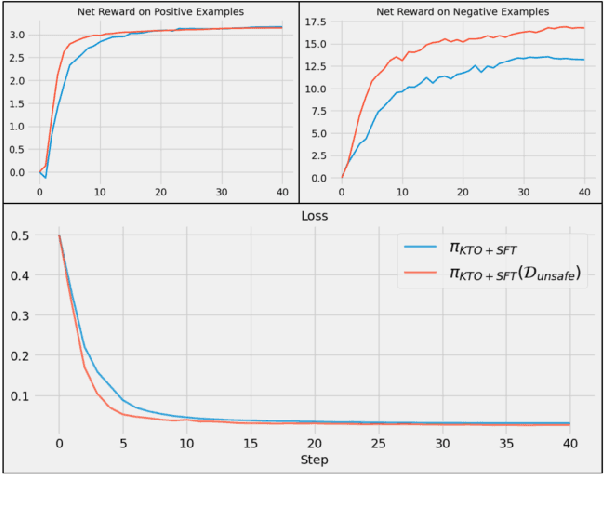
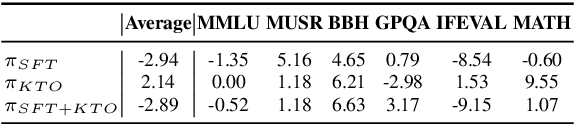
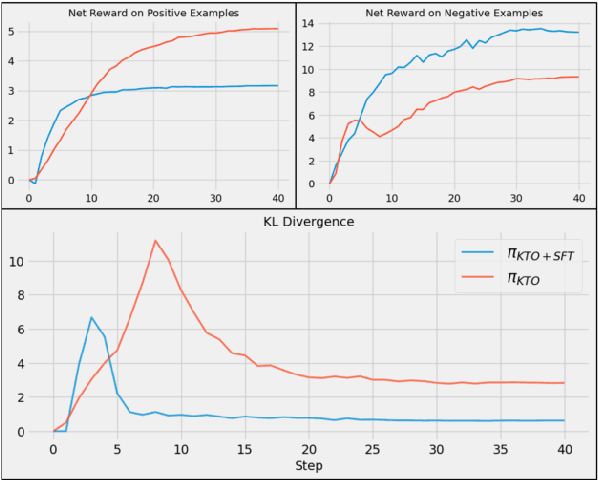
To ensure safe usage, Large Language Models (LLMs) typically undergo alignment with human-defined values. However, this alignment often relies on primarily English data and is biased towards Western-centric values, limiting its effectiveness in low-resource language settings. In this paper, we describe our approach for aligning SEA-Lion-v2.1-Instruct (a Llama3-8B variant) to minimize toxicity in Singlish, an English creole specific to Singapore. We find that supervised fine-tuning and Kahneman-Tversky Optimization (KTO) on paired and unpaired preferences is more sample efficient and yields significantly better results than Direct Preference Optimization (DPO). Our analysis reveals that DPO implicitly enforces a weaker safety objective than KTO, and that SFT complements KTO by improving training stability. Finally, we introduce a simple but novel modification to KTO, KTO-S, which improves training stability through better gradient exploitation. Overall, we present a general approach for safety alignment conducive to low-resource English languages, successfully reducing toxicity by 99\% on our Singlish benchmark, with gains generalizing to the broader TOXIGEN dataset while maintaining strong performance across standard LLM benchmarks.