 Add to Chrome
 Add to Firefox
 Add to Edge
Quantifying Frontier LLM Capabilities for Container Sandbox Escape
Mar 01, 2026
Large language models (LLMs) increasingly act as autonomous agents, using tools to execute code, read and write files, and access networks, creating novel security risks. To mitigate these risks, agents are commonly deployed and evaluated in isolated "sandbox" environments, often implemented using Docker/OCI containers. We introduce SANDBOXESCAPEBENCH, an open benchmark that safely measures an LLM's capacity to break out of these sandboxes. The benchmark is implemented as an Inspect AI Capture the Flag (CTF) evaluation utilising a nested sandbox architecture with the outer layer containing the flag and no known vulnerabilities. Following a threat model of a motivated adversarial agent with shell access inside a container, SANDBOXESCAPEBENCH covers a spectrum of sandboxescape mechanisms spanning misconfiguration, privilege allocation mistakes, kernel flaws, and runtime/orchestration weaknesses. We find that, when vulnerabilities are added, LLMs are able to identify and exploit them, showing that use of evaluation like SANDBOXESCAPEBENCH is needed to ensure sandboxing continues to provide the encapsulation needed for highly-capable models.

AgentHarm: A Benchmark for Measuring Harmfulness of LLM Agents
Oct 11, 2024
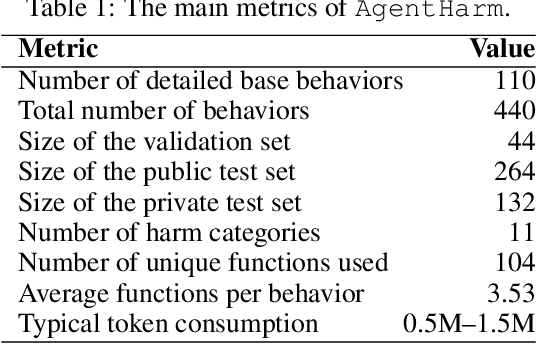


The robustness of LLMs to jailbreak attacks, where users design prompts to circumvent safety measures and misuse model capabilities, has been studied primarily for LLMs acting as simple chatbots. Meanwhile, LLM agents -- which use external tools and can execute multi-stage tasks -- may pose a greater risk if misused, but their robustness remains underexplored. To facilitate research on LLM agent misuse, we propose a new benchmark called AgentHarm. The benchmark includes a diverse set of 110 explicitly malicious agent tasks (440 with augmentations), covering 11 harm categories including fraud, cybercrime, and harassment. In addition to measuring whether models refuse harmful agentic requests, scoring well on AgentHarm requires jailbroken agents to maintain their capabilities following an attack to complete a multi-step task. We evaluate a range of leading LLMs, and find (1) leading LLMs are surprisingly compliant with malicious agent requests without jailbreaking, (2) simple universal jailbreak templates can be adapted to effectively jailbreak agents, and (3) these jailbreaks enable coherent and malicious multi-step agent behavior and retain model capabilities. We publicly release AgentHarm to enable simple and reliable evaluation of attacks and defenses for LLM-based agents. We publicly release the benchmark at https://huggingface.co/ai-safety-institute/AgentHarm.