 Add to Chrome
 Add to Firefox
 Add to Edge
On Halting vs Converging in Recurrent Graph Neural Networks
Apr 28, 2026
Recurrent Graph Neural Networks (RGNNs) extend standard GNNs by iterating message-passing until some stopping condition is met. Various RGNN models have been proposed in the literature. In this paper, we study three such models: converging RGNNs, where all vertex representations must stabilise; output-converging RGNNs, where only the output classifications must stabilise; and halting RGNNs, where a per-vertex halting classifier determines when to stop. We establish expressiveness relationships between these models: over undirected graphs, converging RGNNs are equally expressive as graded-bisimulation-invariant halting RGNNs, while output-converging RGNNs are at least as expressive. Combined with prior results on halting RGNNs, this shows that, relative to the classifiers expressible in monadic second-order logic (MSO), converging RGNNs express exactly the graded modal $μ$-calculus ($μ$GML), and output-converging RGNNs express at least $μ$GML. These results hold even when restricting to ReLU networks with sum aggregation. The main technical challenge is simulating halting RGNNs by converging ones: without a global halting classifier, vertices may locally decide to halt at different times, causing desynchronisation. We develop a "traffic-light" protocol that enables vertices to coordinate despite this asynchrony. Our results answer an open question from Bollen et al. (2025) and show that the RGNN model of Pflueger et al. (2024) retains full $μ$GML expressiveness even when convergence is guaranteed.

Halting Recurrent GNNs and the Graded $μ$-Calculus
May 16, 2025Graph Neural Networks (GNNs) are a class of machine-learning models that operate on graph-structured data. Their expressive power is intimately related to logics that are invariant under graded bisimilarity. Current proposals for recurrent GNNs either assume that the graph size is given to the model, or suffer from a lack of termination guarantees. In this paper, we propose a halting mechanism for recurrent GNNs. We prove that our halting model can express all node classifiers definable in graded modal mu-calculus, even for the standard GNN variant that is oblivious to the graph size. A recent breakthrough in the study of the expressivity of graded modal mu-calculus in the finite suggests that conversely, restricted to node classifiers definable in monadic second-order logic, recurrent GNNs can express only node classifiers definable in graded modal mu-calculus. To prove our main result, we develop a new approximate semantics for graded mu-calculus, which we believe to be of independent interest. We leverage this new semantics into a new model-checking algorithm, called the counting algorithm, which is oblivious to the graph size. In a final step we show that the counting algorithm can be implemented on a halting recurrent GNN.
Learning Graph Neural Networks using Exact Compression
Apr 28, 2023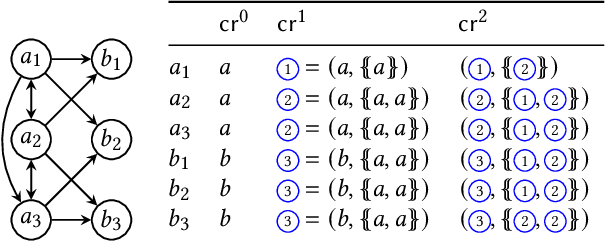
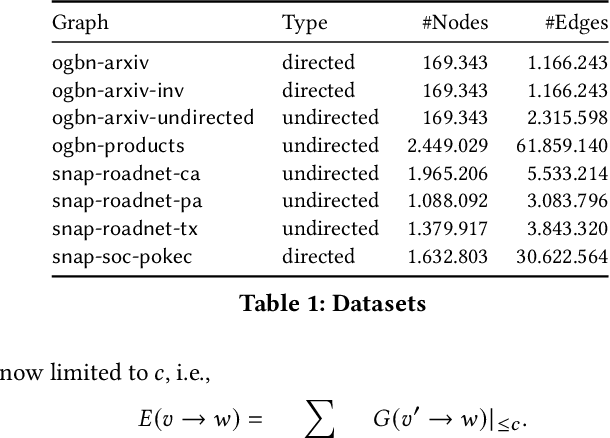
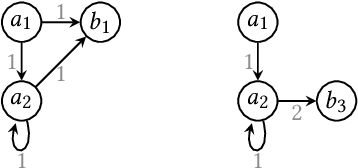
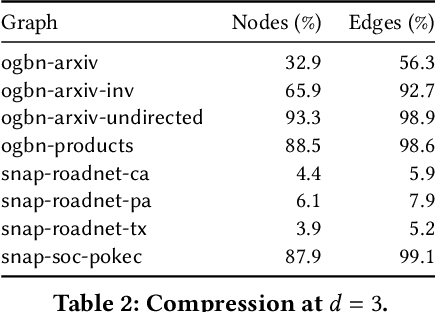
Graph Neural Networks (GNNs) are a form of deep learning that enable a wide range of machine learning applications on graph-structured data. The learning of GNNs, however, is known to pose challenges for memory-constrained devices such as GPUs. In this paper, we study exact compression as a way to reduce the memory requirements of learning GNNs on large graphs. In particular, we adopt a formal approach to compression and propose a methodology that transforms GNN learning problems into provably equivalent compressed GNN learning problems. In a preliminary experimental evaluation, we give insights into the compression ratios that can be obtained on real-world graphs and apply our methodology to an existing GNN benchmark.