 Add to Chrome
 Add to Firefox
 Add to Edge
Machine Learning Approaches to Decoding Topological Quantum Codes
Aug 16, 2026
Decoding is an essential component of quantum error correction (QEC), translating stabilizer measurement outcomes into corrective actions that suppress logical errors and preserve logical quantum information. Building fault-tolerant architectures requires increasing the code distance, which in turn places growing demands on decoding accuracy, scalability, and practical deployability. While a wide range of decoding algorithms have been proposed and demonstrated, achieving reliable, scalable, and real-time decoding remains a significant challenge. Machine-learning (ML) approaches are particularly well suited to this setting, as quantum error decoding is fundamentally a problem of processing large volumes of classical data with complex spatiotemporal correlations. This chapter surveys ML-based methods for quantum error decoding, with a focus on topological codes and an emphasis on architectural principles, practical performance, and real-time considerations. We first frame decoding as a learning problem and outline key paradigms, including discriminative, generative, and reinforcement-learning formulations. We then introduce the neural network building blocks that underpin most contemporary neural decoders and discuss how these components can be integrated to balance expressivity, scalability, and latency. Building on this architectural perspective, we review recent progress and benchmarks in neural decoding for memory experiments, and discuss real-time decoding, open challenges, and future directions toward scalable fault-tolerant quantum computing.

Quantum Occam Learning: Sample-Supported Expressibility for Circuit-Based Quantum Learning
Jun 10, 2026A central principle in quantum machine learning is that an ansatz should be expressive enough to represent the quantum data of interest. Yet, the expressibility is statistically meaningful only insofar as it can be learned from finitely many copies of an unknown quantum state. In this work, we develop an information-theoretic Occam theory for quantum data generated by finite-size quantum circuits. For the class $S_{n,G}$ of $n$-qubit pure states preparable with at most $G$ two-qubit gates, a metric-entropy argument gives the realizable sample law $\widetildeΘ(G/ε^2)$ in the circuit-limited regime. For an arbitrary source $\hatρ$, we introduce the best $G$-gate approximation error $d_G(\hatρ)$ and the approximate circuit complexity $C_η(\hatρ)$. We prove an agnostic quantum Occam theorem: with $M$ copies, one can learn up to the best $G$-gate approximation error plus a statistical penalty $\widetilde{O}(\sqrt{G/M})$. We then remove the need to know $G$ in advance through an adaptive model-selection theorem whose oracle inequality selects the circuit complexity justified by the data. Matching lower bounds yield a sample-supported expressibility law: at trace-distance accuracy $ε$, $M$ samples can support only $G_{\rm supported} \simeq Mε^2$ gates, up to logarithmic factors and tomography saturation at $2^n$. Thus, the circuit complexity becomes an adaptive statistical resource rather than a static promise. Our framework turns bounded circuit complexity into a model-selection principle for quantum machine learning.
Reinforcement learning to learn quantum states for Heisenberg scaling accuracy
Dec 03, 2024Learning quantum states is a crucial task for realizing the potential of quantum information technology. Recently, neural approaches have emerged as promising methods for learning quantum states. We propose a meta-learning model that employs reinforcement learning (RL) to optimize the process of learning quantum states. For learning quantum states, our scheme trains a Hardware efficient ansatz with a blackbox optimization algorithm, called evolution strategy (ES). To enhance the efficiency of ES, a RL agent dynamically adjusts the hyperparameters of ES. To facilitate the RL training, we introduce an action repetition strategy inspired by curriculum learning. The RL agent significantly improves the sample efficiency of learning random quantum states, and achieves infidelity scaling close to the Heisenberg limit. We showcase that the RL agent trained using 3-qubit states can be generalized to learning up to 5-qubit states. These results highlight the utility of RL-driven meta-learning to enhance the efficiency and generalizability of learning quantum states. Our approach can be applicable to improve quantum control, quantum optimization, and quantum machine learning.
Simulation-guided Beam Search for Neural Combinatorial Optimization
Jul 13, 2022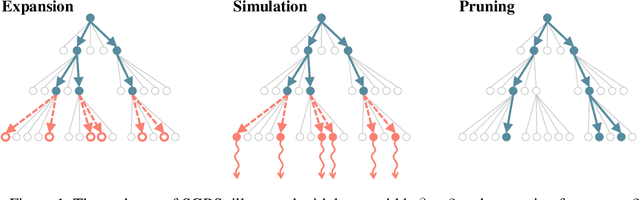
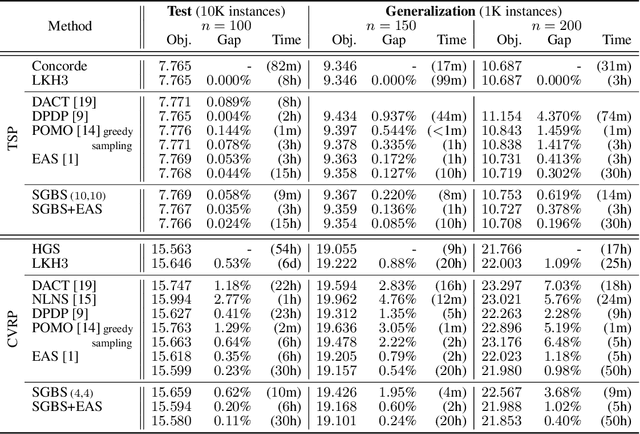
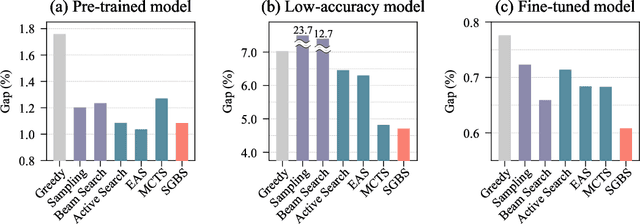
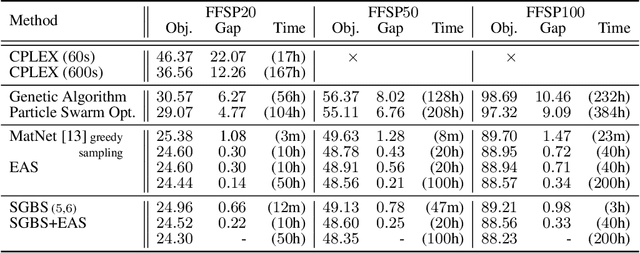
Neural approaches for combinatorial optimization (CO) equip a learning mechanism to discover powerful heuristics for solving complex real-world problems. While neural approaches capable of high-quality solutions in a single shot are emerging, state-of-the-art approaches are often unable to take full advantage of the solving time available to them. In contrast, hand-crafted heuristics perform highly effective search well and exploit the computation time given to them, but contain heuristics that are difficult to adapt to a dataset being solved. With the goal of providing a powerful search procedure to neural CO approaches, we propose simulation-guided beam search (SGBS), which examines candidate solutions within a fixed-width tree search that both a neural net-learned policy and a simulation (rollout) identify as promising. We further hybridize SGBS with efficient active search (EAS), where SGBS enhances the quality of solutions backpropagated in EAS, and EAS improves the quality of the policy used in SGBS. We evaluate our methods on well-known CO benchmarks and show that SGBS significantly improves the quality of the solutions found under reasonable runtime assumptions.