 Add to Chrome
 Add to Firefox
 Add to Edge
WebSpline: Structure-Informed Splines for Real-Time 3D Gaussians from Monocular Videos
Jun 01, 2026
Dynamic scene reconstruction from monocular videos remains highly challenging, as existing methods often struggle to balance global structural coherence and local fine-grained details under limited multi-view cues. To address this challenge, we propose WebSpline, a novel dynamic 3D Gaussian framework that enables structurally coherent and high-fidelity reconstruction from monocular videos with fast rendering. The core of WebSpline is the Structure-Informed Spline (SIS) representation, which models each dynamic Gaussian trajectory using a learnable cubic Hermite spline whose motion is structurally organized with an auxiliary Structural Proxy Graph (SPG). The proposed framework is optimized in two stages: (i) in the first stage, the SPG is initialized from 2D point tracks and refined with temporal rigidity regularization to establish structural coherence for moving objects across the sequence; and (ii) in the second stage, the SIS representation is initialized from the refined SPG and optimized under both spatial and structural neighborhood constraints. At inference, Gaussian motion is obtained solely by evaluating the learned SIS, enabling fast rendering. Extensive experiments on the challenging monocular dynamic scene benchmarks, iPhone and NVIDIA, demonstrate that our WebSpline achieves state-of-the-art rendering quality while rendering over 10 times faster than WorldTree, the second-best method on the iPhone dataset.

DAKD: Data Augmentation and Knowledge Distillation using Diffusion Models for SAR Oil Spill Segmentation
Dec 11, 2024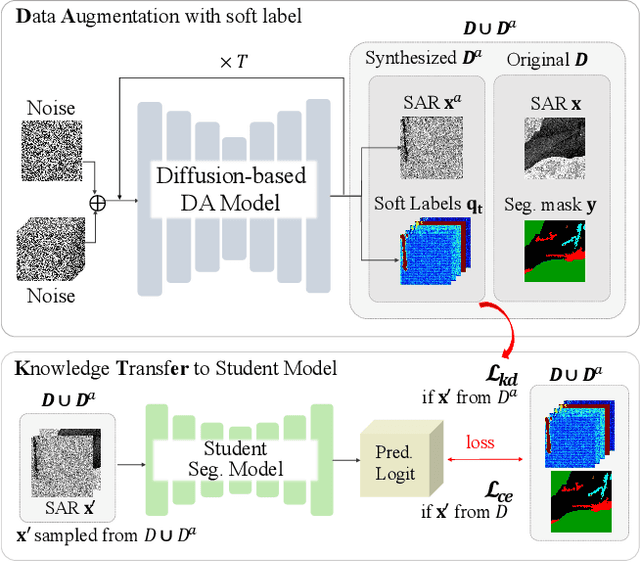
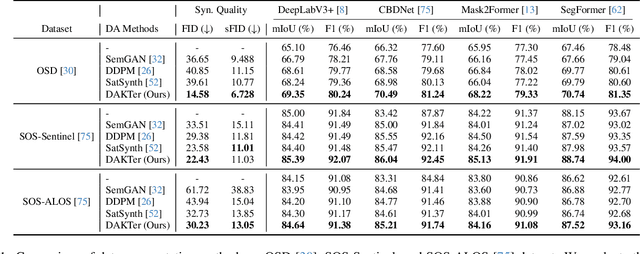
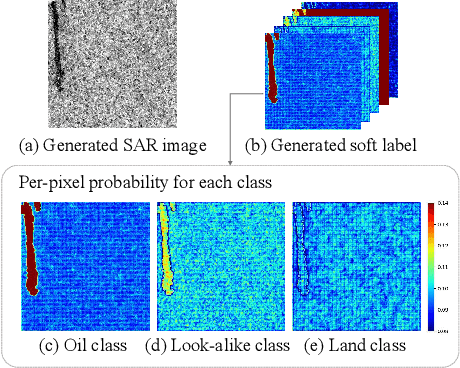
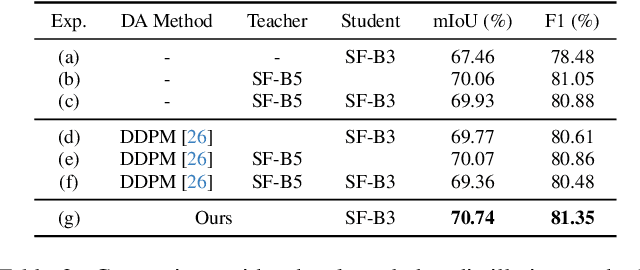
Oil spills in the ocean pose severe environmental risks, making early detection essential. Synthetic aperture radar (SAR) based oil spill segmentation offers robust monitoring under various conditions but faces challenges due to the limited labeled data and inherent speckle noise in SAR imagery. To address these issues, we propose (i) a diffusion-based Data Augmentation and Knowledge Distillation (DAKD) pipeline and (ii) a novel SAR oil spill segmentation network, called SAROSS-Net. In our DAKD pipeline, we present a diffusion-based SAR-JointNet that learns to generate realistic SAR images and their labels for segmentation, by effectively modeling joint distribution with balancing two modalities. The DAKD pipeline augments the training dataset and distills knowledge from SAR-JointNet by utilizing generated soft labels (pixel-wise probability maps) to supervise our SAROSS-Net. The SAROSS-Net is designed to selectively transfer high-frequency features from noisy SAR images, by employing novel Context-Aware Feature Transfer blocks along skip connections. We demonstrate our SAR-JointNet can generate realistic SAR images and well-aligned segmentation labels, providing the augmented data to train SAROSS-Net with enhanced generalizability. Our SAROSS-Net trained with the DAKD pipeline significantly outperforms existing SAR oil spill segmentation methods with large margins.