 Add to Chrome
 Add to Firefox
 Add to Edge
EM-Vid: Training-Free Entity-Centric Memory for Efficient and Consistent Multi-Shot Video Generation
May 22, 2026
Multi-shot video generation requires maintaining a consistent appearance of recurring entities across shots while remaining faithful to shot-specific text prompts. Recent autoregressive methods reuse previously generated frames as memory. However, full-frame storage entangles persistent entity information with transient scene context, leading to irrelevant information leakage and high computational cost. We propose an entity-centric memory in the form of an entity-indexed bank of latent patches. We introduce sparse token conditioning compatible with pretrained models, restricting self-attention to entity-relevant tokens and reducing computational cost. To support this, we introduce a structured multi-shot script format. We additionally propose a budgeted memory update strategy to maintain a compact, evolving memory. Finally, we equip the entity representation with a noise-injection mechanism that enables fine-grained appearance control, preventing leakage of irrelevant information. Our method improves prompt adherence and efficiency while preserving subject consistency.

Edge-preserving noise for diffusion models
Oct 02, 2024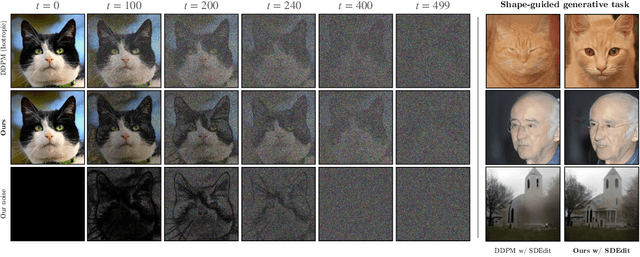
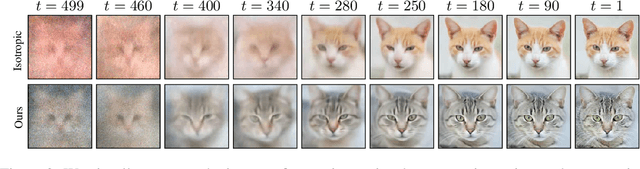
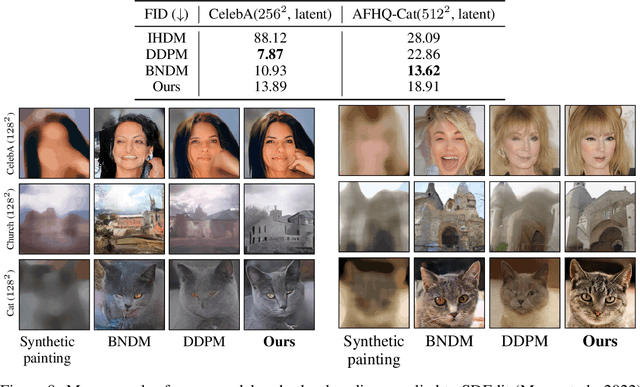
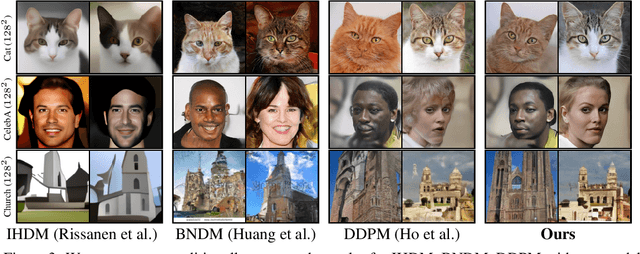
Classical generative diffusion models learn an isotropic Gaussian denoising process, treating all spatial regions uniformly, thus neglecting potentially valuable structural information in the data. Inspired by the long-established work on anisotropic diffusion in image processing, we present a novel edge-preserving diffusion model that is a generalization of denoising diffusion probablistic models (DDPM). In particular, we introduce an edge-aware noise scheduler that varies between edge-preserving and isotropic Gaussian noise. We show that our model's generative process converges faster to results that more closely match the target distribution. We demonstrate its capability to better learn the low-to-mid frequencies within the dataset, which plays a crucial role in representing shapes and structural information. Our edge-preserving diffusion process consistently outperforms state-of-the-art baselines in unconditional image generation. It is also more robust for generative tasks guided by a shape-based prior, such as stroke-to-image generation. We present qualitative and quantitative results showing consistent improvements (FID score) of up to 30% for both tasks.